Autonomous Agent Tool Selection at Runtime
Structuring tool selection around learned task patterns cuts costs and latency at runtime.
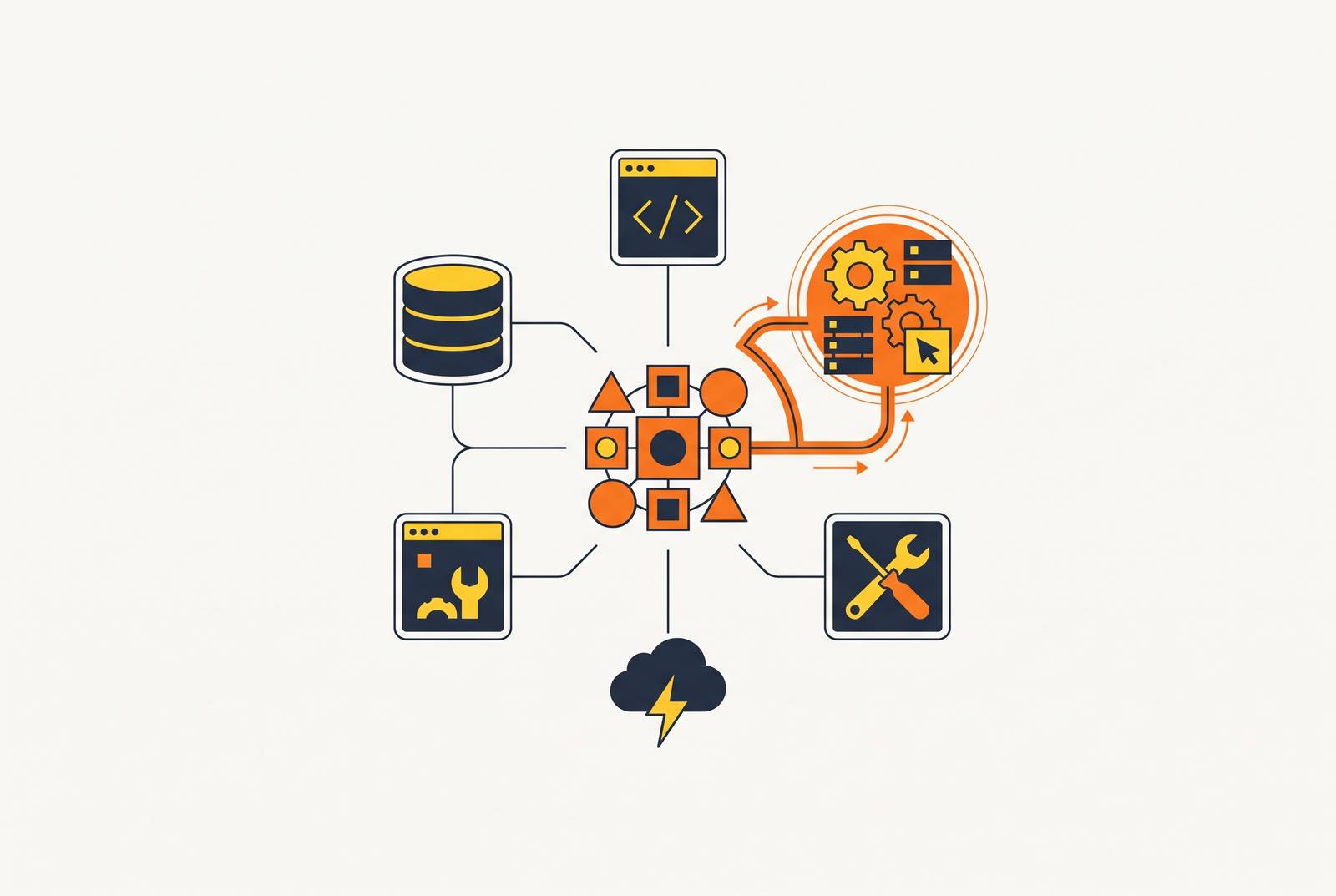
Most agent frameworks still hand the model a system prompt listing every tool it might need, then let inference-time reasoning pick from the pile. That works when the catalog holds a dozen entries. It stops working once a company wires up the sprawl of systems a real business actually runs on, and the average process touches something like 50 different software endpoints once you count the CRM, the shop backend, the helpdesk, the ERP, and the payment processor https://chatarmin.com/en/blog/best-ai-agent-tools. Three failure modes compound on top of each other as that number climbs. Token cost is the most obvious one: every tool description sits in context regardless of whether the current task needs it, so a large catalog burns budget before the model has done any reasoning at all. Attention degradation is subtler and arguably worse: as the tool list grows, the model's attention has to spread across more candidates, and selection accuracy suffers even when the correct tool is technically present in the prompt. Then there's the hard wall: context windows have limits, and past a certain catalog size, full injection simply isn't possible anymore, no matter how much budget a team is willing to spend.
None of this is abstract. Camunda's State of Agentic Orchestration Report found that only 11% of AI agent projects that get started actually reach production, despite 71% of companies already deploying agents in some form https://chatarmin.com/en/blog/best-ai-agent-tools. Roughly 80% of what gets marketed as an "AI agent" today behaves more like a chatbot with a few bolted-on functions than a system that plans and selects tools dynamically https://chatarmin.com/en/blog/best-ai-agent-tools. Static injection is often the reason why. One overlooked piece of this puzzle: tool descriptions themselves aren't boilerplate to write once and forget. They're the substrate that every downstream routing and discovery mechanism depends on, so a vague description doesn't just look sloppy, it actively breaks retrieval later in the pipeline. That point resurfaces in the next section, because how an agent actually calls tools in production turns out to follow patterns precise enough to build infrastructure around.
What tool usage patterns look like in production agent runs
If agents choose tools freely at each step, why would their behavior show any structure at all? The answer, empirically, is that it doesn't behave freely. The AutoTool paper set out to formalize something researchers had suspected anecdotally for a while, a phenomenon they termed "tool usage inertia," where tool invocations follow sequential patterns predictable enough to model. The evidence isn't a toy example. Researchers logged 322 full task trajectories and 6,014 individual tool invocations on the ScienceWorld benchmark, giving a large enough sample to make the finding credible rather than anecdotal https://zylos.ai/research/2026-06-01-adaptive-tool-composition-ai-agent-runtimes/.
The finding that matters for runtime design is that transition probabilities between one tool call and the next are far from uniform. Certain pairs, like calling SearchDatabase and then immediately calling ExtractField, showed up together more than 80% of the time, a pattern too strong to be a coincidence born of a narrow test set https://zylos.ai/research/2026-06-01-adaptive-tool-composition-ai-agent-runtimes/. That reflects something structural about how multi-step tasks actually unfold, not a coincidence born of a narrow test set: once an agent searches for a record, extracting a field from that record is very often the next logical move, and the model... It reflects something structural about how multi-step tasks actually unfold: once an agent searches for a record, extracting a field from that record is very often the next logical move, and the model's behavior mirrors that logic consistently enough to be measured.
What does this mean structurally? Tool call sequences aren't random walks through a catalog. They have learnable shape, the same way a person's clicks through a familiar app follow habitual paths rather than exploring every menu at random. And if the structure is learnable, it's exploitable: knowing the last tool called gives real predictive power over the next one. That's the empirical floor under everything the rest of this piece builds toward, because a runtime that can predict the next tool call with high confidence doesn't have to wait around for the model to ask for it.
Semantic routing: loading only the tools a task needs
The fix for a bloated catalog is to stop injecting all of it at once. It's to stop injecting all of it at once. Semantic routing works by embedding tool descriptions as vectors and storing them in a retrieval index, the same basic architecture behind retrieval-augmented generation for documents, just pointed at tool schemas instead of text chunks. When a task or subtask arrives, the runtime embeds that query and retrieves the top handful of tools that are semantically closest to it. Only that narrow subset ever enters the context window.
The earlier point about description quality is load-bearing, not a nice-to-have. A tool description that says something generic like "handles data operations" won't be retrieved reliably against a specific query about extracting a customer's billing address. Teams that write terse, boilerplate descriptions pay for it later in missed retrievals, because the retrieval system can only route based on what the description actually says. Precision in the tool's stated purpose, its parameters, and its expected inputs is what gets it surfaced when it's actually the right tool for the job.
What semantic routing solves, specifically, is the first two of the three failure modes from static injection: token cost drops because the model only sees a short, relevant list instead of the whole registry, and attention dilution eases for the same reason. It doesn't, on its own, solve the hard context ceiling, because a catalog large enough could still overwhelm even a filtered top-k result. And it doesn't handle latency mid-task, which is a separate problem the next layer addresses.
Inertia-based prediction: pre-loading tools from learned transition patterns
If tool usage inertia is real and measurable, the logical next move is to act on it before the model even asks. The mechanism is a transition probability model built over observed tool pairs: log sequences across production runs, build a matrix (or a lightweight probabilistic model) of what tool tends to follow what, and then, at runtime, fire off pre-load requests speculatively the moment a tool call resolves, based on what usually comes next.
The 80%-plus co-occurrence figure from the AutoTool research is what makes this worth doing rather than a clever but wasteful trick. If SearchDatabase is followed by ExtractField four times out of five, then pre-loading ExtractField the instant SearchDatabase returns wins far more often than it loses https://zylos.ai/research/2026-06-01-adaptive-tool-composition-ai-agent-runtimes/. Wasted pre-loads, where the model goes a different direction than predicted, become the exception on well-worn task paths rather than the rule. That ratio is what justifies the added complexity of running a prediction layer at all.
Pre-loading reduces latency. Pre-loading overlaps the network or compute time needed to retrieve a tool's schema and connection details with the time the model spends generating its next step. Instead of the runtime discovering mid-generation that it needs to go fetch something, the tool is already sitting there, ready, by the time the model asks for it. It's a small mechanical trick with an outsized effect on perceived responsiveness, especially in multi-step agent chains where every added round trip stacks on top of the last.
Active tool discovery: letting the agent request capabilities it doesn't yet have
But what happens when a task needs a tool that semantic routing didn't surface and inertia didn't predict? The agent is stuck holding a subset of tools that simply doesn't cover what the current step requires, with no route back to the rest of the catalog.
The pattern that solves this is a meta-tool, something like a "discover_tool" or "request_capability" call that the agent itself can invoke when it recognizes a gap. Rather than failing or hallucinating a tool call that doesn't exist, the agent asks the runtime for help, and the runtime searches the broader registry and injects whatever matches.
This connects directly to protocol-level infrastructure that's emerged specifically to standardize this kind of exposure. Agent Cards in the A2A protocol do something structurally similar but one layer up, at the agent-to-agent level: each agent publishes a machine-readable description of what it can do, what input and output formats it accepts, and what authentication it requires. These aren't rival approaches competing for the same job. MCP handles tool exposure within an agent's own toolset; A2A handles discovery across separate agents that might need to hand work to each other. They sit at different layers of the same stack, and a mature runtime architecture likely needs both.
One design constraint is easy to overlook: the discovery call itself has to be fast. If asking "what tools exist for this" takes as long as the task itself, the mechanism defeats its own purpose. Caching registry metadata locally, rather than hitting a remote registry cold every time, is the obvious way to keep that round trip from becoming a bottleneck. MCP's Tool primitive, together with its Resource and Prompt primitives, provides a standardized way to expose callable tools and contextual data to an agent client.
Circuit-breaking and reliability patterns for tool-dense agent systems
Tool failures behave differently in agent systems than they do in a conventional microservices architecture, and the difference matters. An agent doesn't stop. It retries. It re-plans. A single slow or failing tool can trigger a retry loop that spirals well past what a human operator would tolerate, and in a multi-step task, one bad tool call early in the chain can poison every downstream step that depended on its output.
The circuit-breaker pattern, borrowed from distributed systems engineering, maps onto this problem cleanly. Track error rates and latency distributions for each tool at runtime. When a tool crosses a failure or latency threshold, open the circuit and pull it out of the selection pool entirely, rather than letting the agent keep trying and failing against it. Probe it occasionally with low volumes of traffic to check whether it's recovered, and close the circuit again once it's stable.
Microsoft's Agent Governance Toolkit takes this further by bundling an Agent SRE package that brings service-level objectives, error budgets, circuit breakers, and chaos engineering into agent infrastructure directly. What's notable there isn't the individual techniques, all of which are decades old in the DevOps world, it's the framing: these are being treated as first-class agent infrastructure rather than practices borrowed wholesale and bolted on as an afterthought. That distinction matters because it signals reliability engineering for agents is maturing into its own discipline rather than remaining an import.
OWASP's Top 10 for Agentic Applications, its 2026 edition, formalized this concern by naming cascading failures and tool misuse as distinct risk categories in their own right. Circuit-breaking is a direct, structural countermeasure to both: it stops a single bad tool from cascading into a chain failure, and it removes a misbehaving tool from the selection pool before the agent has a chance to misuse it further.
How the four strategies compose into a coherent runtime architecture
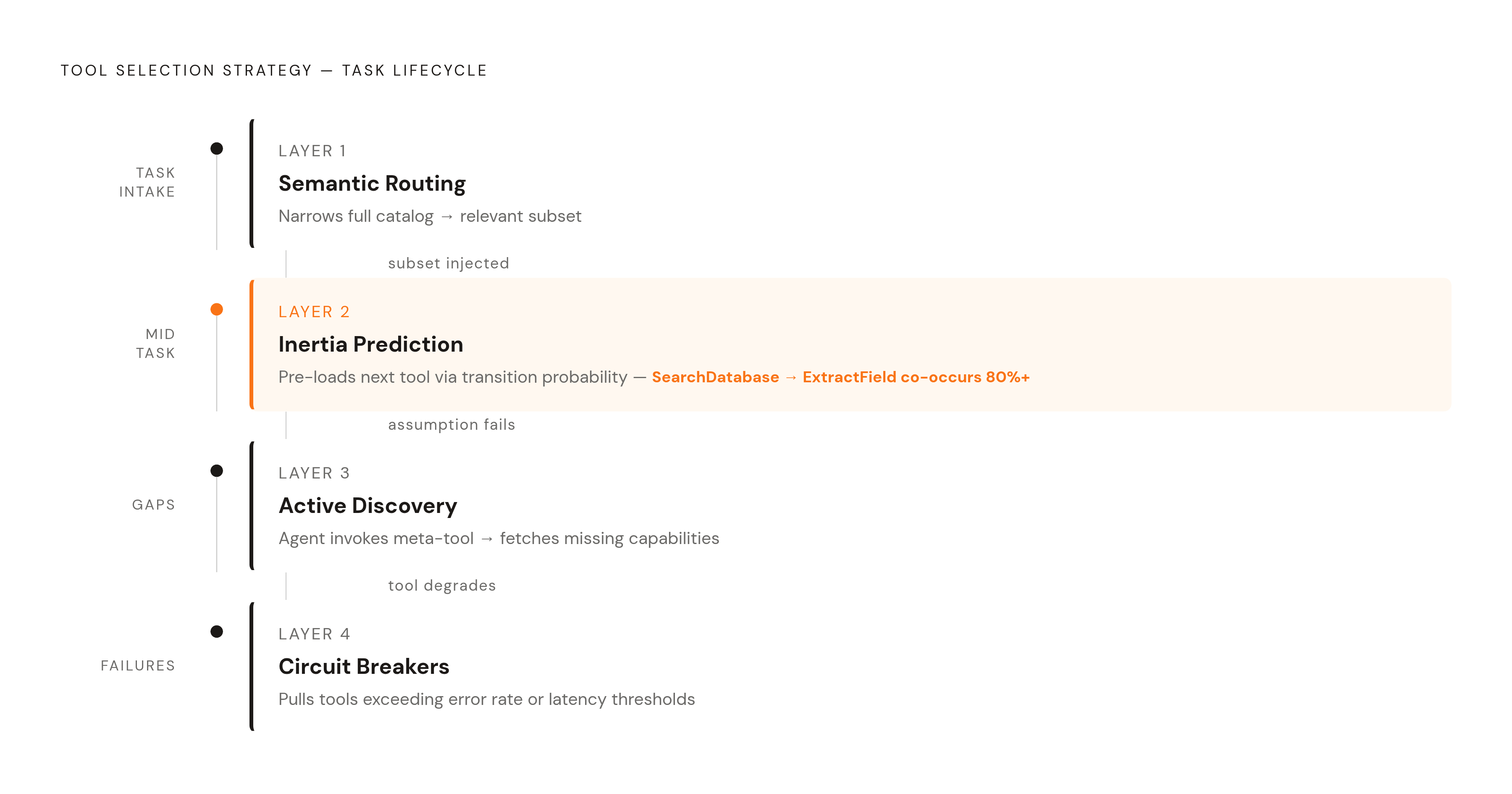
Laid out separately, these four techniques might look like competing approaches to the same problem. They aren't, and each one covers a distinct point in an agent's lifecycle. Each one covers a distinct point in an agent's lifecycle, and none of them substitutes for the others.
Picture the layering as a sequence tied to where a task sits in its execution. At task intake, layer one performs semantic routing: it narrows the full catalog down to whatever's relevant for this specific task before anything else happens. Layer two, mid-task, is inertia-based prediction: after each tool call resolves, the runtime speculatively pre-loads whatever is statistically likely to come next. Layer four functions as a safety net that produces this effect: circuit-breakers stop degraded or failing tools from blocking task completion, regardless of how the tool got selected in the first place.
Routing solves the problem of irrelevant tools crowding the context window. Inertia solves the problem of latency once a task is already underway. Discovery solves the problem of the unknown, the capability nobody predicted the agent would need. Circuit-breaking solves the problem of things that are simply broken. Stacked, they don't overlap so much as they hand off to each other at the exact points where the previous layer's assumptions run out.
What ties all four together operationally is telemetry. Inertia models can't exist without logged tool-call sequences to learn transition probabilities from. Circuit-breakers can't function without per-tool error rates and latency data streaming in continuously. Both draw from the same observability pipeline, which means a runtime instrumented well enough to support one of these strategies is usually most of the way toward supporting the other. That's a genuinely useful design insight: observability isn't a separate concern bolted onto the architecture, it's the substrate all four strategies stand on. MicroVM sandboxes suit agents that execute code, durable-execution platforms suit agents running long tasks that might span hours, and hyperscaler-managed runtimes suit organizations that need centralized governance over everything the agent touches. Picking the wrong execution environment for the agent's actual workload pattern undercuts even a well-designed tool-selection stack. In Layer 3, which handles gaps, active discovery fills requests for capabilities not in the current injected set.
Grounding tools in live web data and why freshness is a tool selection concern
Everything covered so far assumes the agent's tools are internal, databases, APIs, internal services. But a huge share of what agents actually need to do requires reaching outside the organization entirely, out to the live web, and that introduces a tool selection problem of its own.
The stakes here are larger than they might first appear. Give those same models grounded access to web search, and factual accuracy on benchmarks like SimpleQA and FRAMES improves by 25 to 40 percentage points, a large rather than marginal improvement https://www.linkup.so/blog/what-is-a-grounding-api-for-ai-agents. It's a large improvement, not a marginal one. An enterprise can trust the more accurate tool for customer-facing answers, while the less accurate one requires a human to check every output.
This is a tool selection problem specifically, not just a model quality problem, because web search, content extraction, and multi-source research are themselves entries in the agent's tool catalog, subject to the exact same routing, prediction, discovery, and circuit-breaking logic as any internal tool. Route the agent to a slow or inaccurate search tool, and the entire carefully layered architecture from the previous section is undermined at the one point where it touches the outside world. The circuit-breaker layer has to account for search tool quality as a first-class metric, not just uptime, because a search tool that returns stale or low-relevance results can pass every liveness check while still degrading the agent's output.
Grounding solidified into its own recognizable product category, with major platform vendors treating it as a distinct capability layer rather than a side feature of search. Google rolled grounding with Google Search into both the Gemini API and the Gemini Enterprise Agent Platform. Microsoft introduced Web IQ at its Build conference as an agent-oriented successor to its earlier Bing Search APIs, with results carrying page titles, URLs, crawl timestamps, and explicit staleness signals baked in, a detail that matters because it means the freshness of a result becomes something the agent can reason about directly, not something it has to infer.
The grounding pipeline itself, viewed as a tool-selection-aware loop, has a fairly clean shape to it. First, decide whether a subtask actually needs fresh external data at all, since not every step in a task benefits from a web call and firing one unnecessarily just adds latency and cost. Then route to whichever retrieval tool matches the query type: search for broad queries, content extraction for known URLs, or research APIs for synthesized multi-source answers. Once results come back, inject them with provenance intact, so the model can cite where a claim came from rather than presenting it as its own knowledge. Finally, verify the output before it moves downstream, closing the loop rather than trusting a single retrieval pass blindly.
How to evaluate web search APIs for agent tool catalogs using published benchmarks
Independent benchmarking has started to catch up with how crowded this category has become. Artificial Analysis now benchmarks 25 separate search API products across 12 providers, with a combined Search Index Score built as an equal-weighted average across DeepSearchQA F1, BrowseComp accuracy, and AA-Omniscience accuracy, with the most recent data dated September 22, 2026.
Looking at individual published figures tells a more textured story than any single leaderboard rank. Linkup posted a 94% F-score on Verified SimpleQA, leading among APIs that respond in under a second, priced at €5 per 1,000 standard searches, and notably, Linkup publishes its evaluation harness openly on a public code-hosting platform, a transparency move most competitors in this space don't match https://www.linkup.so/blog/best-web-search-api-in-2026-top-providers-compared. Perplexity reported 77.3% task-completion accuracy in the same body of benchmarking https://openbenchmarks.com/web-search/best-search-tools-for-ai-agents. And on price, TinyFish came in at effectively $0.00 per 1,000 queries within its free-tier limits, the lowest recorded figure in the set https://openbenchmarks.com/web-search/best-search-tools-for-ai-agents.
A separate developer-focused benchmark, built around 45 company-discovery questions requiring multi-search reasoning, put Parallel's basic tier ahead on search quality with a 46.5% F1 score https://openbenchmarks.com/web-search/best-web-search-api-for-ai-llm-developers. It's a reminder that no single benchmark captures how a search tool performs across the range of tasks an agent catalog actually asks of it, and that the right choice for an agent's search tool is going to depend heavily on which of these tasks, fast factual lookup, deep multi-source research, or company-level discovery, it's actually going to be running most.
That variance across benchmarks is exactly why the earlier sections matter as much as they do. Tool selection at runtime, whether for internal APIs or external search, is an ongoing routing decision, not a problem that gets solved once at design time. It's an ongoing routing decision that has to account for what a task actually needs, what a tool's real-world accuracy and latency profile looks like under the specific kind of query being asked, and what happens when that tool underperforms or fails outright. The four strategies covered here, routing, inertia, discovery, and circuit-breaking, aren't a checklist to implement once and forget. They're the operational logic an agent runtime needs running continuously if a tool catalog is going to scale past a demo and into something that holds up in production. SERP APIs such as Serper and Google PSE return raw result lists optimized for SEO use cases, while web search APIs for AI such as Linkup, Tavily, Exa, and You.com return structured content designed for LLM consumption, so they solve different problems and should not be compared on the same axis. The following are published accuracy figures from OpenBenchmarks and Linkup's open eval harness. Exa fast achieves 99.3% accuracy at 652ms average latency. Parallel turbo posts 333ms latency and 64.7% task completion, the fastest recorded in that benchmark. Hallucination rates on factual queries are commonly 15 to 25% for frontier models without grounding (linkup.so, https://www.linkup.so/blog/what-is-a-grounding-api-for-ai-agents). Parallel turbo was the fastest search with 333ms latency and 64.7% task completion (OpenBenchmarks, https://openbenchmarks.com/web-search/best-search-tools-for-ai-agents). Exa fast achieved 99.3% accuracy at 652ms latency in search API benchmarks (OpenBenchmarks, https://openbenchmarks.com/web-search/fastest-search-api). Task-specific AI agents featured in enterprise applications in 2025, up to 40% by end of 2026, versus 5% (aihive.global, https://aihive.global/blog/ai-agent-tools/).
Sources
- Introducing the Agent Governance Toolkit: Open-source runtime security for AI agents | Microsoft Open Source Blog
- The 10 Best AI Agent Tools in 2026 Compared
- AI Agent Tools in 2026: Compare Platforms and Frameworks
- Adaptive Tool Composition in Production AI Agent Runtimes | Zylos Research
- artificialanalysis.ai
- linkup.so
- linkup.so