Measuring Search API Latency for Real-Time Agent Loops
Cumulative latency across sequential searches matters more than any single API call's speed.
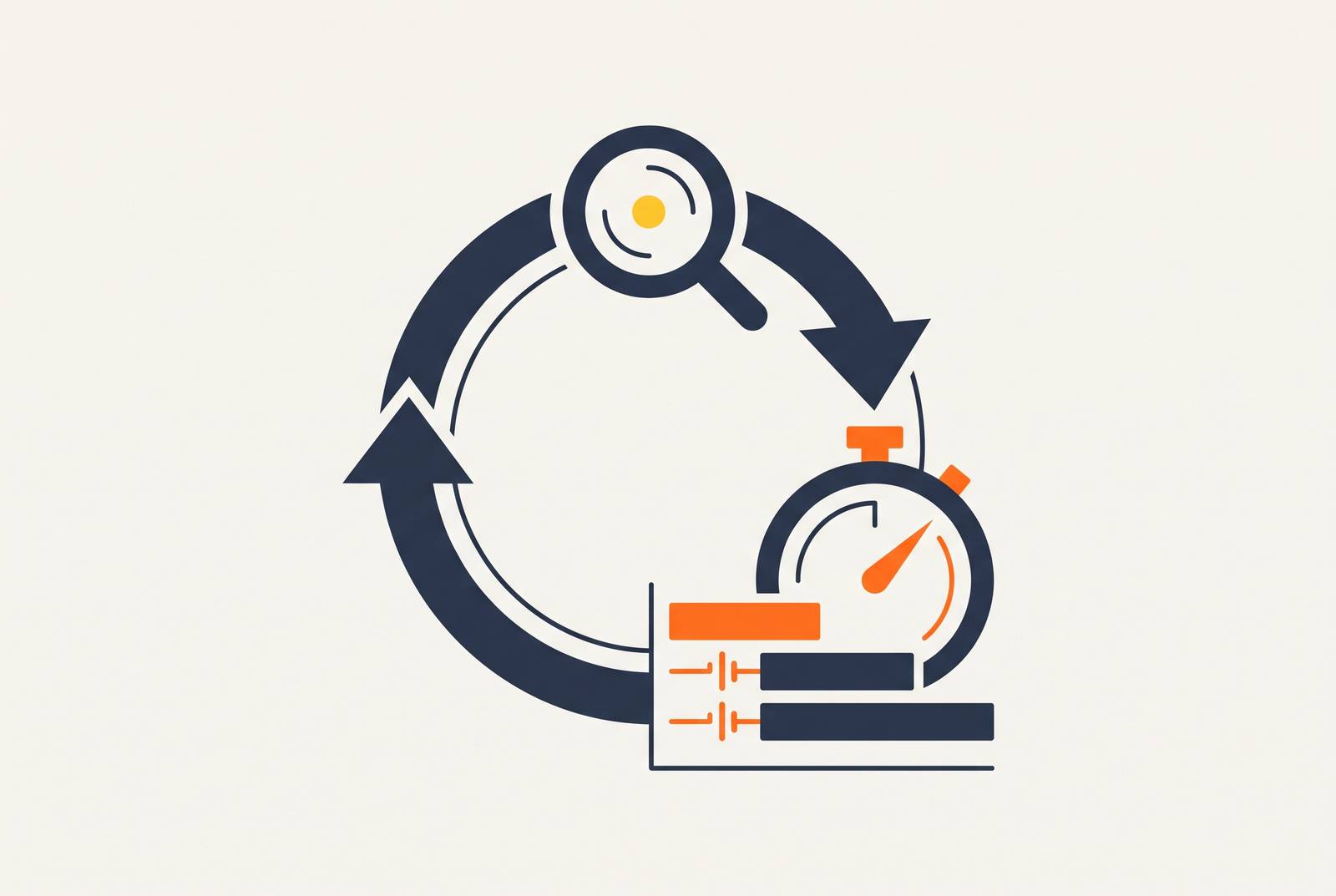
Measuring search API latency for real-time agent loops means measuring the whole retrieval sequence. A published per-call figure is a floor. The number that matters is cumulative time across sequential searches and the processing between them, measured under the traffic the agent will actually face.
Why single-request latency misleads agent builders
Vendor documentation and landing pages report the response time for one query, typically measured from a machine near the provider’s server. An agent, by contrast, may need several lookups before it can finish a task. Each lookup adds another wait, and the agent may need to process each result before it can start the next query. The published number describes an isolated request, while the user experiences a chain of requests. That gap makes a fast-looking API an uncertain foundation for a responsive agent.
Single-request measurements establish a baseline and help identify providers to test. But they leave out the number of searches a task requires, the work between searches, and the effect of concurrent traffic. A provider can perform well under controlled conditions without meeting the deadline of a multi-step agent. Engineers therefore need to assess whether that baseline survives the complete task.
This distinction changes what production readiness means. Retrieval is finished when the agent has the evidence it needs in a form it can use, within the time available.
How sequential calls turn a floor into a forecast
The arithmetic begins with addition. For sequential searches, cumulative retrieval time is the sum of the individual call times. As an illustration, a five-call loop at 669ms per call spends roughly three seconds on search responses alone. At a dramatically higher per-call latency, that same sequence can consume over a minute. Neither figure includes the model’s reasoning or the other work surrounding retrieval.
The important constraint is dependency. An agent often chooses its next query from the evidence returned by the previous one. Reasoning over the result of call two before issuing call three puts those waits on the critical path, where they accumulate. A forecast must account for that sequence instead of treating the calls as independent requests.
Parallel dispatch helps only when sub-queries are independent of one another’s results. For the dependent portion of a research loop, the call count remains a multiplier on the baseline. This makes loop latency calculable, but the calculation needs the task’s structure as well as the provider’s speed. A per-call figure becomes useful for planning only when attached to a representative sequence of searches.
The hidden cost that makes loop latency worse: the extraction pipeline
That sequence takes longer when a search response contains only links. The agent must then fetch the pages and extract the evidence before reasoning can continue. Search APIs therefore fall into two materially different tiers, namely those returning raw links or SERP metadata and those returning clean, LLM-ready text. A speed comparison that leaves out this difference measures different stages of the pipeline.
For a link-only response, fetching and extraction can add seconds of overhead before the model receives usable text. Serialization adds another delay. Converting raw HTML to Markdown inside an agent can consume more CPU time than the search API’s response takes. What looks like a retrieval bottleneck at the provider may come from work inside the agent. Timing only the network request leaves that work out of view.
The cost can also cross into inference. Large volumes of raw search output increase the time required for the model’s initial attention calculation. Cleaner, shorter results give the model less work to do, so the shape of the response matters as much as its speed. An API that takes longer but includes extraction can thus lead to a faster loop than a quick API that returns links and needs a separate extraction call. “Fastest” has meaning only after the measurement boundary includes what the agent must do with the response.
What to measure and when: the right latency metrics for agent loops
The measurement protocol should begin when the agent triggers a search and end when structured data is available for inference. That boundary includes fetching, extraction, serialization, and normalization wherever they occur. Within it, record per-call latency at P50, P95, and P99, segmented by query type and extraction depth. Segmentation helps distinguish a slow provider response from expensive internal processing.
Next, measure cumulative session time for multi-step tasks like those the agent will handle. A five-call session timer in a realistic agent harness is closer to the user’s experience than an isolated curl command. Track time-to-first-token after search returns as well, so delays around preparing and consuming the result remain visible. Keep that measure distinct from the time at which structured data becomes available. Together, the measurements show both retrieval completion and the wait that follows it.
Repeat those measurements as concurrency rises from baseline to the peak of agent traffic. Bursty demand can expose queueing that a quiet test never encounters, even when median request latency looks good. P95 across the search-to-agent pipeline, segmented by tool type, helps locate the bottleneck, while P99 exposes longer delays. The degradation curve from these tests shows whether speed holds up as demand grows. This is a measurement discipline for any provider.
Benchmarks worth trusting and why most published comparisons miss the point
Published benchmarks can still help show how good the answers are and how fast they arrive. A single-request benchmark can support a shortlist without forecasting a multi-step session. A P50 result from a controlled test also says little about how long an agent may wait under concurrent load. Treating either as a complete forecast asks the benchmark to establish something it did not measure.
Benchmark incentives also deserve scrutiny. Vendor-published comparisons may rank their own products first, and the harness can substantially change the ranking. Neither fact makes every result worthless. Both make the method essential to interpreting the claim. The careful reader needs to know what was timed, what the API returned, and how the test represented an agent’s work.
A loop-level benchmark that can be trusted uses a realistic agent harness to test more than a single request. It reports P95 or P99 at meaningful concurrency and cumulative session time for multi-step tasks. Its methodology is openly published and reproducible, allowing the result to be examined. Quality results remain important, but they do not substitute for those timing conditions. The strongest evidence connects answer quality with the workload and deadline the infrastructure must support.
How to build a latency budget before selecting a provider
Begin with the maximum acceptable wait for the end user or downstream system. An interactive support bot needs sub-second retrieval, while a background research agent or asynchronous workflow has more room. This is a product requirement before it is a provider requirement. The deadline turns “fast” into a testable ceiling against which the rest of the system can be budgeted.
Subtract the time needed for non-search work, including LLM inference, prompt construction, output parsing, and downstream tool calls. The remainder is the search budget for the full session. Divide that budget by the expected number of sequential searches to obtain a per-call ceiling. That ceiling must cover the full retrieval pipeline. Build in a concurrency margin and test whether the ceiling holds at realistic peak request volumes.
Provider evaluation then needs five axes, which are freshness, source diversity, latency under concurrency, compliance and data retention, and accuracy on a public benchmark. Freshness matters for time-sensitive queries, while a broad set of authoritative domains reduces single-source bias. Compliance includes zero-retention guarantees and the audit trail requirements of regulated industries. Public benchmark accuracy provides an independently verifiable quality measure. Score providers against these needs and run a live trial with traffic like the agent will handle before choosing one.
Engineering patterns that reduce loop latency without changing providers
A provider trial need not be the only route to improvement. Speculative execution starts retrieval before the agent has confirmed that it needs the result, overlapping the network round-trip with reasoning. That overlap can shorten the wait, but unused calls incur cost and may waste tokens. A sufficiently high confidence threshold limits unnecessary speculation. Track the hit rate by sub-task to establish whether the saved time outweighs the waste.
Semantic caching removes redundant calls by reusing results for semantically equivalent queries. It can reduce both latency and cost when lookups repeat or differ only slightly. Its limit is staleness, especially for agents following real-time events. Even a result from an hour earlier may be wrong for a time-sensitive task. A bypass-cache flag for high-precision, time-sensitive queries preserves the option to retrieve fresh evidence.
Parallel dispatch saves time in a different way when a task has independent sub-queries. Issuing those calls concurrently removes serial waiting for that part of the task. It does not apply where one result determines the next query, so the task’s dependency structure must govern its use.
Token-efficient ingestion and tiered extraction address work inside the pipeline. Pre-filtering and summarizing results before they enter the context window reduce the burden of the initial attention calculation, but that preparation belongs in the end-to-end measurement too. Extraction depth should also fit the query, with a fast static fetch for simple factual lookups and heavier rendered extraction when dynamic content needs it. The lighter path is not a substitute for content it cannot retrieve.
What search infrastructure must deliver to support real production agent loops
The resulting infrastructure requirements are more demanding than a low median response time. Interactive production loops need sub-second P99 latency that holds up under concurrent agent traffic, with search and content extraction in one step when a second stage would take more time than the budget allows. They also need fresh evidence and publicly verifiable accuracy. A continuously fresh index supports time-sensitive retrieval, though cached results still require the safeguards described above. For regulated workloads, zero data retention belongs in the baseline evaluation.
The right service tier still depends on the deadline. Sub-second APIs and synthesis engines that take ten or more seconds per call fit different needs for speed. A deeper answer may justify a longer call in a background research workflow without fitting an interactive loop. Each API in a product family needs to be tested for the task it will handle.
You.com’s Web Search API and Research API are options to test within that framework. The Research API is at the top of the benchmark on DeepSearchQA, while the Finance Research API ranks first on FinSearchComp’s T2 (Simple Historical Lookup) sub-task. These publicly verifiable results establish quality evidence. The Research API’s cited, source-reconciled output also addresses ingestion costs by supplying grounded, compact answers with provenance, eliminating the need to parse raw pages. You.com’s pricing page places zero data retention on enterprise plans, a qualification regulated teams must include in their evaluation.
Define the loop-level deadline, instrument the full pipeline at realistic concurrency, and test providers, including You.com, against representative traffic before committing.