Real-Time Earnings and Filing Monitoring With AI Agents
Preparing, detecting, and synthesizing disclosures in sequence preserves evidence and timing.

Real-time earnings and filing monitoring with AI agents is an architecture problem that includes summarization. A useful system must prepare before a disclosure, detect and ingest it as it arrives, and produce a sourced brief afterward. The infrastructure that connects those stages decides whether the agent delivers useful information on time or stale noise that sounds convincing.
Why real-time disclosure monitoring is a structurally different problem from periodic financial analysis
Material disclosures arrive in bursts. Earnings releases, 8-K filings, Form 4 insider trades, and regulatory disclosures can land within a short window, triggering price moves, analyst revisions, and compliance obligations within hours. Traditional analysis proceeds document by document and quarter by quarter. That creates a structural gap between an event and its interpretation, even when analysts work quickly.
The difficulty is also one of sequence. An agent must distinguish expected release timing, pre-event positioning, the authoritative filing, and the market’s response to it. A price reaction without that chronology is incomplete evidence. Meanwhile, boards and executives expect continuous visibility rather than monthly snapshots, making the response interval part of the system’s usefulness. What architecture fits information that is concentrated, timestamped, and sequentially dependent?
The three-phase lifecycle an earnings monitoring agent must cover
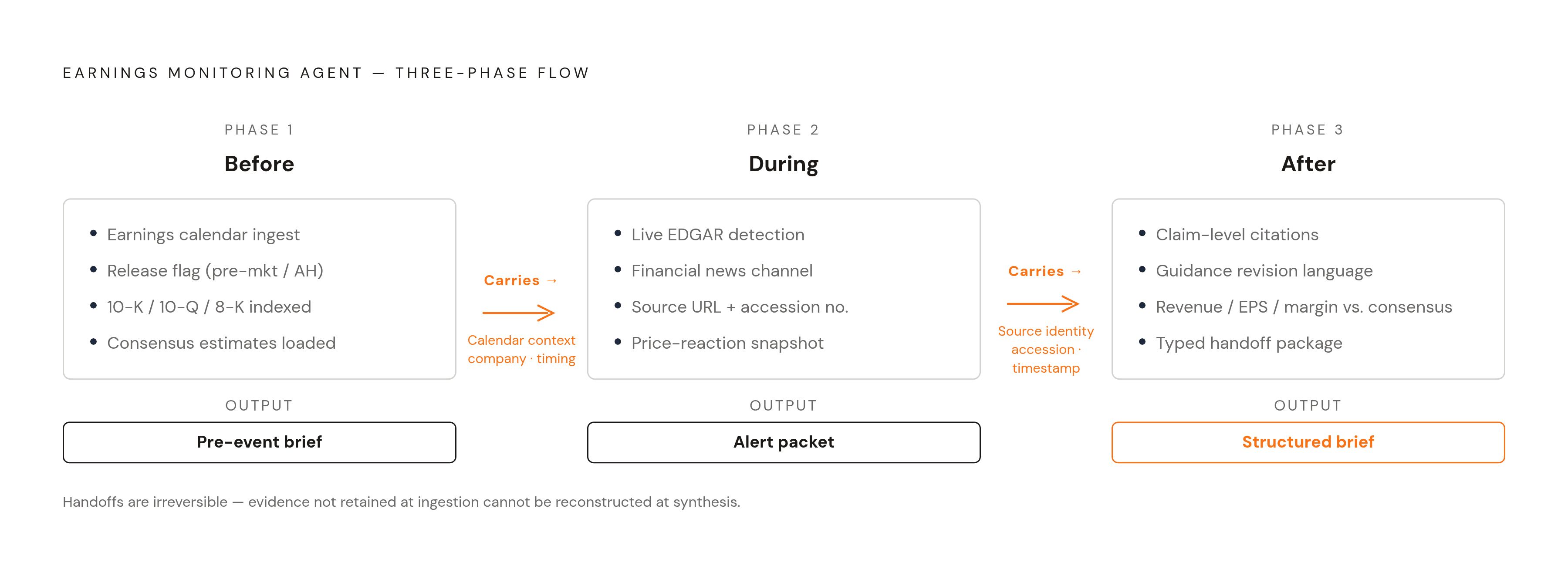
Before the event, the agent prepares a pre-event brief and a schedule for alerts. During the event, live detection produces an alert containing a source URL, filing timestamp, accession number, and price-reaction snapshot. After the event, synthesis produces a structured brief with sourced claims for human review or downstream analysis. These are different outputs with different infrastructure needs. Treating all three as summarization obscures the work required to connect them.
The handoffs are as important as the stages. Calendar context must reach live monitoring, and the detected event must reach synthesis with its source identity and timing still attached. News can precede EDGAR publication, so live detection cannot wait for the filing channel alone. QVeris’s framework separates monitoring, which detects and alerts, from analysis, which interprets content. That boundary allows each workflow to serve a narrower purpose without severing the evidence chain between them.
What the pre-event stage requires — calendar awareness and LLM grounding before the filing lands
Preparation starts with structured earnings calendar data. The agent needs the company, expected release date, and pre-market or after-hours flag to activate monitoring at the right time. Dates can change at short notice. Calendar ingestion therefore has to accommodate rescheduling. This triggering layer establishes when the rest of the system needs to be ready.
Grounding establishes what it needs to know. Prior-period 10-K, 10-Q, and 8-K filings form the minimum retrievable corpus before the new disclosure arrives, while refreshed data compensates for a model’s outdated training knowledge. Workiva’s Workiva Knowledge illustrates a persistent context layer that brings together historical SEC filings, internal policies, board materials, and authoritative guidance. Consensus estimates and timestamped pre-event news then supply the expectation baseline. Without it, how can the agent distinguish a genuinely surprising result from a number the market had already anticipated?
Live filing ingestion — the data pipeline choices that determine freshness versus staleness
Live detection has to watch EDGAR and news at the same time. News may break first and provide market framing, while the filing supplies the authoritative disclosure. Their timestamps are not interchangeable. Recording them separately lets later reasoning distinguish pre-event positioning from post-release reaction.
Extraction introduces another set of trade-offs. A cascade can progress from fast static fetch through block scoring, headless browser rendering, and an LLM extraction fallback. Each escalation takes more time but covers more of the content. Developers therefore need explicit latency budgets and escalation rules for each tier. Search, fetch, and extraction delays accumulate before the reasoning model sees any content, so a fast individual service does not establish a fast pipeline.
Fresh content also needs a recoverable identity. A production context packet needs a content hash, source URL, fetched-at timestamp, extraction tier, verbatim coverage flag, and chunk ID, with the filing’s accession number preserved. Structured SEC access can reduce manual navigation by returning citable filing data through a plain-language API query. However, a returned response is not proof of freshness. Service-level indicators must catch stale data and other silent failures before the agent sends a confident alert today based on yesterday’s disclosure.
Multi-tool orchestration — how agents combine filing, price, news, and fundamentals data without being directed
An earnings agent combines calendar and filing data with live prices, financial news, and fundamentals such as revenue, EPS, margins, and balance sheet data. Each layer answers a different question. The filing establishes what was disclosed, prices show the reaction, news supplies context, and fundamentals place the result against financial history. Timestamp alignment prevents those inputs from being mistaken for evidence from the same moment.
The agentic advance lies in selecting tools. The developer defines available capabilities, while the model chooses which combination to call and in what order for a particular query. SEC search, finance search, company research, and economics search can then help answer different questions without a set order of calls for each one. Parallel.ai’s finance research approach does this through monitoring and structured profiles that link each claim to excerpts from its source.
Post-event synthesis — how the agent generates auditable, citable intelligence rather than a summary
The post-event brief must support examination. It compares reported revenue, EPS, and margins with consensus and prior-period disclosures, characterizing the size of the differences. Guidance revisions require the exact disclosure language, its timestamp, and a citation. QVeris’s earnings agent guide says that guidance changes often move prices more than the headline EPS beat or miss. Every claim based on a filing needs a link back to that filing, its accession number, and its page.
Pathway’s LiveAI results show a complete multi-agent pipeline outperforming a simple RAG baseline on financial document benchmarks, with human-in-the-loop integration improving results further. That supports a layered approach. Workiva’s Benchmarking Agent illustrates source-traceable peer analysis drawn from SEC-filed 10-Ks and 10-Qs. Its persistent context layer keeps provenance in the research from the start, before the prose is written.
The brief also serves as a handoff. A typed, schema-consistent event package can pass results, guidance changes, and provenance to compliance review, portfolio management, or deeper analysis without requiring another retrieval cycle. Monitoring remains responsible for detecting the event, while analysis interprets its content. This separation preserves the event’s identity across workflows. No output-stage rewrite can reconstruct evidence that ingestion failed to retain.
Where accuracy breaks down — the hallucination and data-quality risks specific to financial disclosures
Errors that look plausible can still slip through when the writing reads well. An agent can attribute one company’s figure to another, confuse subsidiaries or ticker symbols, or compare mismatched reporting periods. The number may exist in the corpus. Because the number is there, the mistake is harder to spot than a wholly invented figure, especially when the rest of the answer uses financial language that sounds credible.
These weaknesses are more clearly visible in cross-document and temporal reasoning than in tasks that use a single document. Fragmented data compounds the problem when an inconsistently structured filing feed, delayed news source, and stale fundamentals database enter the same analysis. Their inconsistencies can become apparent conclusions without visible warnings. What would allow a reviewer to challenge that output? Formatting and confidence cannot substitute for a traceable relationship between each claim, entity, period, and source.
The response belongs inside the pipeline architecture. Typed context packets with provenance fields help catch entity mismatches before the content reaches the model, while service-level indicators flag inputs that are stale and failures that would otherwise go unseen. Human review must also take place during synthesis as well as when the final wording is approved. These controls address different failure modes. All of these controls are needed because the system must retrieve the right material, compare it correctly, and be accountable for how it interprets it.
Regulatory requirements that shape what the agent’s audit trail must contain
The EU AI Act sets transparency, traceability, and human oversight requirements for high-risk systems, with August 2, 2026 identified as the compliance date in this context. When an earnings agent is used for compliance or investment decisions, the team must consider how that use is classified as well as how the product is designed. Its use cannot be treated as irrelevant to its obligations. The architecture must be capable of producing the evidence that the applicable classification requires.
That evidence extends beyond the final answer. Each alert needs a filing accession number, source URL, and extraction timestamp, together with records of which data the agent accessed and when. Human oversight checkpoints must have logs as well as a place in the interface. Where filings contain personal data, GDPR exposure also enters infrastructure selection. Zero data retention and SOC2 certification form an enterprise baseline in the proposed design, but they do not replace the event-level audit trail.
Governance also constrains how much autonomy is appropriate. Hui Gong’s April 2026 analysis of AI agents in financial markets argues that systemic effects depend on how architectures are distributed, coupled, and governed as well as on model intelligence. The paper describes bounded autonomy as the most plausible near-term equilibrium. Under that model, monitoring agents, supervised co-pilots, and constrained execution modules stay part of the way people make decisions. For earnings monitoring, this makes supervisory access part of the architecture.
Protocol standards and infrastructure layers that make multi-agent earnings monitoring interoperable
Model Context Protocol, or MCP, provides an agent-to-tool connectivity standard that can separate provider integration from reasoning logic. That separation supports changing data providers without rewriting the agent’s reasoning workflow. It does not mean interoperability is complete. The April 2026 Agentverse infrastructure paper identifies MCP integration as present but incomplete and proposes it within a future reference architecture together with asynchronous messaging and agent registries.
The supporting layers deserve equal attention. In the seven-layer agent cloud reference stack, memory preserves context across quarters, while observability exposes stale data, missing provenance, and extraction problems. Infrastructure selection should therefore consider published benchmark results as well as the cumulative latency of search, retrieval, and extraction. Historical lookup performance is useful evidence for that task, but a live monitoring pipeline must also meet its own freshness requirements.
These choices shape future migration costs. A system whose tools share a protocol has more freedom to change providers than one whose reasoning depends on provider-specific connections. The infrastructure argument therefore ends with three distinct needs, namely interoperable connections, persistent memory, and observable data flow.
Building the agent — the practical implementation sequence from calendar trigger to cited brief
The implementation sequence makes the architecture argument concrete. A team building this system should first define the companies to monitor and ingest their earnings calendars, release-window flags, and prior-period accession numbers. Calendar triggers then activate live monitoring. Before those windows open, the team should index past filings and add timestamps to consensus estimates and pre-event news. This establishes the baseline against which new information will be interpreted.
Next comes dual-channel ingestion from EDGAR and financial news, with separate timestamps, extraction budgets, and escalation rules. Provenance belongs in every content packet before reasoning begins. The team can then define SEC search, market data, news, and fundamentals tools, using a single routing layer where possible. Model-selected tool combinations should be validated against the needs of each lifecycle phase rather than assumed to work because the tools are available.
Finally, the team should define the cited brief’s schema and its typed handoff to reviewers or downstream agents. The schema should record how results compare with consensus, quote guidance changes, show how the language and structure changed from the prior period, and include claim-level citations. Before deployment, observability must detect stale inputs, unreported extraction escalation, and missing provenance before they reach the model, while oversight checkpoints need durable logs.