Streaming Search Results Into LLM Generation Pipelines
Stream search results into models without blocking retrieval or losing performance to buffering.
A support ticket describes a familiar bug: the server logs show tokens leaving the application in a steady trickle, fast and even, but the user's screen sits blank and then dumps the entire response at once, seconds after it should have started typing. The failure sits in the layers between the model and the screen: a CDN buffering by default, a corporate proxy holding the connection open without flushing, an nginx config with proxy_buffering left on, any one of which will collapse a stream into a block of text before it reaches the user. Setting stream=true in an SDK call does one thing: it surfaces token deltas to the client as the provider produces them. The distinction that matters here is the one between printing provider tokens to a UI and treating tokens as structured data inside an application graph, data that other nodes can read, transform, validate, and hold back if needed. Three layers expose the gap between those two things: retrieval, which can force the whole pipeline to wait before generation even starts; orchestration, where queue management, worker allocation, and backpressure get left to callback code that quietly accumulates unbounded buffers or reorders tokens the moment any one mechanism has a bug; and transport, where the network itself can undo everything the application layer got right. Each of these requires a real architectural decision. If you treat streaming as a single flag, you will eventually hit all three failure modes in production, usually without a clear way to tell which layer caused the regression.
How overlapping retrieval with prefill reduces time-to-first-token
The retrieval layer is where the largest latency gains sit, because it governs when the model can start working. A pipeline that waits for a complete set of search results before calling the model turns search latency directly into dead time on the user's screen: nothing appears until retrieval finishes, no matter how fast the model itself streams afterward. The fix is to stream context into the model incrementally, feeding chunks to the model as they arrive rather than holding everything until the corpus is complete. Stream2LLM looked at this exact problem, and on real-world web-crawling and approximate nearest-neighbor search workloads, it found that this overlap approach can substantially cut time-to-first-token.
Once this overlap is in place, two different retrieval patterns each need their own handling. Update-mode retrieval behaves differently: the context set itself changes as a search algorithm refines its results, and a naive scheduler that recomputes the full cache on every update erases whatever latency gain the overlap was supposed to buy. Stream2LLM solves this with longest common prefix matching, which keeps the cached key-value blocks for any prefix tokens that haven't changed and invalidates only the portion that has, so an iterative search refinement doesn't force a full cache rebuild each time results shift.
There's a second complication once multiple requests run at once: each one holds growing key-value cache blocks in GPU memory, and when that memory runs out, something has to be preempted. One might ask why this level of scheduling detail matters to someone just trying to wire a search tool into an LLM app. It matters because none of it is visible from the SDK call. The practical takeaway for pipeline design is that retrieval has to be treated as an asynchronous, chunked feed into prefill. That requirement reaches back into the choice of search API itself: the API has to support incremental result delivery. That constraint sets up the question the next section has to answer.
Grounding API requirements for streaming prefill
Not every search API can participate in the overlap architecture just described. An API that only returns a single, complete response envelope forces the pipeline back into blocking retrieval no matter how well the rest of the system is built, because there's nothing to stream until the whole result set is ready. The choice of grounding API is itself an architectural decision to settle early.
A grounding API built for LLM pipelines needs to return evidence the model can actually cite: clean, structured, markdown-formatted text stripped of visual clutter, carrying clear source attribution, not raw HTML or a page of ranked links meant for a human to click through. A given API fits cleanly into a streaming pipeline only if it has four properties. And you need the output format itself to be ready for the model to read directly, with no cleanup or parsing step sitting between the API response and the prefill stage.
That last property is what splits search providers into real categories. The generation side of the pipeline picks up from here.
Structured streaming outputs and tool-call deltas during generation
If a model streams structured output instead of one block of prose, you can act on each field as soon as it arrives. So routing, validation, and UI updates don't have to wait for the whole response envelope to close. Picture a schema where the first field is intent: if the model emits that field early, a router can act on it immediately, dispatching the request to the right downstream handler while the model is still generating the supporting evidence. This only works if the model emits partial JSON chunks that concatenate into a valid, schema-compliant object by the end of the stream, a capability major model providers now support directly.
This same idea carries over to tool calls, in the connection between search and generation. If a conversation has several tool calls, this cost multiplies, and you feel it as added user-facing delay.
If a downstream node expects a full argument object but gets a partial JSON fragment, it will throw an error or silently drop the event, creating an ordering problem where a dropped event in a tool-call chain is a bug you won't see until a user reports a search that never ran. This is the exact failure class that a typed event model, like the Context<T> pattern AiFlow describes, is built to prevent, by giving every node in the graph a defined contract for what shape of data it will receive at each point in the stream.
A validation problem caused by timing differences between nodes appears even when every node handles its data correctly. In a stream, the user reads the first version, sees the model revise, and watches the contradiction happen in real time, which is a UX failure independent of whether the final answer turns out to be correct. That failure mode, visible only mid-stream and invisible in any evaluation that only checks the final output, is the bridge into the coordination problem that runs through the whole middle of the pipeline: what happens when different parts of the system process tokens at different speeds.
Backpressure and bounded queues as the orchestration contract
Different nodes in a streaming pipeline can process tokens at very different rates. If you don't handle these mismatches directly, the queues between nodes grow without bound, so the application runs out of memory or starts delivering tokens out of order, and you won't see either failure until it's already hitting users.
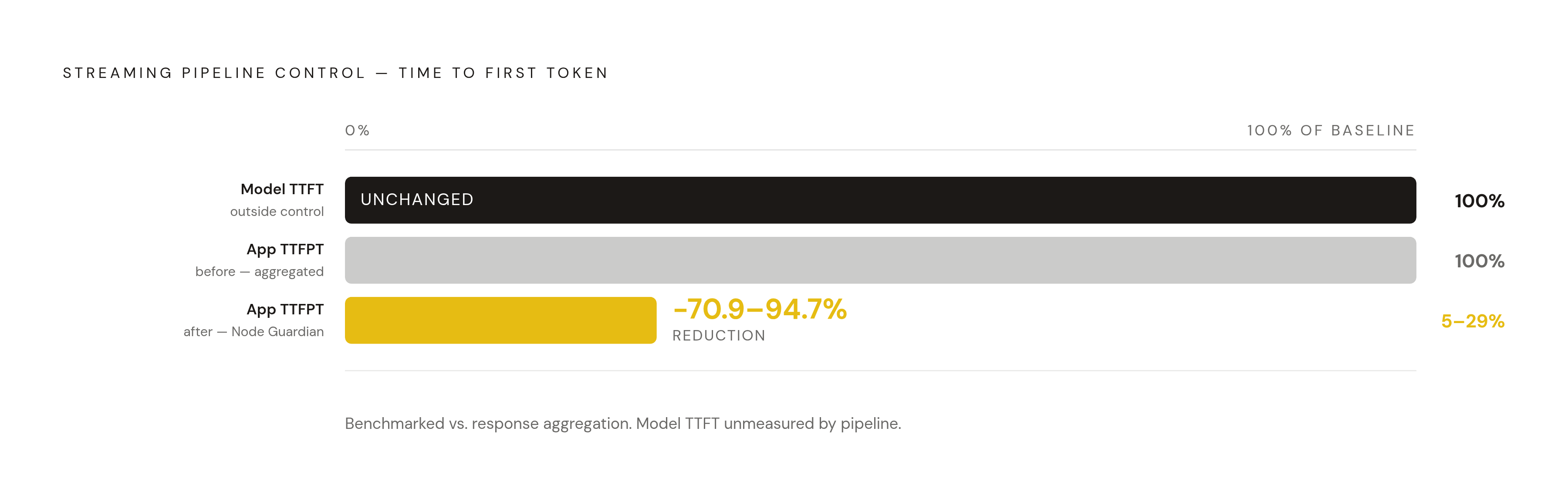
AiFlow's Node Guardian model treats this as something to declare up front rather than patch reactively: queue bounds, worker concurrency, overflow policy, cancellation propagation, and retry behavior all become explicit properties of the graph, enforced by the runtime itself instead of scattered through callback code written separately for each node. Because of this, queue depth stays within its declared limit even when the load is built to break it. Benchmarks of this approach show runtime-owned queue depth staying within its bounds far more often than unbounded policies do, and application-level time-to-first-processed-token drops by 70.9 to 94.7 percent against response aggregation, leaving the provider's own model-level time-to-first-token unchanged.
That last point is worth separating out clearly. Model TTFT, the time it takes the provider to produce its first token, sits outside the pipeline's control. Application TTFPT, the time until that first token has traveled through every node in the pipeline and reached the client, is something the pipeline fully controls, and it's the number users actually experience regardless of how fast the model itself is.
Overflow policy is the decision that determines what happens when a queue fills up anyway, and it carries real tradeoffs depending on what's inside the queue. A blocking or backpressure policy keeps ordering intact and protects citation-bearing output, but if one slow downstream node stalls, it can hold up the entire graph behind it. A spill policy writes overflow to CPU memory or disk: it adds latency but keeps correctness, so it fits high-value, long-context research pipelines where getting the answer right is the priority over shaving off a few hundred milliseconds.
Cancellation deserves the same explicit treatment. When a user interrupts a response mid-generation, the cancellation signal has to travel upstream through the whole orchestration graph and abort any retrieval calls still in flight, stopping new tokens from being emitted. Without that, the pipeline keeps burning search API quota on a response nobody will read, a cost you can miss until a usage bill makes it obvious.
Safety filtering and privacy sanitization without breaking the stream
Filtering a response after it has fully generated is the standard approach in many systems, and it is fundamentally at odds with token-level streaming. A post-hoc filter requires the full output to accumulate before it can run, which forces the system back into response aggregation and reintroduces the exact latency streaming was supposed to remove. Worse, by the time that filter fires, the harmful or privacy-exposing content has usually already reached the client, because the tokens were streamed out before the filter ever saw them.
Self-Sanitize looked at this problem and proposes a different structure. A lightweight Self-Monitor module inspects the model's high-level intentions at the token level, using representation engineering to read the model's internal state rather than waiting on the surface text it produces. Paired with it is a Self-Repair module that corrects harmful content in place, without stopping to start a separate review conversation, and the combination achieves real-time monitoring with a negligible effect on latency. The architecture runs in three phases, and they fit a streaming pipeline naturally. The Self-Monitor runs continuously, so it tracks the model's internal representation of intent instead of scanning finished text, and it can catch a harmful trajectory before it fully plays out in the output. When the monitor's confidence crosses a set threshold, generation briefly hesitates while Self-Repair works out the correction, and that pause happens at the token level, not as a full stop-and-restart of the response. Self-Repair then writes the correction directly into the stream, so you read a coherent answer instead of hitting a truncation or an abrupt refusal mid-sentence.
This matters in a search-grounded pipeline because retrieved web content can carry privacy-sensitive material, personal data, or identifying details that a source document picked up and that the model then weaves into its synthesized answer. The design implication follows directly: the safety node belongs inside the graph as its own node, sitting between generation and output delivery, with its own queue bounds and its own cancellation behavior defined like any other node. Treating it as an external call that the generator sits and waits on puts blocking latency right back into a pipeline that was built to avoid it.
Measuring the pipeline: TTFT, inter-token jitter, mid-stream consistency, and premature termination
A pipeline can report a clean, healthy time-to-first-token number while still delivering a broken experience to users through three other failure modes: inter-token jitter, mid-stream inconsistency, and premature termination. You won't see any of these in a rubric that only scores the final output, so teams that track TTFT alone tend to miss regressions until users start complaining.
TTFT itself should be measured at the 95th percentile per route, not at the median, because it's the one latency number users feel directly, and a high p95 means a meaningful share of sessions feel slow even while the median looks fine. Inter-token timing needs its own ratio: comparing the 99th percentile gap between tokens to the 50th percentile gap. Past that, the stream visibly stutters even when the median gap looks fine, and the most common cause at that point is the provider's own internal buffer flushing in irregular bursts rather than a steady trickle, something that's often fixable with a route swap rather than a deeper architectural fix.
Mid-stream consistency calls for a different kind of check: a judge that scores server-sent event deltas chunk by chunk, flagging the moment a later chunk contradicts something an earlier chunk already stated. You can catch premature termination by joining the model's finish_reason field with a separate task-completion score, because the dangerous case is a stop reason that looks clean on its own but pairs with an incomplete or unsatisfied task, and that mismatch is easy to miss if you never check the two signals against each other.
Taken together, these four measurements describe what it actually means for a streaming pipeline to work: the first token arrives quickly, the tokens keep arriving at a steady pace, what they say stays consistent from one chunk to the next, and the stream ends because the task finished.
Sources
- AiFlow: Token-Native Reactive Orchestration with Bounded Backpressure for Streaming LLM Applications
- 1Context streaming overlaps retrieval with prefill, reducing TTFT by beginning inference as chunks arrive.
- Stream2LLM: Overlap Context Streaming and Prefill for Reduced Time-to-First-Token (TTFT)
- Sanitize Your Responses: Mitigating Privacy Leakage in Large Language Models
- AiFlow: Token-Native Reactive Orchestration with Bounded Backpressure for Streaming LLM Applications
- [2604.16395] Stream2LLM: Overlap Context Streaming and Prefill for Reduced Time-to-First-Token (TTFT)
- AiFlow: Token-Native Reactive Orchestration with Bounded Backpressure for Streaming LLM Applications