Reducing Hallucination in LLM Responses With Search Grounding
Grounding LLM answers in retrieved facts eliminates the model's need to fabricate from memory.

Hallucination is a direct consequence of how large language models generate text, sampling tokens from a probability distribution learned over training data rather than consulting a record of facts, and is not a glitch that better engineering will quietly retire. When a query lands inside the distribution the model learned well, the output tends to be accurate. When it falls outside that distribution, the model does not stop and say so. It keeps generating, producing a sequence of high-probability tokens that reads fluently and carries no particular relationship to what is true.
Why does a model behave this way instead of simply admitting uncertainty? The answer sits in how these systems are trained and graded. Kalai and collaborators at OpenAI and Georgia Tech, in "Why Language Models Hallucinate," make the mechanism explicit: most benchmarks score a wrong answer and an abstention identically, as failures. Given that scoring structure, a model that guesses will always outperform, on average, a model that declines to answer. The training and evaluation loop rewards confident fabrication over honest uncertainty, so confident fabrication is what gets reinforced. This is not a failure of the optimization process. The optimization process is working exactly as specified, and the specification simply never asked for calibrated doubt.
A harder structural limit also produces hallucination: a model's parametric memory, the knowledge encoded in its weights, is a lossy compression of whatever text it was trained on. Compression that loses information has to fill the gaps somehow, and invention is what fills them. A model cannot retrieve a fact it never reliably encoded in the first place, so when a query touches a gap, the output is manufactured rather than recalled, with no internal signal distinguishing the two. Layered on top of that is the plainest limit of all: training data has a cutoff date, so any question about something that happened after that date is structurally unanswerable from the weights alone. No amount of prompt engineering changes what the model never saw.
Taken together, these three facts, the scoring incentive, the lossy compression, and the frozen cutoff, explain why hallucination cannot be fine-tuned away or prompted away in any durable sense. The fix has to come from outside the model's weights: once hallucination is understood as architectural rather than incidental, the only interventions worth taking seriously are the ones that change what the model has access to at the moment it answers rather than the ones that try to make it guess better.
The four failure modes hiding behind a single hallucination score
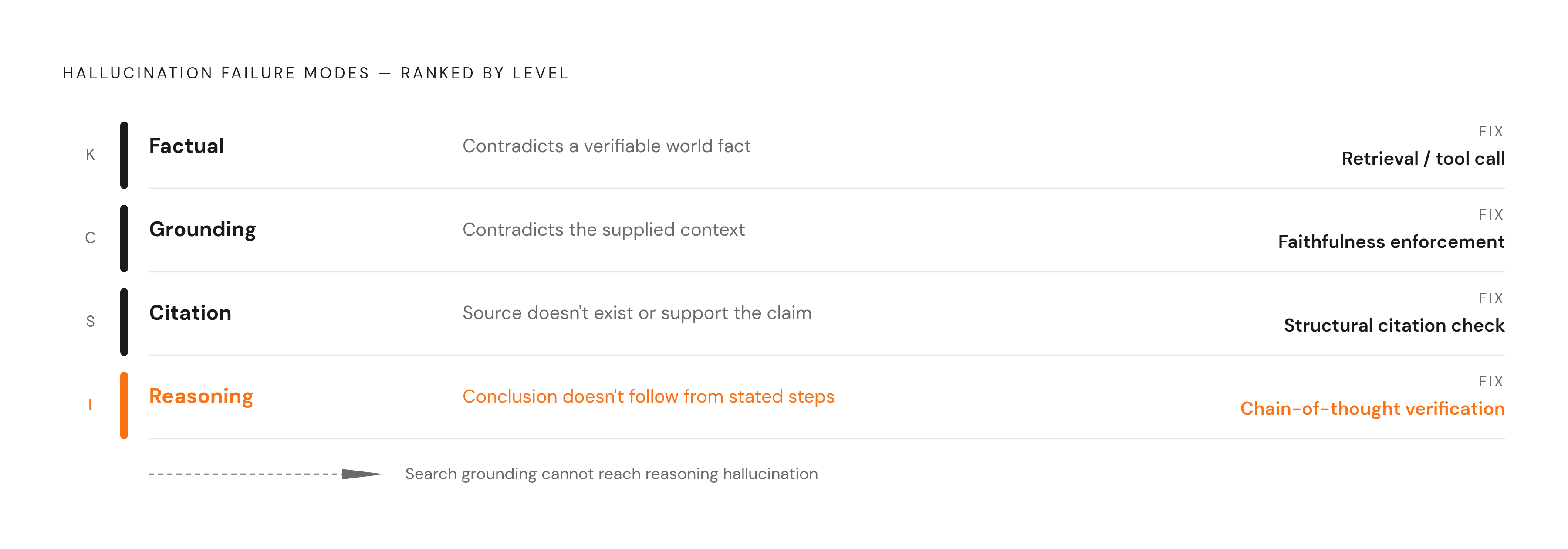
Teams that measure hallucination with a single "is the answer correct?" judge are averaging together four distinct failure modes into one number. That number tells a team something is wrong, but not which of four very different things is wrong, and pushing a prompt change to raise that score by two points can repair one failure mode while quietly making another worse.
FutureAGI's 2026 architectural analysis lays out the four categories that production teams have converged on as operationally distinct. Factual hallucination is a claim that contradicts a verifiable fact about the world, independent of whatever context the model was given. It is a knowledge problem, and the fix runs through retrieval or a tool call upstream, so the model reads a supplied fact instead of reaching into parametric memory for one. Grounding hallucination is different: a claim that contradicts the context the model was actually given. This is the failure mode that matters most in regulated industries, because in those settings the source of record is the supplied context, not the world at large. A grounded answer can still be wrong if the underlying context was wrong, and a factually correct answer is still unfaithful if the model bypassed the context to produce it. Citation hallucination names a third problem: a cited source that does not exist, or a real source that does not actually contain the claim attributed to it. This is the dominant failure mode in research and legal applications, and standard groundedness scoring routinely misses it, because those scores check the answer against the retrieval set as a whole rather than verifying that a specific citation supports a specific claim. Reasoning hallucination is the fourth: an answer that looks right on the surface but whose inference chain is broken, where the stated conclusion does not actually follow from the model's own stated steps. Retrieval alone does not touch this one.
How much does any of this matter in practice? The rates tell a stark story. Open-ended generation tasks show the highest hallucination rates of any category studied. Closed-domain question answering reduces the rate substantially simply by narrowing what the model is allowed to talk about. Summarization grounded directly in source text achieves the lowest rates of all, because the model's job shrinks to restating what it was given rather than drawing on what it knows. Legal research is at the severe end of the range: a legal AI tool can return a case citation, a plausible docket number, a plausible court, a plausible year, for a case that does not exist. Standard groundedness scoring passes that answer, because it never checks the citation structurally against the retrieved documents.
This four-mode taxonomy matters because it dictates what fixes the rest of this piece can credibly claim. Search grounding, the subject of the next section, is a direct and powerful answer to factual and citation hallucination. It is not, by itself, an answer to reasoning hallucination, and factual and citation failure are not the same kind of failure as reasoning failure, a distinction that runs through everything that follows.
Why search grounding is the most direct fix for factual and citation failure modes
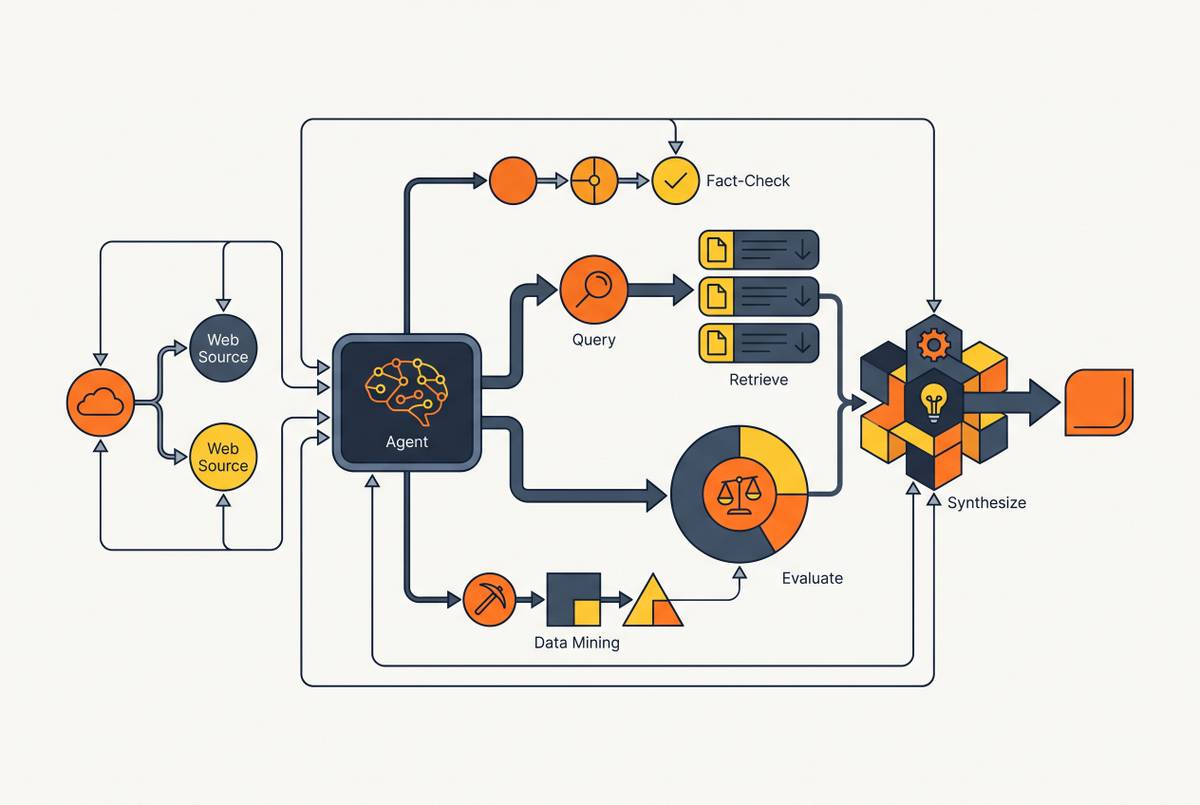
The highest-leverage single change a team can make is to stop asking a model to recall facts from memory and instead place the facts directly in front of it at the moment it answers. Retrieval-augmented generation does this by construction: the model's job changes from knowing the answer to reading and synthesizing a supplied answer, and that change in job description is what makes the difference measurable rather than aspirational.
Zep's agent hallucination guide frames the contrast in its simplest form. Ask an ungrounded model who a company's CFO is. It answers from its weights: confident, fluent, and fabricated if the name was never reliably encoded. Give that same model retrieved, sourced facts, a page from a filing, a press release. It answers from what it was handed: grounded and cited. The prompt does not change. The reliability of the output changes categorically, because the task the model is actually performing has changed.
What separates production-grade retrieval-augmented generation from a naive version of the same idea is the citation contract attached to it. In a strict implementation, every factual claim in the output must reference a retrieved passage by its ID, and the model must abstain when no retrieved passage supports the claim it is about to make. That constraint catches the dominant fabrication failure mode at the moment of generation, rather than leaving it to be caught later in a review process that may never happen. FutureAGI's 2026 hallucination reduction guide ranks this exact pattern, retrieval-augmented generation paired with a strict citation contract, as the single highest-lift strategy available against unsupported claims, ahead of live evaluation and guardrail systems, ahead of uncertainty routing, and ahead of domain-specific fine-tuning. That ranking lines up with a broader pattern FutureAGI's analysis documents: retrieval-augmented generation delivers a 30 to 70 percent reduction in hallucination rates across the domains studied.
The gain is not confined to one model family or one vendor's stack. A published NCBI study in clinical settings found that adding a retrieval step substantially increased accuracy for both GPT-4 and Claude 3 Sonnet relative to their closed-book baselines, two different model architectures from two different labs, moving in the same direction once grounding was introduced. The improvement comes from the infrastructure surrounding the model, not from any particular model's internal tuning, which explains the consistency across models.
Industry framing has shifted to match that evidence. Analysis documented by The Neural Base describes a reclassification underway in how practitioners talk about the problem: hallucination moving from an "unsolved problem" and a "fundamental limitation" of the technology to a "symptom of ungrounded systems." Hallucination stops being an open research question the moment a system is built to supply facts rather than ask a model to remember them. It becomes something closer to an infrastructure metric: a rate that depends on how retrieval was built, how citations were enforced, and how fresh the underlying sources were.
Where grounded retrieval still fails
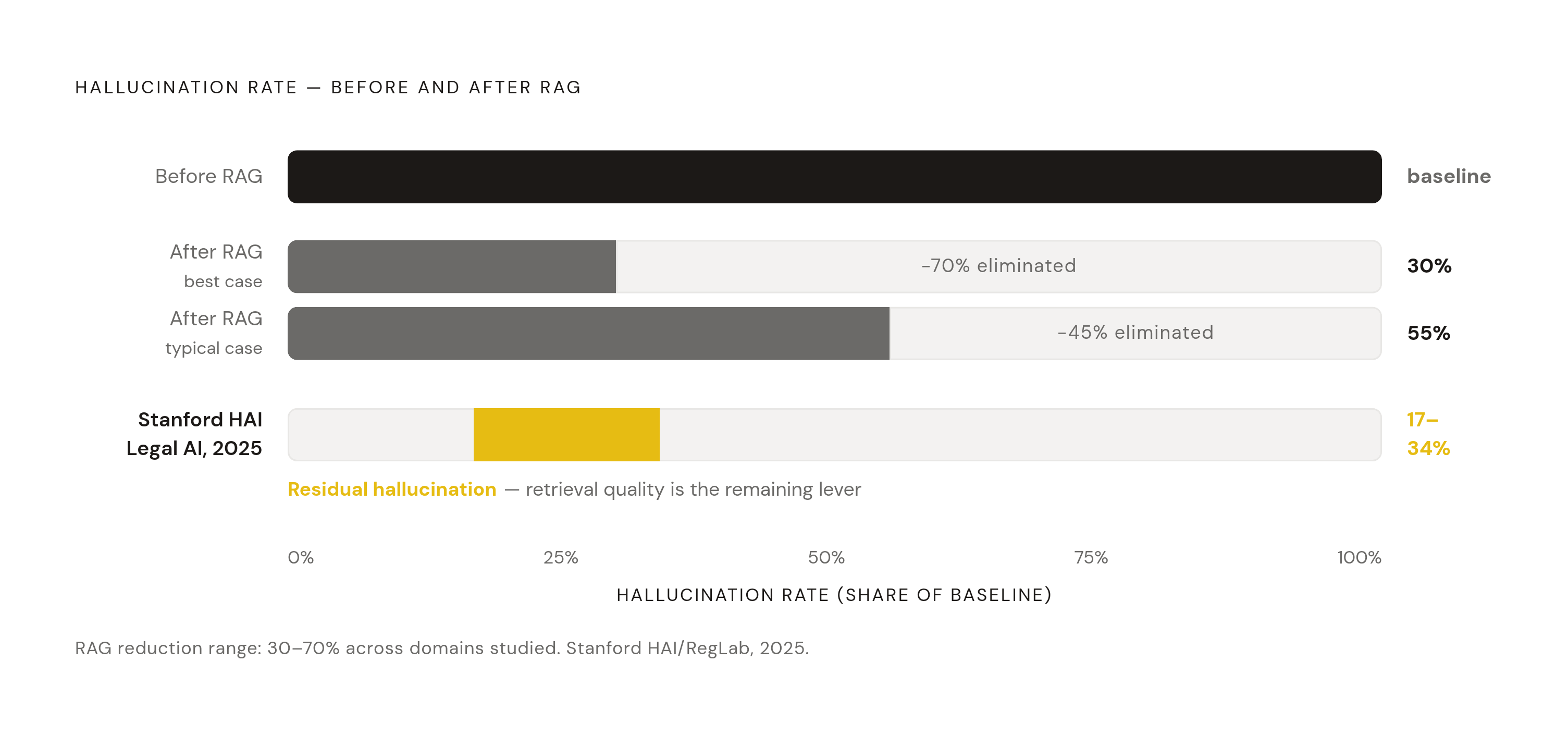
Search grounding does not eliminate hallucination. It relocates the point where failure happens, from the model's weights to the retrieval pipeline feeding it, and that relocation is progress precisely because a pipeline can be inspected, measured, and fixed in ways that a model's internal weights cannot.
The 2025 Stanford HAI and RegLab study "Hallucination-Free? Assessing the Reliability of Leading AI Legal Research Tools" is the sobering data point here: commercial legal AI tools built on retrieval-augmented generation still hallucinated on 17 to 34 percent of queries tested. These are specialized, well-resourced products, built specifically to ground legal claims in retrieved case law, and the hallucination rate did not drop to zero. It dropped to a rate low enough to be useful and high enough to demand continued scrutiny. That finding earns the architecture credibility precisely because it does not overclaim: grounding is the correct intervention, and retrieval quality is the lever that determines how well it works.
One might assume that simply expanding the context window, feeding a model more retrieved material rather than retrieving more precisely, would solve the remaining gap. The evidence runs the other way. Liu and colleagues, in "Lost in the Middle," found that model performance peaks when relevant facts sit at the very start or the very end of the context window, and degrades measurably when those facts are buried in the middle of a long context. Dumping an entire chat history or a large pile of retrieved chunks into the prompt does not guarantee the model will notice the one fact that matters. It dilutes the signal and raises the odds that the model leans back on its own priors instead of the data it was actually given. Long context is a different problem from targeted retrieval, with its own failure mode.
What that leaves is a plain diagnosis: retrieval quality is the binding constraint on whether grounding delivers its promised reduction in hallucination. A system with poor document chunking or weak vector similarity scoring will still produce an answer that looks grounded, carries a citation, and reads with the same confidence as a well-grounded one, while resting on a retrieved passage that does not actually support the claim. The architecture is sound. The input feeding it is not, and the output inherits that weakness without flagging it.
A related anti-pattern compounds the risk. Some systems cache by generated response rather than by the retrieved source that produced it. Caching the response rather than the source means that once a hallucination slips through, the system serves that same fabrication to every subsequent user who asks a similar question, with the full confidence of a grounded, cited answer. The cache treats a correct grounded answer and an incorrect one identically. It only knows that an answer was produced once and is cheaper to serve again.
None of this argues against search grounding as the right intervention. It argues for where developers should actually spend their engineering effort: not on a better prompt, and not on a bigger model, but on the retrieval pipeline itself. That is the subject of the next section.
Implementation decisions that determine whether grounding holds
Two retrieval-augmented systems built on the same underlying model can produce wildly different hallucination rates, and the gap between them is almost entirely a matter of implementation choices that teams tend to treat as defaults rather than decisions: how documents are chunked, what similarity threshold retrieval enforces, and whether grounding happens at every step of a multi-step task or only at the final output.
Chunking strategy sets the ceiling on everything downstream. Naive fixed-size chunking splits a document at arbitrary token boundaries, which can sever a sentence from the clause that explains it, or separate a claim from the citation that supports it. Semantic chunking, which respects sentence and paragraph boundaries, keeps a retrieved unit coherent enough to actually support the claim it gets attached to. A retrieval system can have excellent vector search and still fail if the units it searches over were cut apart from their own context before indexing ever began.
Retrieval configuration is the next lever. A strict cosine similarity threshold, above 0.7, combined with an explicit cap on how many chunks get retrieved per query (top_k), keeps the model from drowning in loosely related material. Over-contextualizing is not a safe default. Passing too many weakly relevant chunks into the prompt is roughly as damaging as passing too few tightly relevant ones, because both outcomes leave the model guessing which supplied fact, if any, actually answers the question. Hybrid retrieval, combining sparse keyword-based search with dense vector search, improves recall meaningfully over dense retrieval alone, because it catches documents that share the right keywords with a query but sit too far apart in embedding space for a pure vector search to surface them.
For agents that work in multiple steps, grounding has to happen at every step. If a step produces a fact that a later step will depend on, that fact needs to be checked against a fresh search before the agent moves forward. An error introduced early and never checked does not stay contained. It compounds, because each subsequent step treats the earlier, unverified output as established fact. Verification loops that cross-reference claims before the agent acts on them catch grounding hallucination at precisely the point where it would otherwise propagate into a downstream tool call or decision that is harder to unwind.
Pre-retrieval runs a search before every single call to the model, with results automatically folded into context, rather than letting the model decide when a search is warranted. This guarantees that every response is grounded, because the model is never given the chance to skip the search step. It adds latency and cost to queries that may not have needed a fresh lookup. The trade-off is deliberate: use pre-retrieval when factual accuracy carries the highest priority and the cost of an ungrounded answer outweighs the cost of an unnecessary search, particularly in domains where a model's own judgment about whether to search cannot be trusted.
Layering an uncertainty check on top of all of this amplifies the gain further. Using token-level log probabilities, or measuring disagreement across multiple sampled decodes of the same prompt, gives a system a signal for when an answer is low-confidence even after retrieval. Low-confidence answers can then be routed to a stronger model, returned as a refusal, or sent to a human reviewer, instead of being served with the same unearned confidence as a well-grounded response.
What real-time web search adds that a static vector store cannot
A vector store built from documents indexed last month is a real improvement over no grounding at all, and it still produces stale answers the moment reality moves past its last ingestion run. The property that separates genuinely agent-ready search infrastructure from a static knowledge base is freshness: whether the facts a system retrieves reflect current reality at the moment a query is asked, rather than a snapshot taken whenever someone last ran an indexing job.
This is the same structural problem identified in the opening section, recurring at a smaller scale. A model's parametric memory is frozen at a training cutoff; that is why it fails on recent events. A static vector store is frozen at its last update, which produces the identical failure on a shorter timescale. Real-time web search is the intervention that removes that ceiling entirely, because it retrieves against the live state of the web rather than against a copy of it taken at some earlier point.
Microsoft built directly toward this gap. Web IQ, unveiled at Build 2026, runs on the Bing search index to supply agents with up-to-date general information, and it is built differently from a document-delivery model: rather than handing an entire document to a querying agent, which forces the model to process the same long document repeatedly across calls and drives up inference cost, Web IQ is designed to integrate with Model Context Protocol servers, tying an agent's output directly to live data rather than to a cached copy of it.
The infrastructure question for developers is whether the tools available are built for agent workloads specifically, rather than adapted from consumer search. A set of APIs purpose-built for this, spanning web search, answer synthesis, content retrieval, deep research, and finance-specific research, is designed around the latency and accuracy demands that production agents impose, which are a different set of requirements than a person typing a query into a browser. One such Research API claimed the top position on the DeepSearchQA benchmark at its February 2026 launch, though independent leaderboards later in 2026 place other systems ahead of it on that measure. A corresponding Finance Research API ranks first on the T2 historical lookup sub-benchmark within FinSearchComp. Numbers like these matter less as marketing and more as the kind of verifiable evidence developers can actually check, which is the entire point of treating hallucination as a measurable infrastructure problem rather than an article of faith about which vendor to trust.
The remaining question for any team evaluating these tools is whether the operational baseline holds up under production load. Zero data retention, SOC2 certification, and low-latency performance (1659ms at the 99th percentile) should be treated as the floor for enterprise search infrastructure, not as premium features to negotiate separately. A search layer that cannot meet that bar adds a new bottleneck of its own, even if it solves the freshness problem that a static vector store never could.