Multi-Step Research Agent Design Patterns
Architecture, not model choice, determines whether research agents succeed at scale.
Multi-Step Research Agent Design Patterns.
Why architecture, not model choice, determines whether a multi-step research agent works
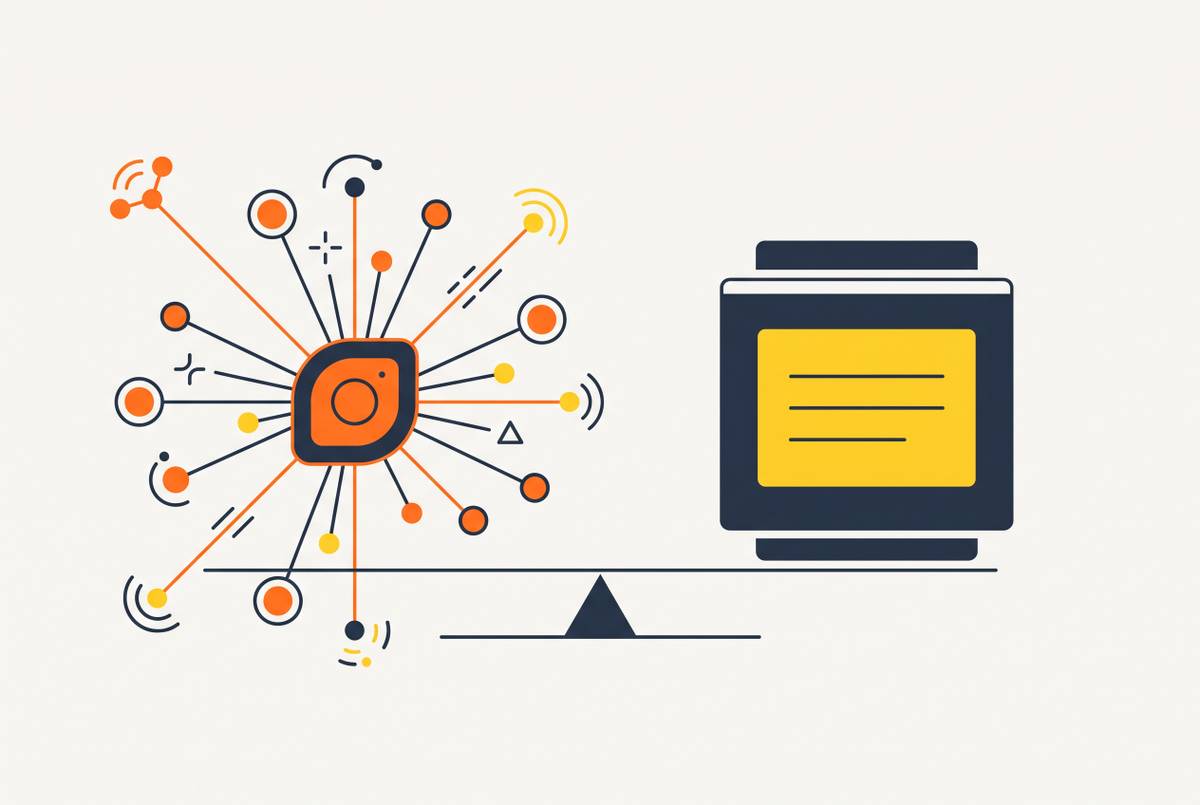
Multi-step research agents succeed or fail based on the architectural patterns that govern how they plan, search, reflect, and synthesize, not on which large language model sits at the center of the system. That distinction matters more now than it did even a year ago, because the deployment window is closing fast: Gartner figures cited across multiple 2026 sources put AI agent adoption in enterprise applications at 40% by 2026, up from under 5% in 2025. That is not a gradual ramp; it's a wave already breaking.
But adoption and success are not the same thing. A 2026 analysis found that over 40% of agentic AI projects could be canceled by 2027, largely due to cost overruns and scaling complexity that teams didn't anticipate 5 Agent Design Patterns Every Developer Needs to Know in 2026 - DEV C…. Companies are clearly building research agents. The question is why so many of these builds stall out anyway.
The pattern occurs the same way in almost every case. A team picks a capable model, wires together a few search calls, and the thing works fine on a demo question. That failure isn't a model problem. It's a structural one, rooted in how the agent plans its steps, retrieves evidence, checks its own work, and stitches everything into a final answer⟴. LangChain's 2026 survey backs this up directly: 57% of practitioners already run agents in production, but output quality (32% of respondents) and latency (20%) rank as the top two blockers, and both are architectural problems that a bigger model can't fix on its own.
This piece is not a model comparison, and it's not a tutorial on chaining API calls. It's a structural map: which design pattern solves which failure mode, and how to know which one a given research workflow actually needs.
What makes research agents structurally different from general-purpose agents
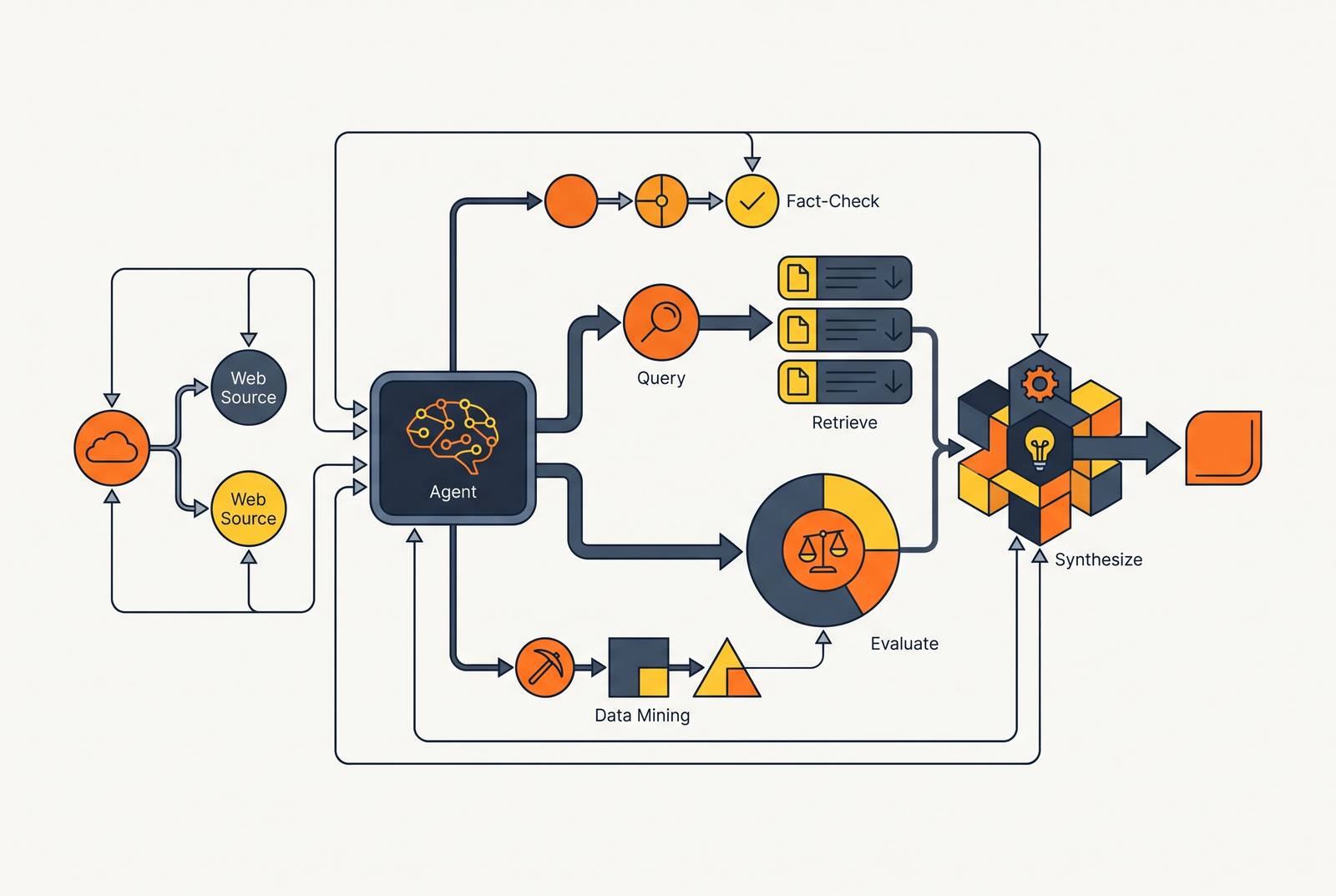
A research agent's job isn't to answer a question. It's to take an ambiguous objective, break it into sub-queries, go retrieve live evidence for each one, reconcile whatever conflicts show up across sources, and produce a synthesis that cites where every claim came from. That's a fundamentally different task than completing a single well-defined action, and it's why research agents carry more internal structure than a general-purpose assistant needs.
Two product shapes dominate how these systems get built. Interactive workflows run in real time alongside a user, so they're latency-sensitive and tend to favor narrow, targeted retrieval over broad exploration. Background tasks run independently, often against genuinely ambiguous, multi-topic questions that require deep retrieval and the orchestration of many tool calls across a longer time horizon. These demand different architectural priorities: interactive workflows need fast, interpretable reasoning loops, while background tasks need planning stability and the ability to fan out across parallel threads.
Why doesn't standard retrieval-augmented generation cover this? RAG is good at single-turn grounding, pulling a document and answering a question against it. But as models get better at reasoning and tool use, the bottleneck stops being "can the model find a document" and starts being "can the system plan, coordinate, and execute across many retrieval steps in sequence". Simply retrieving more documents doesn't solve a coordination problem.
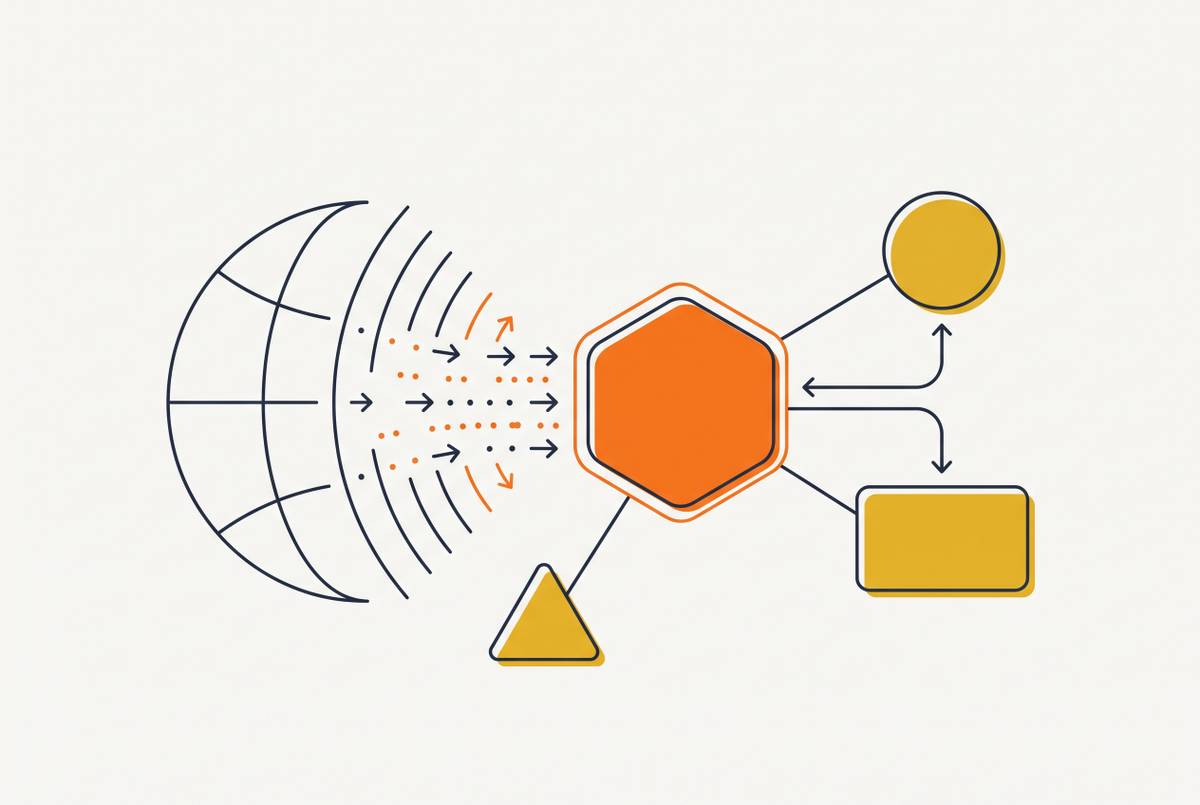
There's also a live-web dimension that static-index RAG systems never had to deal with. A research agent making real-time queries against the open web runs into rate limits, latency that compounds call after call, and freshness constraints, since the information it needs might not have existed when any index was last built. The search API layer is a first-class architectural concern in this discussion, and later sections come back to why.
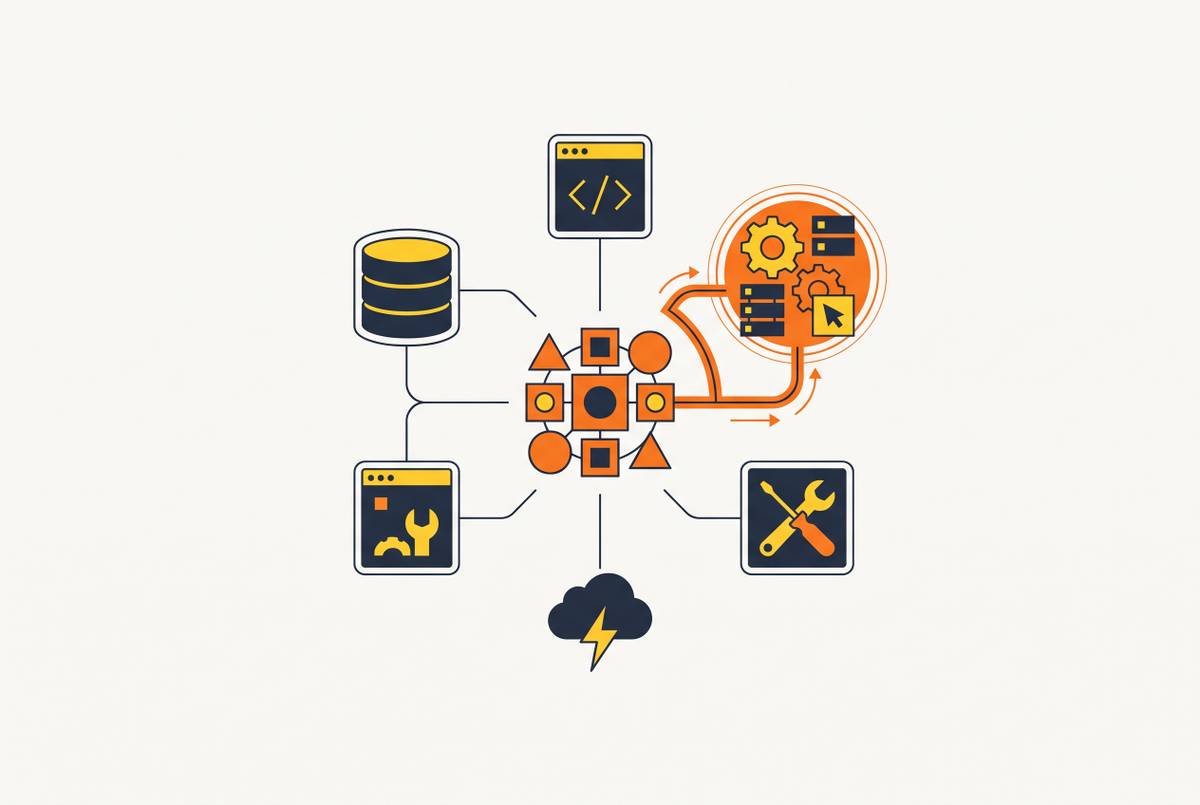
With that structural picture in place, the rest of this piece works through the four patterns that make research agents behave reliably: planning, ReAct, reflection, and orchestrator-worker parallelism https://you.com/resources/introducing-the-finance-research-api-agentic-research-no-infra-required.
The planning pattern: separating what to do from how to do it
Planning, as a design pattern, means the system doesn't act the moment it receives an objective. Instead, it first breaks that objective into an ordered sequence of sub-tasks, and only starts executing once that structure exists. Without a plan, dependencies get missed, and the agent drifts or loops back on itself.
Why does this matter specifically for research tasks? Because complex questions have dependencies baked in. Sub-question B often can't be answered without evidence gathered while answering sub-question A. Acting without a plan means the agent either answers things out of order or ends up in circular retrieval, chasing its own tail across search calls that don't build on each other.
The Plan-and-Execute variant of this pattern splits the labor cleanly: one capable planner agent produces the full task sequence, and separate executor agents handle individual sub-tasks without needing to hold the entire strategic objective in their own context. That division lowers the cognitive load on each individual agent and reduces the risk that one confused executor derails the whole pipeline — the difference between a system that finishes its job and one that technically runs but rarely lands.
Mature implementations don't stop at the initial plan. They build in re-planning checkpoints, so if a dependency fails or a retrieved source contradicts an assumption baked into the original plan, the system can adjust mid-flight rather than plowing forward with a plan that's already wrong.
Model spend isn't evenly distributed across a research pipeline. Once a planner has done the hard cognitive work of structuring the task, the execution steps themselves can often run on smaller, cheaper models, and planning-first architectures let teams put expensive reasoning where it actually earns its keep.
None of this is fringe experimentation anymore. Google Cloud's Architecture Center codifies planning as a distinct design pattern, signaling that this is no longer an experimental approach A Two-Dimensional Framework for AI Agent Design Patterns. Planning fits best where sub-task dependencies are clear upfront: multi-topic research questions, workflows where step N cannot begin until step N-1 returns its result.
The ReAct pattern: keeping reasoning and evidence tightly coupled
Planning assumes the task can be decomposed in advance. What happens when it can't?
ReAct answers that question with a loop: Thought, then Action, then Observation, then back to Thought. The agent states what it needs, takes an action like a search call or an API request, observes what comes back, and updates its reasoning before deciding what to do next. It's iterative by design, and that's precisely the point.
Exploratory research rarely has a knowable structure at the outset. If the full sub-task breakdown can't be determined before retrieval even starts, a fixed plan becomes a liability rather than an asset, because the agent is locked into a sequence that made sense before it knew anything. ReAct sidesteps that by letting the agent's direction shift based on what it actually finds, one observation at a time.
This has a secondary benefit that's easy to undersell: hallucination reduction. Because each reasoning step has to ground itself in an observation before the next thought happens, the agent can't quietly compound a chain of unverified assumptions the way it might if it were reasoning purely from its own prior output.
There's an interpretability payoff too. Every decision the agent makes gets logged as an explicit thought, which means the whole reasoning trail is auditable after the fact. That matters enormously in regulated industries, or in any context where the research output will eventually be cited externally and someone might ask "how did the system get to this conclusion." ReAct remains one of the most widely deployed patterns specifically because interpretability is often non-negotiable.
None of this comes free, though. Each loop iteration means another round of LLM calls, and verbose thought chains eat up tokens and add up latency fast. Latency showed up as 20% of deployment blockers in LangChain's 2026 survey. It's not purely an infrastructure problem — it's a direct consequence of choosing a pattern that trades speed for adaptiveness and auditability.
So the practical line between planning and ReAct comes down to how confident the team is about decomposing the task before retrieval starts. Use Plan-and-Execute when the breakdown can be done upfront with real confidence. Use ReAct when the research question is genuinely open-ended and the retrieval path only reveals itself as results come in.
The reflection pattern: catching errors before they propagate into the final synthesis
Reflection works differently from either pattern above. One agent generates an initial output, and then a second step, sometimes the same agent, sometimes a separate one, reviews that output against a set of criteria: accuracy, completeness, whether it actually matches what the sources said. The output either gets approved or gets flagged for revision.
Why does this matter so specifically for research tasks? Multi-step retrieval accumulates small errors the way a long conversation accumulates minor misunderstandings. A synthesized answer can read as perfectly coherent while quietly misrepresenting one of the sources it drew from, and nothing about fluent prose signals that misrepresentation to a reader. Reflection is the structural check that catches this kind of drift before it ships.
The performance numbers here are striking. Reflection alone raises coding benchmark accuracy from 80% up to 91%, and when paired with external verification tools, produces accuracy gains of 10 to 30 percentage points. That's a wide enough range that reflection should be treated as close to mandatory for anything high-stakes, rather than a nice-to-have polish step.
One particular variant, the Evaluator-Optimizer setup, assigns a dedicated evaluator agent to score the output using rubrics, reference answers, or an LLM-as-judge approach. Separating the "doer" from the "judge" prevents an agent grading its own homework from tending toward self-serving revision loops where it just convinces itself the first draft was fine.
Reflection also happens to be the natural home for citation enforcement. Before an answer goes out the door, the reflection step can verify that every claim in the synthesis actually traces back to a retrieved source URL. That's the same structural check, just pointed at attribution instead of factual accuracy.
Reflection earns its cost on outputs that get acted on, cited, or shared, where a missed source or a misattributed claim has consequences downstream. It's less valuable for simple factual lookups or latency-constrained interactive workflows, where the added round-trip just slows things down without much payoff.
The orchestrator-worker pattern: running multiple research threads in parallel
Some research tasks aren't sequential at all. They're a bundle of genuinely independent threads that happen to share a final report.
The orchestrator-worker pattern handles exactly that shape. An orchestrator decomposes the overall task, hands heterogeneous subtasks off to worker agents that run concurrently, and then assembles their outputs once everything comes back. The wall-clock time for the whole job ends up bounded by the slowest single worker, not the sum of every worker's runtime, which is the entire point.
Where does this actually pay off? Multi-topic reports where domain A, domain B, and domain C can all be researched at the same time. Competitive landscape analyses across several unrelated companies. Any workflow where the sub-tasks genuinely don't depend on one another. That independence requirement isn't a minor caveat: forcing parallelism onto a workflow that's actually sequential just adds coordination overhead without buying any speed, because the workers end up waiting on each other anyway.
Cost is the other side of this ledger. Parallel LLM calls multiply spend, so orchestrator-worker architectures are explicitly trading budget for speed, and teams should run the math on whether the wall-clock savings actually justify what the inference bill looks like afterward. The orchestrator and the workers don't have to run the same model, which is an efficiency lever worth pulling. A capable planning model can direct a fleet of cheaper, faster executors, extending the same cost logic that makes Plan-and-Execute efficient into full multi-agent territory.
Multi-agent systems only pay off when the underlying task is genuinely separable. The practical advice is to start with a single agent and only graduate to orchestrator-worker complexity once the task structure actually demands it. Reaching for parallelism because it sounds sophisticated, rather than because the workflow calls for it, tends to multiply debugging headaches without any guaranteed improvement in output quality.
How the search API layer determines whether these patterns hold up in production
None of these four patterns matter if the underlying retrieval infrastructure can't keep pace, and this is where a lot of otherwise sound architecture quietly falls apart https://you.com/resources/introducing-the-finance-research-api-agentic-research-no-infra-required.
Traditional search APIs were built with humans in mind: a person types a query, waits a second, reads results, maybe types another. That rhythm imposes rate limits that force synchronous, query-wait-parse-query cycles, and every additional retrieval step in that chain adds to total latency. Plan-and-Execute achieves a 3.6× speedup over reactive approaches.
AI-native search APIs need to deliver a specific set of capabilities to actually support these patterns: solid extraction quality even on JavaScript-heavy or CAPTCHA-protected pages, and source URLs returned alongside excerpts, because citation propagation through the pipeline isn't optional for anything calling itself a research agent.
Per LangChain's survey, 57% of AI practitioners already run agents in production, with output quality (32%) and latency (20%) as the top two deployment blockers. AI-native search APIs return content that's already LLM-ready, with extraction handled inside the response itself. The practical difference is whether the agent's own pipeline has to do additional parsing work before the model can use anything it got back, and that parsing overhead is exactly the kind of thing that turns a fast-looking demo into a slow production system.
This isn't hypothetical risk, either. Microsoft retired its Bing Search APIs on August 11, 2025, pointing developers instead toward Grounding with Bing Search inside Azure AI Agents. Teams that had built their retrieval backbone entirely around Bing found out the hard way what single-provider dependency actually costs when the provider changes course, and that event pushed a lot of teams toward independent, purpose-built search infrastructure.
Attribution deserves its own mention here, because it's the dimension most developers skip during prototyping and only discover matters once someone challenges a research output. Search APIs that return source URLs by default let citations flow straight through the pipeline into the final synthesis. APIs that don't require teams to bolt on extra extraction logic just to reconstruct where a claim came from, which is exactly the kind of thing nobody notices until it's missing.
How to match pattern to workflow: the decision logic builders need
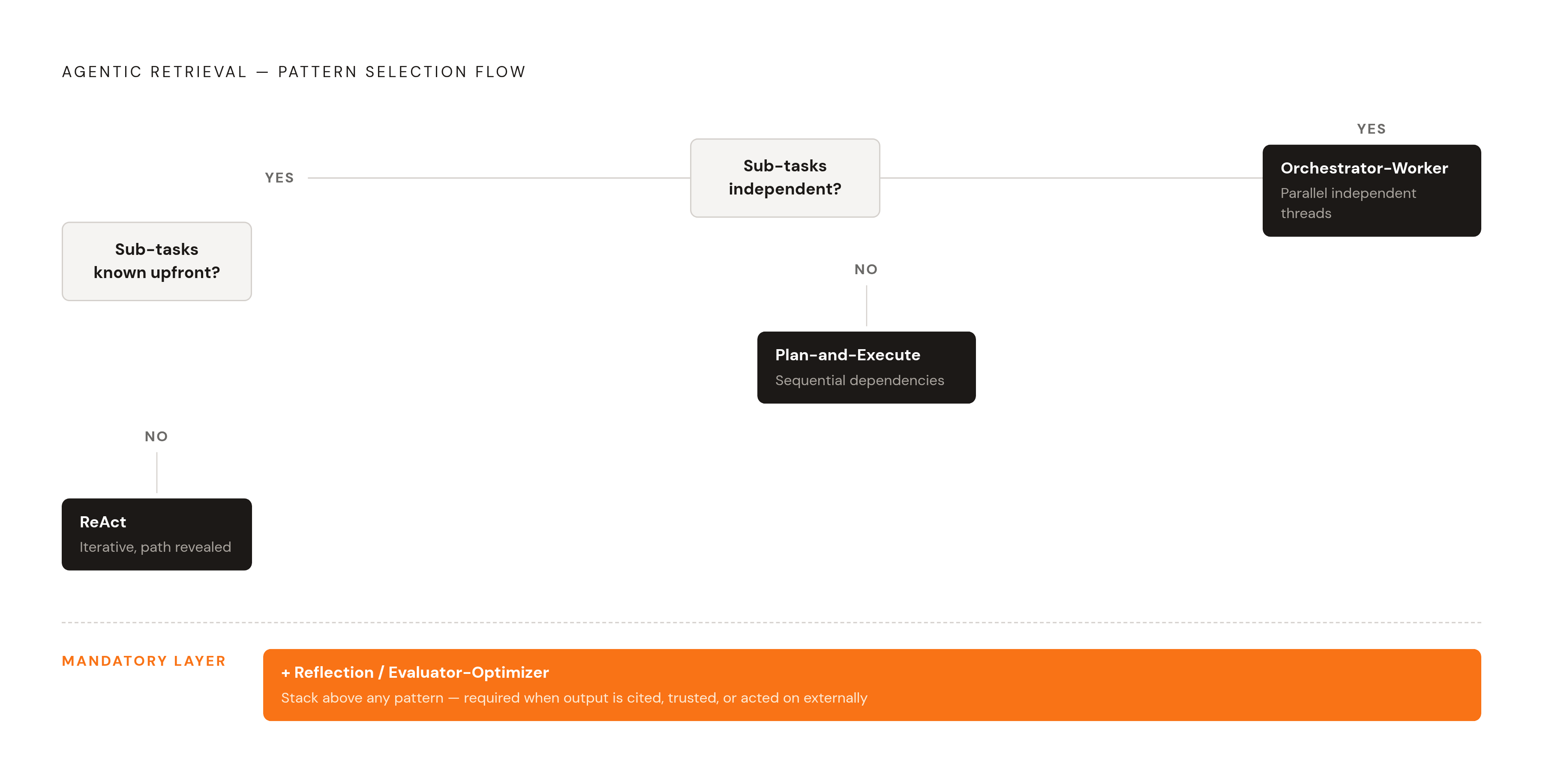
So which pattern fits which job? Google Cloud's Architecture Center frames the decision around a small set of questions to ask about any research workflow. Are the sub-tasks independent or do they depend on each other sequentially? Does the output need to be auditable step by step, or does only the final answer matter? What do the latency and cost budgets actually allow? And does any point in the workflow require a human to sign off before proceeding?
The mapping that falls out of those questions is fairly direct. Structured research with known sub-tasks calls for Plan-and-Execute, with re-planning checkpoints added for anything long-horizon. Open-ended exploratory research, where the path only reveals itself as results come back, calls for ReAct, accepting the higher token cost in exchange for interpretability. Multi-topic reports built from genuinely independent domain threads call for Orchestrator-Worker, provided the independence has actually been verified rather than assumed. Anything that needs to be trusted and cited externally should run Reflection or Evaluator-Optimizer as a layer on top of whatever retrieval pattern is doing the underlying work. And high-stakes decisions need Human-in-the-Loop checkpoints, particularly at the re-planning junctures where a wrong turn does the most damage.
One might argue this reads like a menu where builders pick exactly one item. In practice, that's rarely how production systems look. Composition is the norm, not the exception: a lot of working research agents run Plan-and-Execute at the top level, with ReAct loops inside each individual executor, topped off with a Reflection pass over the final synthesized output. The patterns are layers that stack.
The start-simple heuristic still holds even inside that composed reality. Start with a single agent, and only add multi-agent complexity once the task structure genuinely demands it, because premature complexity multiplies both cost and debugging surface area without any guarantee that quality actually improves. It's tempting to reach for the most sophisticated architecture available. That temptation is usually the wrong instinct.
The tooling to build any of this has matured well past the experimental stage, too. LangGraph and LangGraph.js have reached stable, versioned releases as of 2026, and are already handling production workloads across teams running dozens of concurrent agent instances. That's a meaningful shift from a couple of years ago, when most of these patterns lived mainly in papers and conference talks.
Whatever combination a team lands on, the obligation doesn't end at implementation. It ends at measurement. Pull 50 to 100 real production queries from actual logs, run each candidate configuration head-to-head using identical agents and identical prompts, and change only the search API layer between runs parallel.ai. An architectural choice becomes something a team can actually defend, with numbers, the next time someone asks why the system is built the way it is.