Grounded AI Answers vs Static LLM Responses in Production
Grounded retrieval prevents hallucinations by replacing model guessing with sourced facts.

The core problem with static LLM responses in production is not that models are bad at reasoning; it is that they are designed to predict plausible tokens, and plausible is not the same as true. In production environments, that architecture can make a system untrustworthy for a customer-facing question, and the evidence now spans benchmark data, incident reports, and infrastructure choices that enterprises are making in 2026.
Why static LLM responses fail in production
Large language models are next-token predictors, not reasoning engines that occasionally slip. They are next-token predictors trained to output the statistically most plausible continuation of a prompt, and plausibility is a different property from truth. That distinction sounds academic until it plays out in a support ticket or a financial memo, where a fluent, confident sentence turns out to be fabricated from nothing more than pattern completion.
The incentive structure makes this worse, not better, as models improve. Research from Kalai and colleagues at OpenAI and Georgia Tech frames hallucination as a predictable consequence of how models are trained and graded. Evaluation regimes reward a confident wrong answer over an honest "I don't know," so across enough training runs, models learn to guess rather than abstain. The AA-Omniscience benchmark, run in November 2025, put a number on the consequence: even frontier models score poorly on knowledge reliability, and GPT-5.5, despite leading on raw accuracy, ranks only third on the benchmark's reliability index because it guesses instead of holding back when it does not know. Swapping in a smarter model just produces a more articulate guesser, not a fix to the underlying incentive problem.
Two separate failure types get lumped together under "hallucination," and treating them as one problem creates blind spots. Factuality hallucinations occur when an output contradicts the real world; the fix is retrieval or abstention. Faithfulness hallucinations occur when an output contradicts the context the model was actually handed, and no amount of external grounding fixes that on its own; it requires tighter retrieval and verification layered on top. A retrieval system can solve the first problem completely and still leave the second one live. Compounding this, Farquhar and colleagues, publishing in Nature in 2024, showed that a large share of hallucinations are confabulations: arbitrary, incorrect generations that shift from one run to the next even on an identical prompt. Because these are unstable rather than systematic, they can be flagged just by sampling a model multiple times and measuring how much the answers disagree with each other semantically, without touching any outside knowledge source.
Even when a model is handed the right information, where that information sits in the prompt changes how reliably the model uses it. Liu and colleagues, in the widely cited "Lost in the Middle" study, found that models perform best when relevant facts appear at the very start or the very end of the context window, and performance degrades measurably when the same facts are buried in the middle, a pattern that holds even in models built for long context. The practical implication cuts against a common instinct: dumping the entire retrieval corpus into a prompt does not make an agent smarter, it dilutes the signal and raises the odds the model falls back on its own internal priors instead of the sourced content. Less context, placed deliberately, outperforms more context scattered carelessly.
None of this describes a bug waiting for a patch. It describes an architecture doing what it was built to do: predict, guess when uncertain, and drift when relevant facts are hard to locate inside a prompt. If the failure sits in the architecture, so must the correction, and that correction is what the rest of this piece works through.
How hallucination rates change across task types
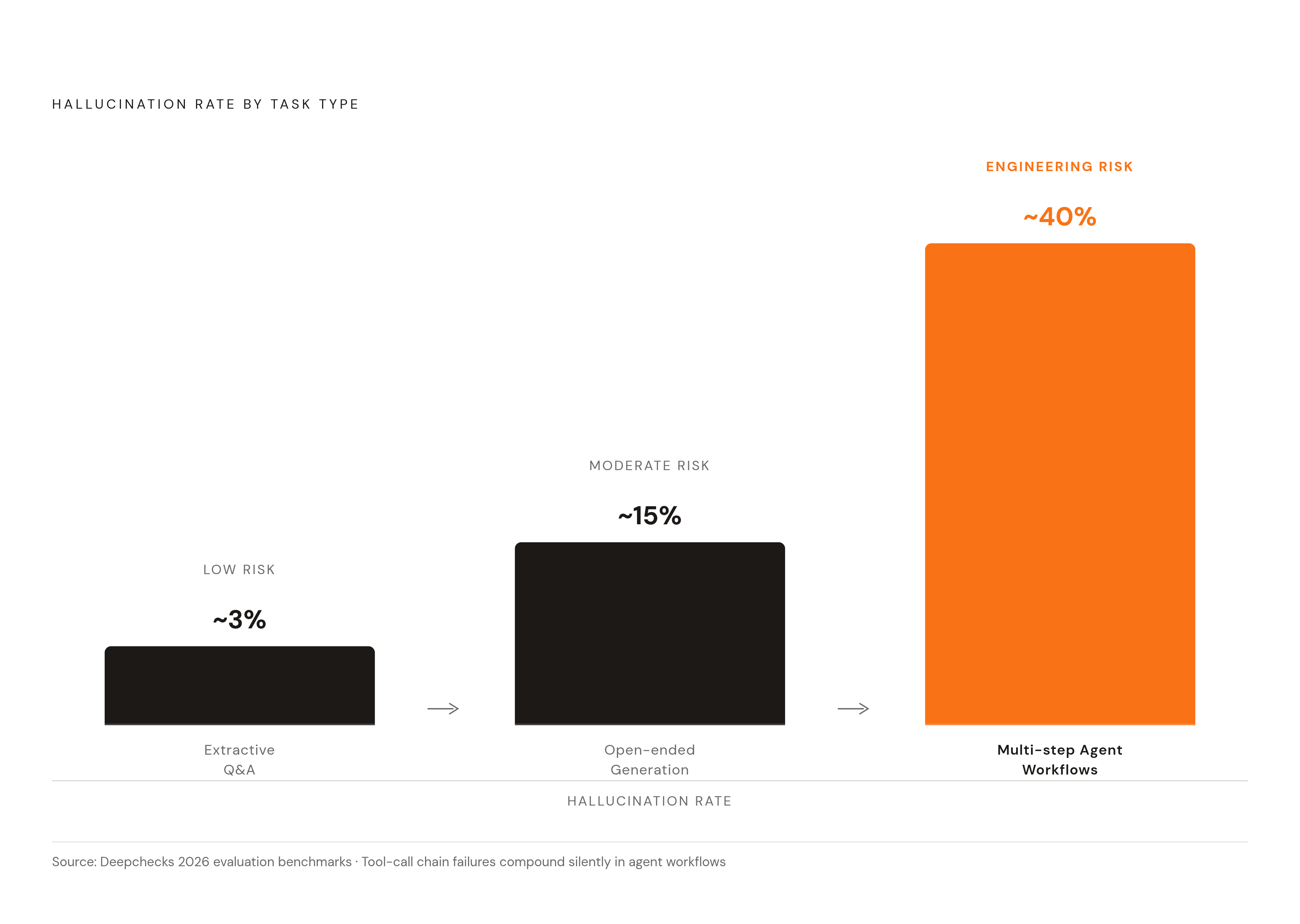
Hallucination is not a single number a team can budget against. It scales with how much reasoning a task demands and how many steps stand between a question and an answer. Deepchecks' 2026 evaluation benchmarks show a clear gradient: extractive question-answering systems, where the model largely locates and repeats a fact, hallucinate on only a small fraction of responses. Open-ended generation, where the model has to synthesize rather than retrieve, sees a meaningfully higher rate. Multi-step agent workflows, where a model chains together tool calls and reasons across intermediate results, reach substantially elevated hallucination rates on those tool-call chains.
That gradient matters because most agent failures in production are retrieval failures rather than model-quality failures. Often the right fact simply was not in front of the model at the moment it needed to reason over it. The postmortem shows a retrieval gap rather than a reasoning gap.
The shape of the failure has also shifted as agent deployments have gotten more sophisticated. The failure modes have expanded beyond simple factual fabrication: FutureAGI's 2026 analysis found hallucination now includes free-form fabrication, citation invention (now the dominant failure mode for research and legal agents), and tool argument spoofing, where the model invents arguments when calling a tool, causing silent corruption inside an agent loop. Tool argument spoofing deserves particular attention because it produces no visible error. The agent does not crash or flag anything, it just keeps executing on bad inputs, and the corruption compounds with every subsequent step. Much of the gap between simple hallucination and this more dangerous silent-failure category traces back to multi-step delegation chains, where one bad tool call feeds the next without anyone checking the seams.
The financial exposure behind these numbers is not abstract. Arthur AI's 2026 data puts the share of enterprises that experienced a customer-facing incident tied to an LLM hallucination in the past year at roughly a third, with remediation costs in regulated industries reaching significant sums per incident. Once a team can see where its own workload sits on that gradient, extractive QA at the low-risk end, autonomous multi-step agents at the high-risk end, the argument for grounding becomes an engineering requirement tied to a specific, quantifiable risk.
How grounding works mechanically: retrieval replacing recall
Grounding changes what the model is asked to do. Instead of asking it to generate a fact from the weights it learned during training, grounding hands it the fact directly and asks it to reason over that fact. Recall is replaced with retrieval, and that substitution moves the entire failure mode from fabrication to verification.
Zep's documentation lays out the mechanism in a single side-by-side example that makes the abstraction concrete. Zep's documentation shows two paths for the same prompt: the ungrounded path produces a confident, fabricated CFO name from the model's weights, while the grounded path retrieves sourced facts and returns a citable answer. Same prompt, same model, two entirely different failure profiles, and the only variable that changed was whether the model had something real to point to.
That is the same pattern that governs how agents use search tools generally. Agents call search APIs as tools when they need external information, receiving relevant excerpts to reason over rather than generating from training data alone. Real-time web search gives the model current facts it can cite, shifting the operation from recall, which is inherently prone to fabrication, to retrieval, which is grounded in an external, checkable source.
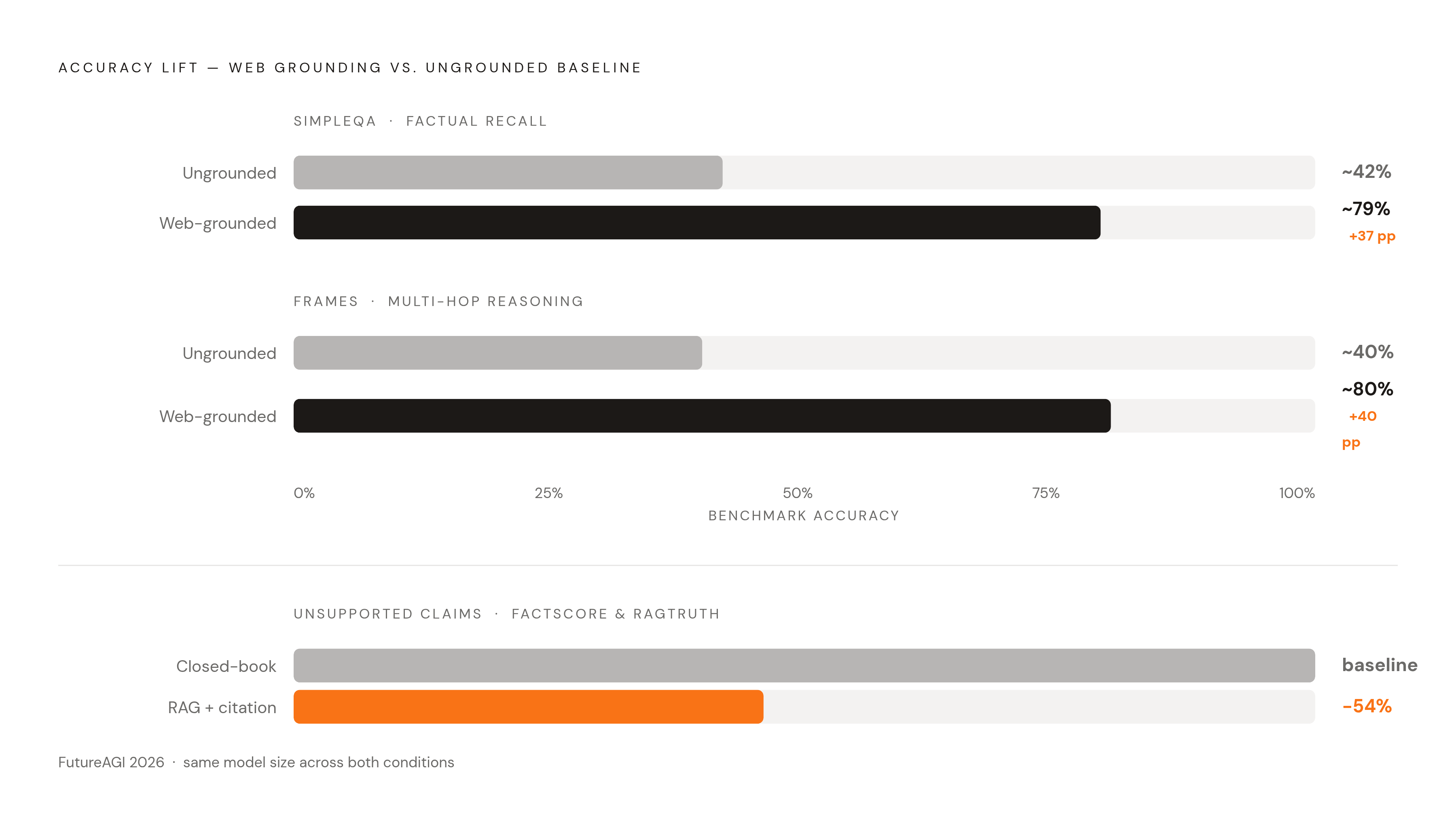
The benchmark evidence backs the mechanism up substantially. On SimpleQA, which tests factual recall, and FRAMES, which tests multi-hop reasoning across several facts, web-grounded systems post accuracy gains of 25 to 40 percentage points over ungrounded baselines. The largest gains cluster around queries that need current information or require cross-referencing several facts at once, which is precisely where a model relying only on training data tends to produce its most confident, most wrong answers. FutureAGI's review of public benchmarks including FActScore and RAGTruth finds the same pattern from a different angle: a tightly built RAG pipeline paired with a strict citation contract cuts unsupported claims by half or more compared to a closed-book baseline running the same size model.
The citation contract is the part of this that turns retrieval from a nice-to-have information source into an actual hallucination control. Under a strict contract, every factual claim in the output must reference a retrieved passage by its ID, and the model must abstain rather than answer if no retrieved passage supports the claim. That rule catches the dominant fabrication failure mode at the moment the model is generating text, rather than relying on a human reviewer to catch it after the fact. Grounding also addresses a failure static models structurally cannot fix on their own: temporal hallucination, the confident assertion that outdated information is current, which persists because a static model has no built-in awareness of its own knowledge cutoff.
The web search API market for grounding infrastructure
Grounding requires a source of retrieved information, and the API market that supplies that information splits into two structurally different tiers. Picking the wrong one turns the grounding layer itself into the new bottleneck.
SERP-style APIs wrap Google, Bing, and similar search engines and return metadata: titles, snippets, and URLs. That is a pointer to content, not the content itself, and the agent has to fetch the page, parse it, and clean it before it has anything usable to reason over, adding both latency and additional points where the pipeline can break. AI-native search APIs go a step further and return full page content or fully grounded answers, already cleaned and structured for an LLM to reason over directly. A SERP pointer leaves downstream work for the agent to execute reliably every single time, while an AI-native result arrives closer to a finished grounding artifact the model can cite immediately.
The performance spread between providers is wide enough to count as a real design decision rather than a rounding error. Benchmark gaps between providers are large enough to constitute a system design decision, per Openbenchmarks (last measured across a field of major providers): Parallel Basic leads the multiple-search comparison by F1 score across a set of benchmark questions. In developer-focused search tasks, Perplexity leads completion at 77.3%. For single-search grounding tasks, Exa's fast configuration leads on answer accuracy. No single provider wins across every category, which is itself the point: the right choice depends on whether a workload needs broad multi-source recall, developer-specific search, single-query precision, or finance-grade historical lookup.
Layered on top of provider choice is the Model Context Protocol, which is making multi-source grounding practical at a scale that custom integration code could not match. MCP standardizes how agents connect to external data sources: those sources expose their capabilities as "tools" through MCP servers, and agents query them through one common protocol rather than a different bespoke integration for each source. That standardization is what lets an enterprise agent draw on several grounding sources, a web search API, an internal document store, a financial data feed, without writing custom glue code for every single one.
Enterprise agentic architectures need more than a search API call
Grounding a single query against a search API is a solved problem at this point. Grounding an autonomous agent as it moves through a multi-step workflow inside an enterprise environment is a considerably harder problem, and it demands architectural changes that go well past wiring in a search call.
2025 has been described as a year of agentic disillusionment: enterprises poured money into agents expecting something close to seasoned-employee judgment across a workflow, and instead watched those agents hit a production wall. The wall was not a symptom of the underlying models being unintelligent. It came from legacy request-response plumbing that is fundamentally incompatible with how autonomous agents actually need to operate. Only 48% of AI projects reach production as of 2026 analysis, and the ones that do take an average of eight months to get there. It is a data-plumbing bottleneck: agents need reliable, version-controlled, grounded data available at every step of a workflow chain, not only at the first prompt, since agents need reliable, version-controlled, grounded data available at every single step of a workflow chain.
Adobe's REGAL architecture is a useful concrete case for what solving that problem actually looks like at enterprise scale. It is a registry-driven architecture built for deterministic grounding of agentic AI operating over enterprise telemetry. Rather than letting a model reason freely over raw event streams, the system constrains it to a bounded, version-controlled action space, which is what makes its behavior predictable across repeated runs instead of drifting run to run. Mechanically, it combines a Medallion ELT pipeline that produces replayable, semantically compressed Gold artifacts with a registry-driven compilation layer that synthesizes MCP tools from declarative metric definitions. Governance policy sits at that same semantic boundary instead of being bolted on as a review step after generation, so compliance checks and grounding checks happen at the same point in the pipeline instead of two disconnected stages.
The broader industry prescription for scaling this kind of grounding echoes the same architectural instinct: move agents toward asynchronous, event-driven designs where they interact with a message bus, something like Apache Kafka or Amazon EventBridge, instead of making direct, blocking calls into legacy databases. That decoupling separates an agent's reasoning step from the latency of data retrieval, which is what makes grounding survivable inside a high-throughput workflow instead of stalling the agent loop every time it needs a fact. Enterprise-grade grounding, in other words, is a pipeline design problem as much as it is a retrieval-accuracy problem.
Where grounding requirements are strictest
Finance turns grounding from a quality-of-life improvement into a compliance requirement, because the sources themselves have to be independently verifiable and generic web search cannot clear that bar.
Per a McKinsey analysis of gen AI in private markets, public LLM reports were systematically more optimistic than expert-interview research and diverged on core metrics such as market size and growth. Worse, those reports missed deal-critical details entirely: contract structures, unit economics, regulatory hurdles, exactly the categories of information where a confidently wrong answer inflicts the most damage on a deal team relying on it.
Deepchecks LLM Evaluation Benchmarks found extractive QA systems hallucinate on a small fraction of responses, open-ended generation is meaningfully higher, and multi-step agent workflows reach substantially elevated hallucination rates on tool-call chains. That confidence collapses sharply, though, the moment users cannot easily verify where an output came from. Respondents were consistent on what restores that trust: the ability to check, directly and quickly, which source document an answer traces back to. The Cambridge Centre for Alternative Finance's Global AI in Financial Services Report backs this up from the regulatory side, finding that data privacy and protection, alongside model hallucination and unreliable outputs, ranked as the top two risks named across every stakeholder group surveyed, industry and regulators alike.
Financial decision-making asks something more exacting of a grounding system than a general knowledge query does. It needs verified sources rather than generic web results, attribution precise enough that an analyst can trace a claim back to a specific filing or transcript, and temporal context that distinguishes a stale figure from a current one.