Real-Time Web Data in CrewAI and AutoGen Workflows
Real-time web data keeps AI agents grounded in fact.
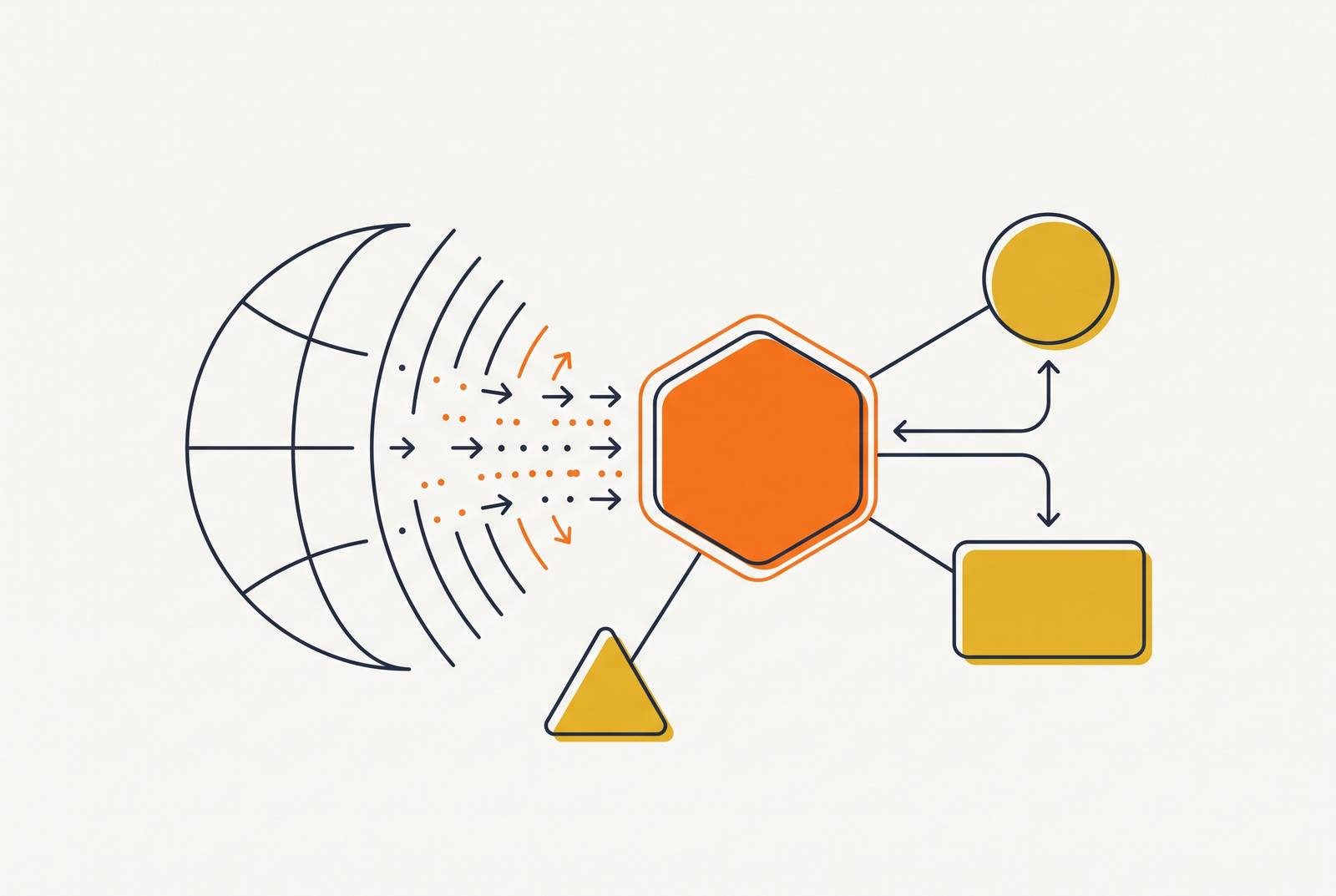
Real-time web data separates a CrewAI or AutoGen deployment that actually works from one that just produces confident nonsense dressed up as research.
CrewAI and AutoGen's Different Approaches to Agent Coordination
By 2026, agents run inside production systems doing real work, not sitting in a lab as a proof of concept, and the ecosystem backing them has grown to over 120 production-ready tools spread across 11 categories. That scale forces a question teams often skip: which coordination model actually matches the task, and what does that choice cost later when something breaks?
CrewAI treats agents like a staffed team. Tools are assigned per agent at definition time, so a web search tool given to a "Researcher" agent is not automatically available to a "Writer" agent; tool scope is explicit and bounded. The framework organizes everything around four building blocks, Agents, Tasks, Tools, and Crews, and the process connecting them can run sequentially, hierarchically, or through a consensual model where agents negotiate the plan together.
AutoGen takes the opposite bet. Agents behave more like participants in a conversation who negotiate, write code, run it, and revise based on what comes back, without the fixed role assignments CrewAI leans on. The framework's core pieces reflect that: a UserProxyAgent handles human input, an AssistantAgent generates responses, and GroupChat coordinates the back-and-forth across multiple agents. Microsoft moved active development over to the Microsoft Agent Framework, its official successor, putting AutoGen itself into maintenance mode as of October 2025, with the new framework reaching general availability in April 2026. That doesn't mean AutoGen stops working. It means teams choosing it now are choosing a framework whose forward momentum lives elsewhere.
So what does this architectural split actually mean for pulling in live web data? In CrewAI's role-based model, web search is a tool handed to one specific agent, full stop. In AutoGen's conversational model, any agent in the exchange can trigger a search call. The logic responsible for grounding the answer in real information has to live somewhere less fixed. Each approach wins in different situations. The right pick depends on whether a task needs bounded, predictable roles or open-ended negotiation between agents, and that fit, not popularity or GitHub stars, is what should drive the decision.
How each framework's architecture shapes web search tool integration
CrewAI assigns tools per agent at definition time. If the web search tool is given to the Researcher, the Writer agent doesn't have it unless someone explicitly grants it too, which makes tool scope explicit and bounded by design. Task dependencies then decide when that search actually fires. If the Writer's task can't start until the Researcher's task finishes, results flow forward through output chaining, and any latency in that first search compounds sequentially down the chain.
AutoGen flips that model. Tools get registered on the UserProxyAgent or the AssistantAgent and stay available across the whole conversation turn, so any agent that receives a message can decide to call search, which is broader in scope but harder to predict. That's broader in scope but harder to predict. GroupChat adds another layer of complexity on top: the GroupChatManager decides which agent speaks next, so whether search gets invoked at all depends on that manager's routing logic, a subtle difference from CrewAI's up-front assignment but a consequential one. AutoGen also supports a code-execution loop, where an agent writes Python that calls a search API directly, runs it, reads the output, and revises its approach. That's more flexible than a fixed tool call, but it drags in real infrastructure requirements around sandboxing and dependency management.
The practical fallout appears in debugging. In CrewAI, a grounding failure usually traces back to one agent or one task, since scope is bounded from the start. In AutoGen, the failure can emerge from the conversation flow itself, from a routing decision nobody explicitly coded. The debugging strategy has to differ accordingly. Microsoft Research frames AutoGen as improving the debugging and scaling of agentic solutions through multi-agent collaboration, though there's no published study from late 2025 backing a specific number like a 43% reduction in debugging time for complex coding work. That framing, in any case, describes code generation tasks, not the search-grounded research tasks where the actual failure mode is stale or irrelevant retrieval.
What ties this section to the ones that follow is the idea of a grounding surface: the exact point in the pipeline where real-world data enters, and who's accountable for it once it does. CrewAI puts that surface at a named agent. AutoGen puts it somewhere inside a conversation that a manager routes. Both integration patterns below build directly from that distinction.
Integrating a web search API into a CrewAI workflow: patterns and pitfalls
The basic pattern in CrewAI is simple to state: write a search tool as a Python function or class wrapping the API call, hand it to the agent that needs live information, and let CrewAI's task runner invoke it whenever that agent decides external data is required. Building the tool itself usually means decorating a function with @tool or subclassing BaseTool. The tool's description is what the LLM reads to decide whether to call the tool at all, and imprecise wording there directly causes the wrong tool getting picked.
Tool count is where things quietly go wrong. The fix isn't complicated, just disciplined: keep each agent's tool roster tight, and resist the urge to load one agent up with every API available.
Process choice changes how latency behaves. In a sequential process, each task waits on the one before it, so search latency early in the chain blocks everything downstream. A hierarchical process lets a manager agent delegate work in parallel, which can overlap search calls, but that manager's context window grows with every sub-result it collects. CrewAI's memory system offers a way to soften the cost here: short-term memory within a task, long-term memory across sessions, and entity memory for specific facts, and because every memory operation involves its own LLM call, caching search results in entity memory instead of re-querying can cut both cost and latency at scale.
There's a trap hiding underneath all of this, though. If the search API itself is returning cached or aggregated results, then the agent's "fresh" answer is only as fresh as that API's last crawl, and simply bolting a search tool onto an agent doesn't fix stale grounding if the tool feeding it is stale. So what should a team actually look for in a search API built for CrewAI? Four things stand out: clean, structured output instead of raw HTML so the LLM isn't reasoning through noise; low latency at the p99 level, since sequential tasks amplify any slowness; and a native CrewAI integration or a thin wrapper matching the BaseTool interface.
One documented option here returns clean, LLM-ready snippets and integrates natively with CrewAI, but its higher-tier modes can run five seconds or more per call, which compounds badly across a sequential chain, and it has been documented returning stale snippets when its cache hasn't refreshed. You.com's Research API and Web Search API fit the BaseTool pattern, delivering structured, cited outputs built for LLM consumption with latency characteristics (1659ms p99) that don't bottleneck sequential task chains, and its Research API holds the top position on DeepSearchQA, making benchmark-verifiable accuracy available at the tool layer.
Integrating a web search API into an AutoGen workflow: patterns and pitfalls
AutoGen's core pattern registers the search function as a callable tool on either the AssistantAgent or the UserProxyAgent. The function-calling interface passes the tool's schema to the LLM, and the model decides mid-conversation when to invoke it. Direct function registration defines a Python function and registers it through register_for_llm and register_for_execution, so the AssistantAgent proposes the call and the UserProxyAgent actually runs it. The code-execution path goes further: the AssistantAgent writes Python that imports and calls the search API on its own, and the UserProxyAgent executes that code inside a sandbox and returns the result. More flexible, yes, but it needs a working execution environment to produce that flexibility, since the code must actually run somewhere.
GroupChat setups add a routing problem that CrewAI simply doesn't have. Picture a GroupChat with a WebResearcher agent and a Synthesizer agent: the GroupChatManager has to route any question needing live data to the WebResearcher, and if that routing prompt is even slightly imprecise, the Synthesizer can end up answering straight from its training data instead. The fix is to give the search-capable agent an explicit speaker-selection hint inside its system prompt, rather than trusting emergent routing to handle anything grounding-critical.
Context window accumulation is the other quiet risk. Every round-trip in the conversation appends more content, and if search results come back verbose or get repeated across turns, the window fills up and earlier retrieved content gets truncated right out from under the agent. The practical answer is to design the search tool to return concise, structured excerpts, not full pages.
AutoGen Studio, the no-code interface for building these multi-agent conversations, makes wiring up a search tool visually easy enough, and that's genuinely useful for prototyping. The same architectural constraints apply to the visual layer, so routing logic still needs testing before anyone treats a Studio configuration as production-ready. Teams already inside the Microsoft stack should also look at the Microsoft Agent Framework, the active successor to both AutoGen and Semantic Kernel, which keeps similar tool-registration patterns but adds graph-based workflow control, worth evaluating against AutoGen's conversational routing for anyone who needs more reliable search invocation.
Latency behaves differently here than in CrewAI, because AutoGen conversations loop. One option built for structured JSON responses, real-time indexing, and cited sources maps cleanly onto the AssistantAgent and UserProxyAgent split, and its latency profile supports multi-turn conversations without stalling out. Latency matters differently in AutoGen, where conversations can loop and an agent may call search multiple times across turns, so a slow API (the benchmark recorded APIs ranging from 669ms to 13.6 seconds) can cause the conversation to stall visibly between turns. Exa (neural, embeddings-based) averaged 1.18 seconds in an independent December 2025 benchmark while Tavily averaged 1.885 seconds, both at 100% success rate, and in a multi-turn AutoGen conversation that difference accumulates across calls.
How search API choice affects what agents get right
The GAIA benchmark makes the stakes concrete. Researchers studying the OpenHands-Versa agent found resolve rates ranging from 56.96% up to 64.24% depending on which search API was used, with one option scoring 58.18% in between. Simply switching from the lowest-performing option to the highest one produced a 7.28 point absolute improvement, with no other change to the agent at all. That's a large swing for a variable most teams treat as an afterthought.
What explains the gap? It comes down to what the API hands back. For a grounded agent, that gap separates actually reasoning from just navigating.
Latency belongs in this conversation too, not as a speed concern but as a quality one. In AutoGen's looping conversational structure, that accumulated delay doesn't just feel slow, it raises the real risk the conversation times out before it ever reaches a grounded answer.
Staleness deserves its own category of failure, separate from low relevance. An API can return snippets that are topically right but pulled from pages that are months old, and the agent produces a confident, well-structured answer that used to be true. Neither the agent nor the person reading its output can easily catch that without a timestamp attached to the source. What does "grounded" actually require, then? Three things together: real-time indexing, structured output, and source citations. An API that only satisfies two of those three leaves a gap the agent has no way to close on its own. You.com's Research API holds the top benchmark position on DeepSearchQA, and its Finance Research API ranks first on FinSearchComp's T2 (Simple Historical Lookup) sub-task, figures that are publicly checkable rather than marketing copy, which matters for any team that has to justify an infrastructure choice to someone above them. The gap exists because Brave extracts snippets from raw webpage text while Exa and Tavily provide LLM-generated summaries, and since the agent relies on snippets to decide which pages to open, snippet quality shapes the entire retrieval chain.
Matching search API capabilities to the task type each framework handles best
CrewAI fits structured research pipelines well, the kind where one agent gathers material and another turns it into a finished report, running sequentially or hierarchically. The sturdiest pattern here assigns search to the Researcher agent alone, then caches results in entity memory so the same query doesn't get run twice.
AutoGen suits a different kind of work: complex reasoning, code generation tied to web-sourced requirements, multi-round research where agents actively push back on each other's conclusions. That calls for concise structured excerpts rather than full pages, since the context window fills fast across multiple turns, reliable low latency held steady across repeated calls, and output that can be parsed programmatically inside the code-execution path.
Financial and other high-stakes research work carries its own requirement regardless of which framework is running it. Source reconciliation isn't optional here. Unverifiable output has no place in a financial workflow, and the API has to return cited, traceable sources alongside whatever answer it produces. One option built specifically for this, ranked first on FinSearchComp, offers structured financial intelligence with cited sources, built for agentic pipelines that need to pass an actual audit trail later.
As a rough map: fast, role-based prototyping with web grounding points toward CrewAI paired with an AI-native search API that has native CrewAI integration. Conversational, multi-agent research involving code execution points toward AutoGen paired with a low-latency API with JSON-structured output. Teams that need production-grade reliability and explicit state management for web data pipelines should also weigh LangGraph, which one 2026 analysis from Apify credits with winning that category precisely because its explicit state machine makes retry logic and error recovery straightforward. And financial or compliance-grade research, regardless of framework, demands cited, reconcilable sources as a baseline.
One rule matters before any of this gets built. Roughly 80% of use cases, according to a developer guide from daily.dev, are actually better served by a single agent than by a multi-agent setup. Before standing up a CrewAI Crew or an AutoGen GroupChat, ask whether the task benefits from that coordination overhead at all, or whether the real problem is search quality, not orchestration complexity. API fit requires clean, LLM-ready structured output, low latency that compounds in sequential chains, and source citations that pass through task output to the final document.
Production considerations: latency budgets, tool count discipline, and keeping agents grounded over time
Everything above points toward the same operational discipline. Latency budgets need to be set per framework, not treated as a single global number, since a sequential CrewAI chain and a looping AutoGen conversation fail in different ways when an API runs slow. Tool count needs active management rather than benign neglect.
Grounding is an ongoing property of the pipeline. It's an ongoing property of the pipeline, one that depends on real-time indexing, structured output, and citations all holding together at once, and it degrades quietly the moment any one of those three slips. A search API that satisfied every requirement during a pilot can drift into returning stale or thin results months later, and because the agent's output still reads as confident and coherent, nobody notices until the wrong answer costs something real. That's the throughline connecting every section here: the coordination model a team picks matters less, in the end, than whether the data feeding it stays honest over time.
Sources
- AI agents in production: LangChain & CrewAI patterns 2026 | daily.dev
- AI Agent Frameworks 2026: LangGraph vs AutoGen vs CrewAI for Web Data Pipelines | Use Apify
- Tools - CrewAI
- Agents — AutoGen
- The state of agentic AI in 2026 | CrewAI
- Similar Accuracy, Unequal Evidence: Search APIs as Decision Surfaces for Tool-Using Agents