Fanout Query Strategies for High-Coverage Agentic Research
Structuring queries by type—not just volume—retrieves the evidence agents need to answer completely.
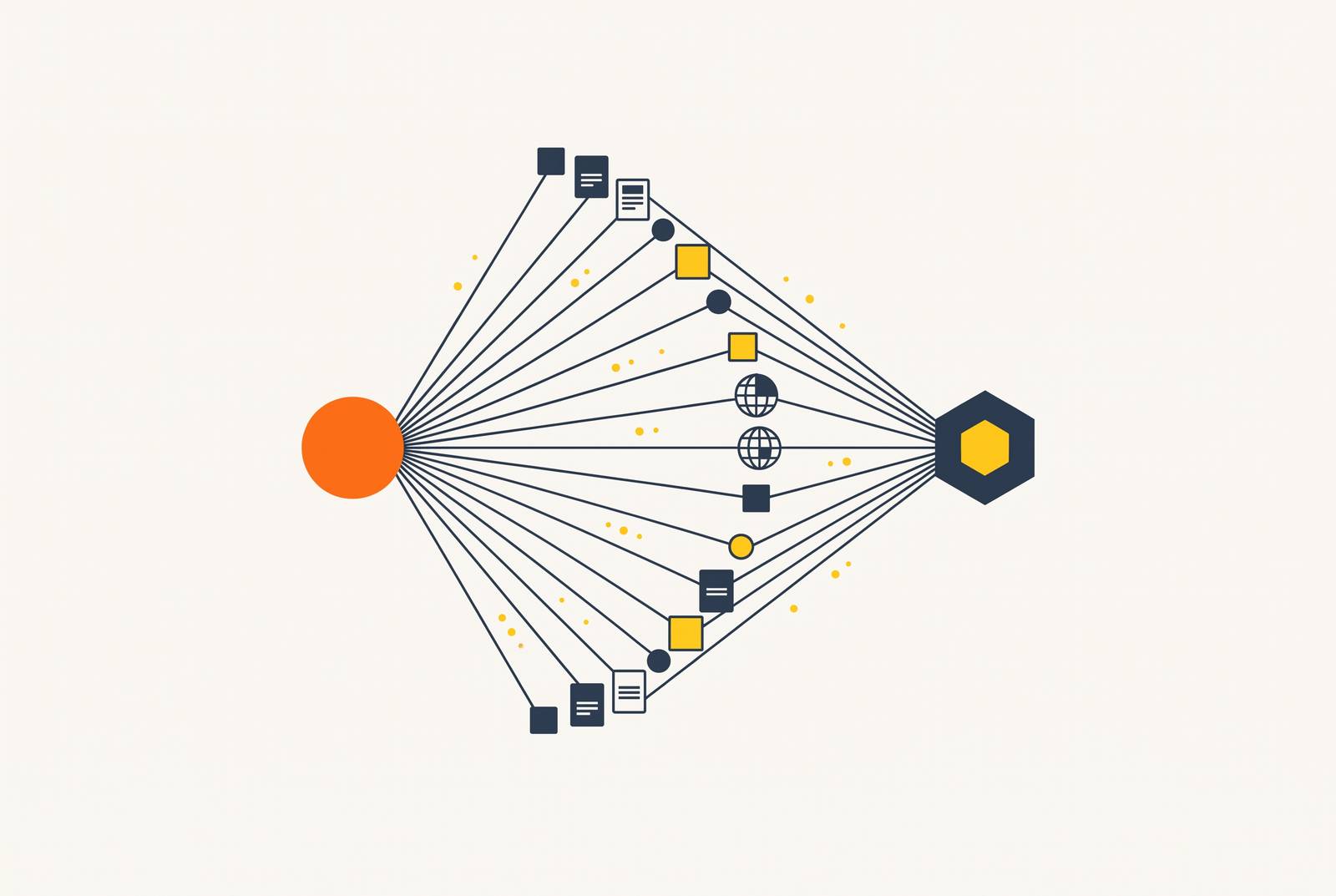
High-coverage agentic research depends on how queries divide a question. A deliberate fanout spans structurally distinct retrieval needs, so that phrasing variations do not crowd out context, comparisons, unstated requirements, current information, or entity-specific detail. The design must make those dimensions explicit, then trace whether their evidence reaches the answer.
Why agents misfire when query design is left to chance
For a developer building a research agent, a search call that works can hide research that has failed. The agent retrieves material, synthesizes it, and returns a confident answer without an execution error. Yet its searches may have been near-literal restatements of the same prompt. Each call then draws from much the same evidence pool, while comparative, implicit, and time-sensitive needs remain unaddressed.
The failure is easy to miss in the output. An answer can be well supported on the narrow subject searched and still omit an entire dimension of the question. If no query asks for current information or entity-level detail, the agent has no retrieved basis for those parts of its response.
SearchAtlas finds question constraints that never reach the answer and unverified parametric knowledge that enters the response, both of which are strongly linked to wrong final answers. An agent's searches therefore need to give every requirement a route into the final answer.
How query fanout works as a retrieval architecture
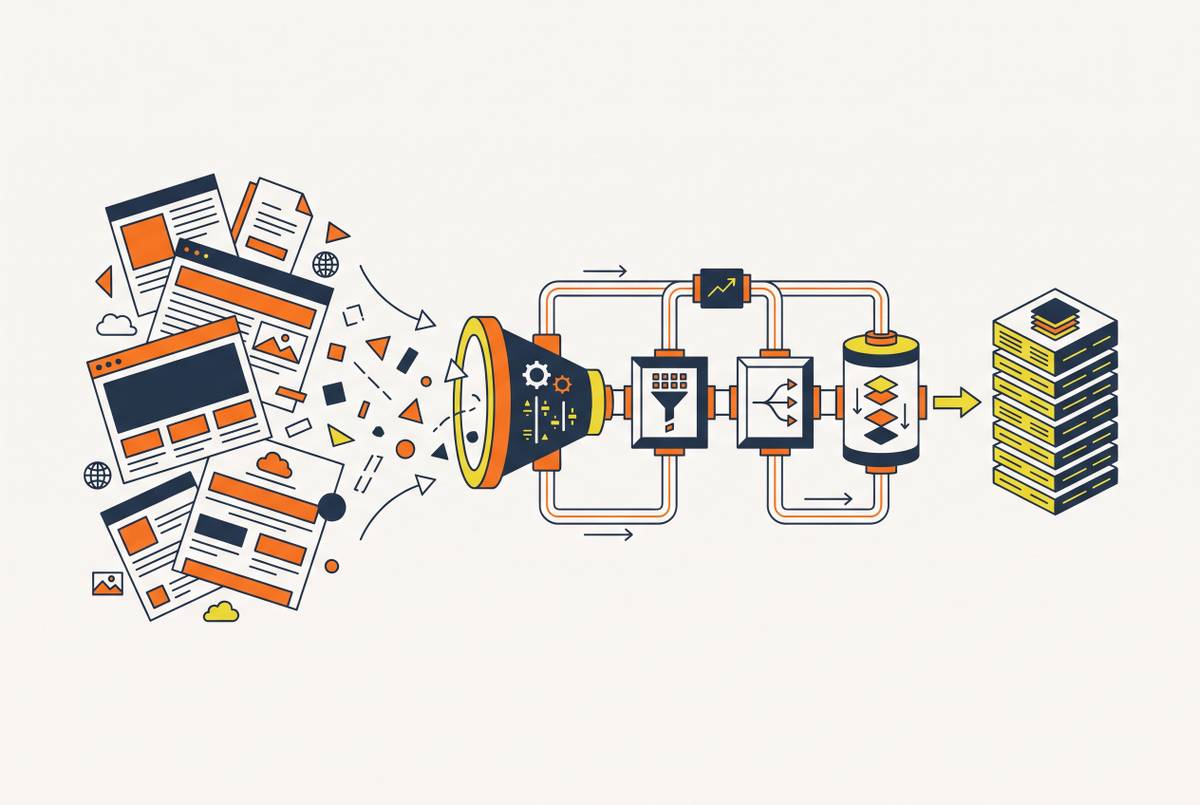
Query fanout replaces a single search with independent, structurally distinct sub-queries that run simultaneously. Their candidate pools are merged and deduplicated before the retrieved evidence is synthesized into one grounded answer. This differs from classical query expansion. The purpose is not only to express one intent in more ways, but to assign separate retrieval tasks to different parts of the investigation.
That changes the unit of retrieval and competition. Instead of relying on document-level ranking for one query, the agent draws on passages retrieved across many sub-queries. A source that answers a narrow question well can enter through that branch, although it still competes against everything else retrieved for that sub-query.
In deeper research, this structure becomes iterative. First-round results generate new sub-queries, so the initial fanout seeds a branched retrieval process. SearchAtlas represents these trajectories as directed acyclic graphs, or DAGs, with queries as nodes and evidence dependencies as directed edges. The graph shows whether one search informed the next, a link that can be hard to see in a query log alone.
The six structurally distinct sub-query types and what each retrieves
Reformulations preserve the user's intent while changing its wording. They provide baseline breadth across phrasing variation, helping retrieval avoid dependence on one expression of a need. For the brief's “help desk software” example, this is the part of fanout that remains focused on the original software request. Its role is useful but bounded. Rewording cannot substitute for asking about a requirement the original wording never expressed.
Related queries search adjacent topics that the prompt presupposes but does not name. Their role is to retrieve context. In the help desk example, finding software differs from looking into the conditions that shape how it is used. A related topic needs to be checked for whether it helps answer the question. It earns a place when it prevents an answer from being technically correct but practically incomplete.
Comparative queries introduce head-to-head or “best” framings, including when the user has not explicitly requested a comparison. Engines have been seen to expand queries in this way. Structurally, it retrieves evidence about relative choices, because a collection of product descriptions does not necessarily answer how those products compare. A comparative branch asks for that relationship directly.
Implicit queries surface needs inferred from the user's intent. The help desk prompt, for example, can imply questions about pricing, integrations, and reviews even though none of those words appears. Observed fanout behavior also includes evaluative terms such as complaints, showing how an agent can move beyond the category the user named toward evidence needed to assess it.
Recency queries make time a retrieval constraint. They seek information that the agent's training data cannot supply, using an explicit scope such as a year, quarter, or “latest.” Observed behavior shows why inference is insufficient. Claude appends year tokens inconsistently and sometimes uses the wrong year. Without an explicit recency branch, a time-sensitive claim can remain unsupported even when the surrounding topic has been searched extensively.
Entity expansion queries look for particular products, organizations, or named features. Captured searches show added brand names and domain-scoped searches that reach specific pages beyond general category results. The target is operational detail. Delivery times, policy pages, and spec sheets are examples of evidence that broad searches can miss. This type complements the other five by moving from a general research need to the particular entity whose details determine the answer.
Why more queries does not equal more coverage without structural diversity
More reformulations may retrieve additional passages, but they do not deliberately address missing time scopes, implied requirements, or entity details. Queries with different structures open paths to different evidence pools. It gives each branch a distinct reason to exist, while deduplication remains necessary because results may overlap.
SearchAtlas analyzed 1,350 search trajectories across five agent configurations and found large differences in search scale, evidence reuse, and the question constraints that reached the answer. Those differences coexisted with similar final-answer accuracy scores. Query count concealed the important variation. An agent's activity level did not reveal how completely its evidence supported the task.
Could redundant searches still improve recall through brute force? They can broaden retrieval within an existing dimension, but that does not close a gap in a dimension never queried. Additional latency and cost are consequences. Fragmented support, omitted constraints, and unverified knowledge can survive an increasingly busy search process. The design needs another kind of question.
How to architect a fanout set for a given research task
The lesson for developers is to begin with intent decomposition. Enumerate the prompt's explicit constraints and inferred needs, then assign at least one sub-query type to each. Before increasing query volume, anchor at least one query to each of the six types. This makes the initial design inspectable. A branch should exist because it retrieves a needed class of evidence.
Recency deserves a discrete query with an explicit year, quarter, or “latest” scope rather than a hope that the engine will infer it correctly. Entity expansion should use brand names, product identifiers, and domain-scoped queries to reach deep pages. Those choices serve different purposes. One constrains when the evidence applies, while the other constrains whose details the agent needs.
For implicit needs, ask what a skeptical auditor would check that the user did not request. In the help desk example, those checks can cover pricing, integrations, reviews, and complaints. Comparative queries can then look at how the choices compare, while related queries supply the context needed to understand those comparisons. Each branch should remain connected to an explicit constraint or a reasoned account of the user's intent.
For iterative tasks, treat this first set as a DAG seed. The first pass should make room for evidence that generates targeted follow-up questions, rather than assume every useful question is knowable in advance. Hypothesis-Driven Deep Research, or hdri, formalizes this gap-driven mechanism by identifying informational and logical gaps after retrieval and triggering supplementary queries. Its experiments report a 14% completeness gain from gap-driven supplementation and high subject-matching accuracy. That result supports building gap detection into the research process rather than relying on a final summarization pass to expose omissions.
How the search API layer shapes what a well-designed fanout can actually retrieve
If the search API cannot provide the freshness, depth, or parallel execution the branches require, some of the architecture remains only an intention. Infrastructure constrains achievable coverage. An explicit time scope is useful only if the retrieval service can return suitable information, just as an entity-specific query needs access to more than top-level category pages.
API evaluation therefore needs five axes, including freshness, source diversity, latency under concurrency, compliance and data retention, and factual accuracy on public benchmarks. Each tests a different requirement. Freshness supports recency branches, while source diversity helps comparative and entity-expansion searches reach deep, specific material. Concurrency latency tests the parallel workload that fanout creates. Compliance and retention belong in the evaluation because retrieval capability is not the only constraint on agentic use.
SearchAtlas evaluates agents on BrowseComp, WebWalker-Hard-English, and DeepSearchQA. These cover sequential-constraint questions, parallel-constraint questions, and comprehensive deep-research demands, respectively. Their scope makes benchmark performance a useful proxy. However, because these evaluations concern agents, a score is evidence about the tested system rather than a guarantee that every API call will satisfy every fanout requirement. Benchmark comparisons need to stay tied to what was tested and the task it was tested on.
For developers implementing this architecture, the practical requirements follow from the branches themselves. The API needs to handle parallel sub-query execution, return chunked and date-filterable results, and support domain-pinned queries. Research on a specific subject may need SEC filings, earnings data, or other specific source types that go beyond general browsing results. An API designed around consumer browsing patterns may therefore be unsuitable even if it performs well on a straightforward single query.
Measuring whether a fanout strategy actually achieved coverage
Two agents can give answers that are about equally accurate even when their searches cover very different numbers of question constraints. The audit must inspect the trajectory. Otherwise, a correct result can hide unsupported reasoning or a recurring retrieval gap that becomes consequential on another task.
SearchAtlas offers a model for this inspection by converting trajectories into evidential DAGs. Queries become nodes, and traceable evidence dependencies become edges that show how retrieved information propagates toward the answer. This exposes more than search activity. It can reveal which constraints received evidence, which failed to reach the response, and where unverified parametric knowledge entered. Its process-level diagnostic scores capture information that final-answer accuracy does not.
To audit a fanout, first ask whether it has all six sub-query types or is made up mostly of reformulations. Then trace each explicit constraint to a query and its retrieved support. A node alone is not enough. The evidence also needs a path into the answer, and facts supplied from parametric knowledge need to be flagged and verified. In iterative research, check whether first-round findings led to follow-ups that widened coverage or left the graph largely flat.
The next retrieval pass should act on what the audit found. The hdri mechanism makes this concrete by enumerating remaining informational and logical gaps and treating each as a trigger for a targeted sub-query. As research domains evolve, that loop lets the fanout change with the evidence it lacks. The audit determines what the agent asks next, turning a one-time query design into a durable research architecture.