Hybrid Retrieval Combining Vector Search and Live Web Results
Hybrid retrieval fixes blind spots no single search method can overcome.

Picture an agent that confidently tells a customer their return window closed last week, citing a policy page that was replaced three months ago. Or one that cites "Order AP-8127" with total conviction, except it has pulled up the wrong order because the number itself never registered as meaningful. The failure did not happen in the language model's reasoning. It happened one layer down, in retrieval, and it happened because the system relied on a single retrieval method to do a job that structurally requires more than one.
Vector search and live web retrieval's shortcomings
Vector search has a specific, well-documented blind spot. Embedding models are built to capture meaning, not to preserve exact strings, so an identifier like "Order AP-8127" gets compressed into the same high-dimensional space as every other order number, every other alphanumeric code, every other string that looks structurally similar but means something entirely different. The embedding is semantically "close" to the right document, but closeness is not the same as certainty, and for exact-match lookups, closeness is not good enough. The same failure occurs with product SKUs, error codes, API method signatures, and regulation clause numbers: anything where precision, not meaning, is the whole point.
Keyword search has the opposite problem. The document can be exactly right and still never surface, because lexical overlap, not relevance, is what the algorithm actually measures.
A third failure sits outside both of these. Even a system that perfectly balances exact-match and semantic retrieval is still only as current as its last ingestion. A local index, however well built, is a snapshot, and snapshots age. Questions about something that happened after the index was built, about a document that was never in the training corpus to begin with, or about a fact that changes weekly cannot be answered by a static index, regardless of how it blends sparse and dense retrieval internally. That is the gap live web retrieval exists to close, and it is a different kind of gap entirely from the exact-match and paraphrase problems above. Three distinct failure modes, three distinct fixes. None of them substitutes for the others.
How the sparse, dense, and live layers work mechanically
BM25 works by counting. That mechanism is why BM25 finds "AP-8127" reliably but cannot find a document about "troubleshooting" when the query says "how to fix": the rare string stands out sharply, while "how to fix" and "troubleshooting" share no tokens to count.
Dense retrieval works on a different principle. But the same geometry that makes conceptual matching possible also flattens precision: a product code or method signature gets mapped into a region of that space shared with many superficially similar strings, and the one exact match the user needs can get lost among several near matches.
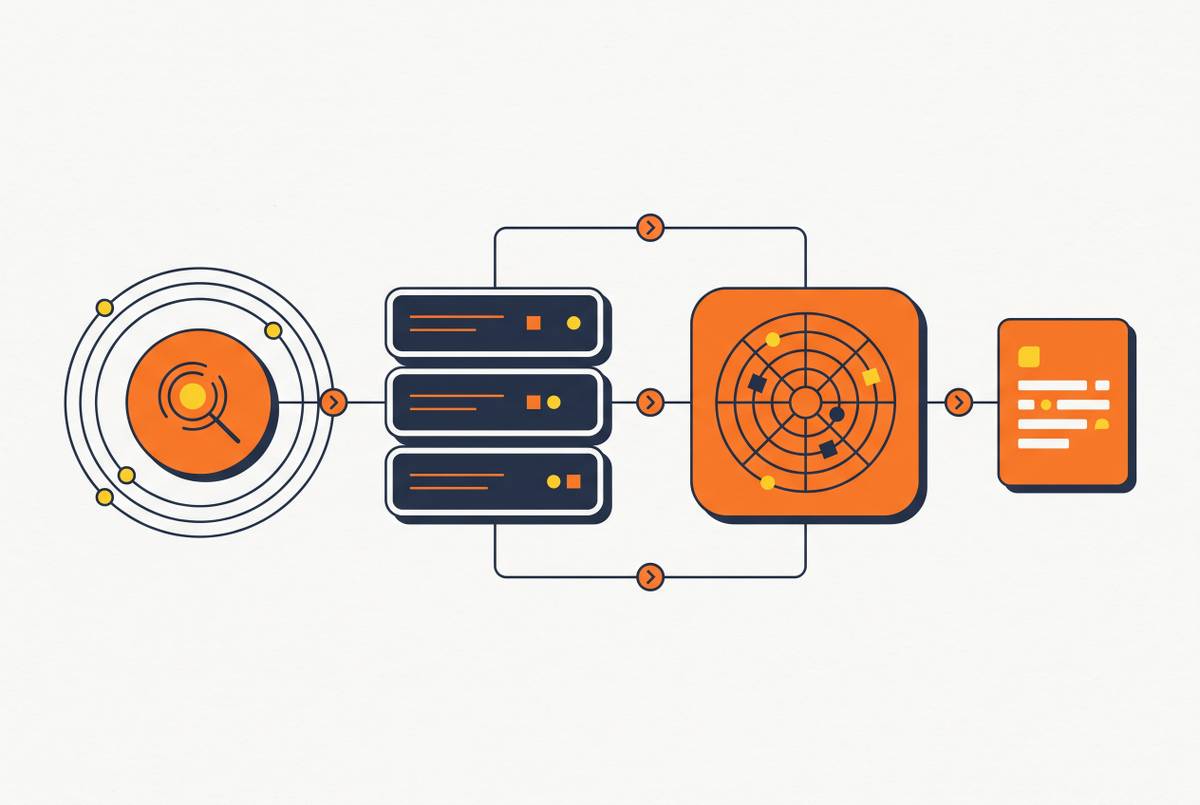
The live web layer runs on its own clock. Rather than searching a fixed, previously ingested set of documents, it queries an index of the current crawled web, and the freshness of what comes back depends on how recently that content was crawled. The unit being retrieved is a live page rather than a stored chunk, which is the structural reason it can answer questions a local index cannot touch.
Combining all three branches creates a scoring problem: BM25 produces term-frequency scores, dense retrieval produces cosine similarities, and live web APIs return their own internally ranked lists, none of which sit on a comparable scale. Reciprocal rank fusion, RRF, sidesteps that problem by combining rank positions rather than raw scores, which makes it scale-agnostic. Netflix, S&P Global, Leroy Merlin, and Coveo have all described dense-plus-sparse retrieval fused with RRF in production at Haystack Europe 2026, a strong signal that RRF functions as the de facto standard in deployed systems.
A simple routing table makes the complementary relationship concrete:
| Query example | Branch that should win | |---|---| | "Order AP-8127 ship date" | BM25 (sparse) | | "How do I reset my password?" | Dense (semantic) | | "What changed in the EU AI Act last month?" | Live web |
None of these branches is better than the others in any general sense. Each wins on the query type it was built for.
What parallelism requires in a hybrid retrieval system
Writing four async functions, one per branch, and awaiting each one in turn, looks like parallel execution but is not. Each await blocks until the branch in front of it finishes, so total latency ends up as the sum of every branch's individual latency. A system with four branches run this way costs roughly the sum of all four latencies, not the latency of the slowest one, and that difference compounds badly as branches or turns multiply.
Hindsight's four-way hybrid memory retrieval system, built across semantic, BM25, temporal, and graph branches, surfaced a specific version of this problem during development. The bottleneck was not query logic. It was that each branch independently tried to claim a connection from a shared database connection pool, and under load, those claims serialized, forcing branches to wait on each other even though their underlying queries were logically independent. Connection pool acquisition, alongside cross-encoder inference, turned out to be a hard latency floor that no amount of query optimization could fix on its own.
The broader lesson generalizes beyond this one system. Each retrieval branch has its own cost profile: vector similarity search runs over an HNSW index, keyword search runs over PostgreSQL full-text indexing, graph retrieval involves traversal, temporal retrieval involves time-range queries. Those cost profiles should determine how connection pooling and concurrency budgets get allocated. Decide that first, then write the query logic around it, rather than starting from the queries and hoping the infrastructure keeps up.
This is not a minor implementation detail for agent workloads. Longer queries and multi-branch retrieval both add latency, and in a multi-turn agent loop, that latency compounds: a slow retrieval step at turn two delays every turn that follows it.
When a local index beats live search
Framing this as a choice between retrieval-augmented generation and live search treats it as a single architectural decision, when it behaves more like a cost function with corpus size, update frequency, and query volume as its inputs.
Analysis presented at Haystack Europe 2026 put concrete numbers on one side of that function: for private code, the break-even point for maintaining a local index is somewhere in the tens to hundreds of daily queries. If the index itself is free to run, local, serverless, built on infrastructure that already exists, the break-even point collapses to the first query, because there is no ongoing cost to offset.
There is also a class of query where a local index adds nothing at all: code in long-running, widely used public repositories that a foundation model has already been trained on. Indexing it locally adds infrastructure cost without adding any recall the model did not already have.
Live web retrieval wins decisively in three situations: when the question concerns events or data that postdate the model's training cutoff, when the answer depends on proprietary documents that never appeared in any public training corpus, and when the underlying facts change quickly, prices, regulatory text, live filings, faster than any local ingestion cycle can keep up with.
Exact-identifier queries go to BM25. Paraphrase and concept queries go to dense retrieval. Time-sensitive or post-cutoff queries go to live web. Relationship or causation queries go to graph traversal where that's available. When a query's type is ambiguous, hybrid fusion becomes the sensible default, hedging across branches. The three examples from the routing table above, "Order AP-8127 ship date" to BM25, "How do I reset my password?" to dense, "What changed in the EU AI Act last month?" to live web, show the pattern well enough that it does not need to be expanded into an exhaustive matrix to be useful.
How agents change retrieval requirements relative to human search
S&P Global runs one hybrid relevancy platform that serves two distinct consumers at once: the search box embedded in its core enterprise product, used directly by human analysts, and the retrieval layer sitting behind agentic workloads, used by autonomous systems issuing their own queries. Those two consumers produce fundamentally different query distributions, short and sparse from humans, long and operator-dense from agents, yet both have to be served by the same underlying infrastructure simultaneously. That dual-consumer requirement is a structural feature any hybrid retrieval system serving both populations has to account for from the start.
What if the retrieval miss that would merely annoy a human searcher propagates much further inside an agent loop? A human who gets a bad search result usually notices and rephrases.
Research on agentic retrieval frames the next step past fixed retrieval pipelines as agents that can plan and adjust their own retrieval strategy turn by turn, deciding for themselves when to search, when to fetch a specific URL directly, and when the context already gathered is enough to proceed without another retrieval call. That shift also raises the bar on freshness. An agent researching a live financial situation or tracking a regulatory change in progress cannot tolerate working from a stale snapshot. For agentic workflows where recency is itself part of the correct answer, the live web layer is a requirement, not a convenience.
Reranking and fusion as the layer that makes the combination coherent
Running sparse, dense, and live branches side by side produces three ranked lists that cannot be compared directly. Merging those scores as though they sat on the same scale distorts the combined ranking, since a high BM25 score and a high cosine similarity do not mean the same thing.
Fusion is not the final step, though. After RRF produces a combined candidate set, a separate reranking stage, typically a cross-encoder model, scores each candidate directly against the original query and reorders the set based on relevance. One production trace makes the value of this step concrete: an enterprise search assistant's BM25 branch correctly retrieved the exact plan document a user needed, but the fusion policy still promoted three generic billing articles above it in the final ranking. How they were being ranked was.
That also means fusion weights are not something to set once and leave alone. Tuning fusion weights is ongoing work, not a configuration step to check off during initial deployment.
Governance and security at the retrieval layer
Security cannot be handled by the language model at the end of the pipeline, because the model only ever sees what retrieval decides to hand it. Access control has to be enforced before a document enters the candidate set, not filtered out afterward in generation, since by the time generation happens, the document has already been read.
That principle has a direct operational form. Permission structures from source systems need to be replicated at the index and retrieval level rather than assumed to follow automatically from login credentials.
Data Loss Prevention controls need to run before chunking and embedding happen, not after. A document carrying PII or other regulated data that makes it into the vector store can leak that data through retrieval later, even in a system where the generation step itself is carefully constrained.
Multi-jurisdictional compliance adds a separate constraint that applies specifically to live web retrieval. GDPR, ITAR, FedRAMP, and CMMC each set rules about where data can be processed and where it can be transmitted, and a live web query that happens to route through a US-based API provider could constitute an unlawful transfer of EU personal data if the right safeguards are not in place. Zero data retention and SOC2 certification at the API layer function as baseline requirements for enterprise deployment rather than optional upgrades to consider later, because a live web search API that retains query logs creates a compliance exposure that security teams have to account for whether or not anyone built it intentionally.
Measuring whether a hybrid retrieval system is working
Measurement remains the hardest unsolved problem in production retrieval. Aggregate accuracy numbers can hide branch-level failures entirely: a system can look perfectly healthy against broad FAQ traffic while silently failing every entity-heavy query or every query touching recently ingested documents, and the aggregate score would never reveal it.
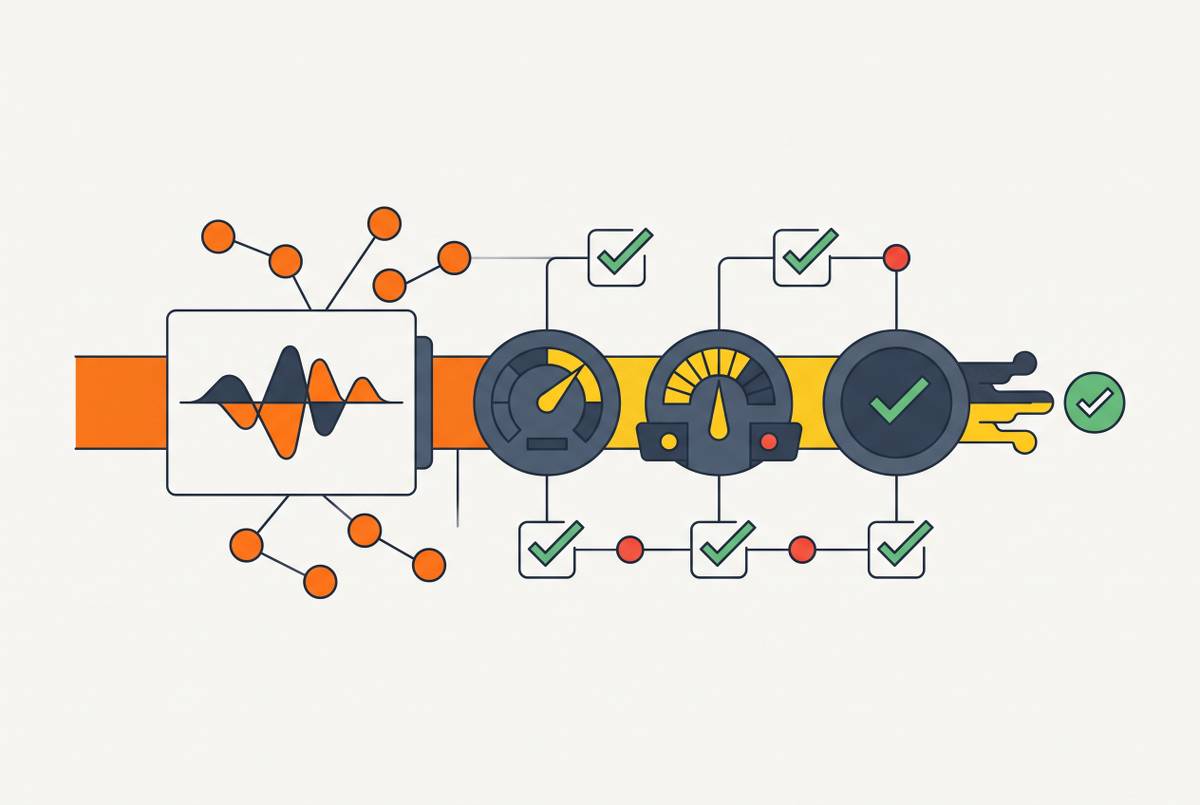
The way around that is measuring each part separately. Branch recall, ranking quality, answer support, and runtime cost each need their own measurement, because judging only the final answer's quality obscures which stage in the pipeline actually produced the failure.
Branch recall is the most direct of these to check: for each labeled query in a test set, did the BM25 branch retrieve the expected document? Did the vector branch? Did the fused result after RRF? Running that check branch by branch is what identifies which specific part of the system is responsible when a query fails, rather than leaving the failure as an unexplained drop in an aggregate score. A hybrid system earns the label only once its branches have each been checked this way. Trusting the architecture without checking the branches repeats, at a structural level, the mistake of trusting a single retrieval method to cover every query.