Evaluating RAG Output Quality With Automated Test Harnesses
Test RAG systems at three separate layers, not one end-to-end score.
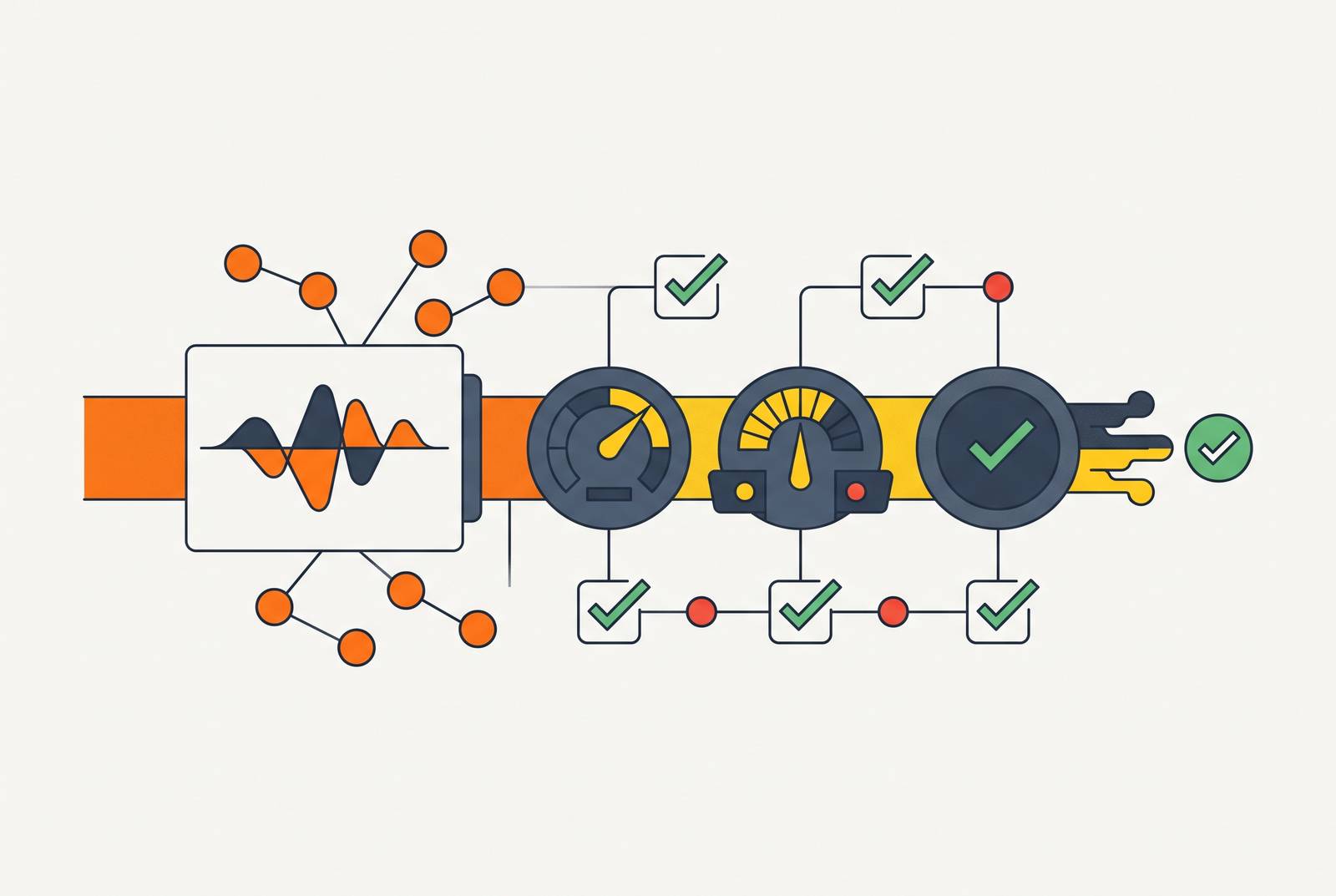
A support bot quotes a refund policy that expired months ago. It still fails, because retrieval pulled the wrong document, and a single accuracy score would never catch that. This piece lays out why retrieval-augmented generation needs three separate kinds of measurement, not one, and how to wire those three into a test harness that blocks a bad release before it reaches a user.
Diagnosing a RAG failure beyond a single accuracy score
That expired-policy scenario points to something structural about how RAG systems break. A RAG pipeline can fail in two places that operate independently of each other, and those two failures compound rather than cancel out. Retrieval can hand the generator a batch of irrelevant chunks, and the generator can summarize those chunks with total fidelity, producing a fluent answer built on the wrong evidence. Or retrieval can do its job perfectly, surfacing exactly the right passage, while the model still invents a detail that appears nowhere in that passage. A single end-to-end accuracy score cannot tell you which one happened, because it was never built to look at the two stages separately.
The first failure mode is the harder one to catch by instinct, because the model itself is behaving correctly. A well-calibrated large language model given irrelevant context will still produce a plausible-sounding answer, because its job is to generate coherent text from whatever it's handed. The sentence structure is clean, the tone is appropriate, and the citation (if there is one) points to a real document, just the wrong one. No fluency check and no latency check was ever designed to ask whether the retrieved evidence was the right evidence.
The second failure mode hides inside averages. The fabricated sentence is visible only when groundedness is measured at the level of the individual sentence. That's the gap a composite score always leaves: it tells you the system is fine, on average, while the one sentence a customer actually acts on, the refund date, the dosage, the contract clause, is the one that was made up.
The three failure surfaces and the metrics that target each one
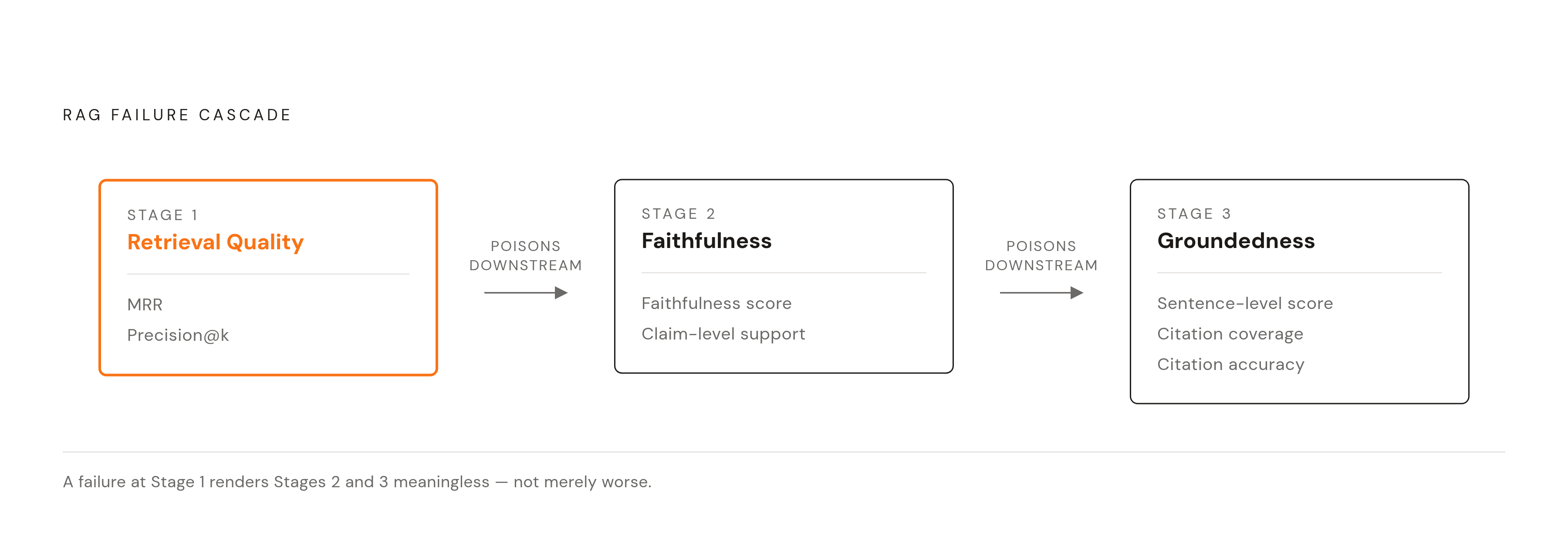
Retrieval quality, faithfulness, and groundedness aren't three equivalent ways of describing the same problem. They sit in a causal chain, each one gating what the next can even measure. Retrieval quality determines what evidence the model ever sees. Weak retrieval poisons everything downstream of it, so debugging a RAG system has to start at the retrieval layer.
On the retrieval surface, four metrics do most of the work. Mean reciprocal rank, or MRR, looks at where the single most relevant chunk landed in the ranked list, capturing its position in that list. MRR matters in a specific, practical way that precision@k doesn't capture on its own: a correct chunk sitting at position eight in the ranked list is functionally the same as a chunk that was never retrieved, if the RAG implementation truncates its context window before reaching position eight. Precision@k can look fine while this exact failure happens silently.
On the faithfulness surface, two metrics carry most of the weight. A faithfulness score checks whether each individual claim in a response is actually supported by what retrieval pulled back. Faithfulness functions as the main defense against the kind of hallucination that's hardest to catch by reading: a confidently stated, syntactically clean, contextually plausible policy detail that simply isn't true.
The groundedness surface adds sentence-level groundedness, citation coverage, and citation accuracy. Sentence-level groundedness identifies which specific sentence in a response lacks support in the retrieved context, rather than handing back one verdict for the whole answer. That's the distinction between groundedness and faithfulness: groundedness names the exact sentence an engineer needs to look at, instead of a pass or fail stamped on the response as a whole.
None of this replaces the end-to-end metrics teams already track: correctness, task completion, latency, and cost. Those sit on top of the three surfaces and describe whether the system works as a whole. They complement the surface-specific metrics rather than substitute for them, and a harness that only tracks end-to-end numbers is exactly the harness that misses the expired-policy failure described above.
Translating metrics into build gates
Measuring these three surfaces is only half the problem. A metric that's computed offline, written into a report, and reviewed by a person once a week can't stop a bad model from shipping on a Tuesday afternoon. The shift that actually changes outcomes is turning evaluation from something teams report on into something that enforces a decision. That means wiring these metrics into continuous integration as pass or fail assertions that run before a merge goes out.
A paper describing something called the LLM Readiness Harness (arXiv:2603.27355) makes this concrete. It combines automated benchmarks, OpenTelemetry-based observability, and CI quality gates under a minimal API contract, and it aggregates workflow success, policy compliance, groundedness, retrieval hit rate, cost, and p95 latency into a single readiness score that's weighted by deployment scenario. The paper's own framing is direct about why readiness isn't one number: its benchmark results on BEIR grounding tasks, specifically SciFact and FiQA, show that under an "sla-first" deployment scenario, a model leading on faithfulness can coexist with another model that pays a real latency cost in that same scenario. Gate weights have to shift depending on what a team is actually optimizing for in production, not sit fixed at some universal threshold.
Several tools fill different roles in that enforcement pipeline, and no single one does all three jobs. DeepEval runs evaluations as pytest-style assertions, failing a build outright when a quality threshold isn't met, which makes it the natural fit for gating merges inside a CI pipeline. Arize Phoenix, an open-source tracing and evaluation tool built on OpenTelemetry, instruments a RAG application to capture execution spans, letting an engineer inspect exactly which chunks were retrieved and work out why a particular answer went wrong after the fact. That makes it the stronger tool once a failure has already happened and someone needs to find the cause. Maxim AI takes a broader, end-to-end platform approach, unifying experimentation, simulation, evaluation, and production monitoring, and it supports evaluation at the session, trace, and span level. That multi-level granularity matters specifically when retrieval succeeded but generation failed, or the reverse, and a team needs to isolate which layer is actually responsible.
ARES, introduced above as a three-dimensional evaluation framework, also solves a problem the other tools don't directly address: it fine-tunes lightweight language model judges for each RAG component against a contrastive learning objective, rather than relying on one fixed heuristic prompt the way simpler LLM-as-judge setups do. One might argue that any automated judge, however it's trained, is still a target that can be gamed: a team under pressure to pass a gate can tune a system to score well against a fixed judge without actually improving retrieval or generation. That risk is real enough that ARES builds a check against it directly, applying prediction-powered inference to attach statistical confidence intervals to its scores, calibrated against a small set of human-annotated datapoints, roughly 150 or more. Human annotation doesn't disappear from this picture. It anchors the automation and keeps it honest, bounding how far a gamed metric can drift before the confidence interval exposes it.
Assembling a coherent harness: wiring retrieval, faithfulness, and groundedness gates into one pipeline
A harness is a sequence, where each gate has to pass before the next one's result means anything: retrieval quality gets checked first, because a faithfulness score computed against badly retrieved context is measuring nothing useful, and a groundedness score built on top of that is measuring even less.
The LLM Readiness Harness architecture gives a working reference for what that sequence looks like end to end. Instrumentation built on OpenTelemetry captures what happened at each stage of a request: the retrieval step, the generation step, and a policy validation step, giving engineers a record they can trace back through after a gate fails. That tracing layer is what separates a harness that just reports a dropped score from one that tells an engineer which retrieved document, which prompt variant, or which chunk boundary actually caused the drop. Without it, a failed gate says groundedness fell below threshold and stops there, leaving the actual fix to guesswork.
Scoring readiness by deployment scenario rather than against one fixed bar is the architectural decision that makes the whole system usable in practice. The same retrieval and faithfulness numbers get weighted differently depending on whether a team is optimizing for cost, for risk, or for service-level agreements, and the harness produces a recommendation suited to that specific operational context instead of a single pass or fail that ignores what the deployment actually needs. Layered on top of that, Pareto frontier analysis plots cost against utility directly, surfacing which model configuration gives the best quality for the money under a given scenario, rather than leaving engineers to guess at a trade-off between accuracy and spend.
Building toward that kind of setup from scratch has a reasonably natural order. Start with RAGAS for broad RAG-specific metric coverage and fast iteration early on. Layer in DeepEval once there's a CI pipeline worth gating, since its pytest-style assertions are built to fail a build. Add Arize Phoenix when debugging speed starts to matter, since its OpenTelemetry-based tracing gives chunk-level visibility into what went wrong. RAGAS itself remains actively maintained with recent commit activity, which matters for a team deciding whether to build a long-term CI dependency on it.
Agentic RAG and non-deterministic retrieval paths
Everything described so far assumes retrieval is a single, repeatable step: the same query goes in, and the same set of chunks comes back, run after run. That assumption is what makes a static test set workable. But what happens once retrieval turns into a sequence of decisions the system makes on the fly?
Agentic RAG replaces the single retrieval step with a dynamic chain of tool calls, search, find, open, summarize, where the exact path taken varies from one run to the next and can't be fully predicted by a fixed test set written in advance. That shift isn't a minor complication; it's where the three-surface harness built in the previous section meets its limit, because context precision and recall were designed around the idea of one retrieved set to score, not a branching sequence of retrieval decisions. A snapshot of whatever chunks were retrieved at one particular step in that sequence gives an incomplete picture of whether retrieval, taken as a whole process, actually worked.
The performance case for agentic retrieval is strong enough that the trade-off deserves serious evaluation. Agentic retrieval uses substantially more tokens per query than single-shot search does, so an evaluation harness tracking only per-query metrics is missing part of the economics. It needs to track token consumption per retrieval path, since two systems with identical accuracy can have very different operating costs depending on how many tool calls they made to get there.
Agentic systems also introduce a retrieval source that static vector indices never had to deal with: live web search. If a knowledge index isn't synchronized with whatever is current on the live web, an agent will state outdated information with exactly the same confidence it uses for current information, and no static offline benchmark, built against a fixed snapshot, is positioned to catch that kind of drift. A web search API that returns real-time, cited results, paired with a research API that performs multi-step reasoning across sources and synthesizes a cited answer, addresses this by giving an agent something to retrieve against that the harness can check for recency directly, rather than trusting a static index to still be accurate months after it was built.
Extending a harness to cover agentic paths means treating each individual tool call as its own retrieval span inside the observability layer, rather than bundling the whole session into one event. And it means adding a citation-recency check to the groundedness gate, one that verifies a cited source isn't stale, which a traditional groundedness check, built for static retrieval, was never asked to do.
Security and compliance gaps that standard metric layers do not cover
Even a fully wired three-surface harness, extended to cover agentic retrieval paths, still leaves a category of failure untouched. Precision@k, faithfulness, and groundedness were built to catch accuracy problems: wrong chunks, unsupported claims, fabricated sentences. None of them were built to catch an adversary. A retrieval corpus that's been deliberately poisoned, a prompt crafted to extract private information buried in an index, a context window manipulated to steer a model toward a response it shouldn't give: a harness scoring only for accuracy will watch all of this happen and report healthy numbers the whole time.
That gap calls for evaluation that treats security and privacy as dimensions in their own right, not as an afterthought bolted onto an accuracy report. A security- and privacy-aware approach to RAG evaluation has to weigh retrieval quality, generation faithfulness, leakage risk, attack success rate, latency, and energy consumption together, as co-equal dimensions. A harness that measures how well a model stays grounded in its sources but never asks whether those sources were sitting behind the right access controls, or whether an attacker could manipulate what gets retrieved in the first place, has only solved part of what "readiness" actually has to mean.