Solving LLM Knowledge Cutoff Problems With Live Web APIs
Integrating live web APIs into language models keeps them current and cuts hallucination risks.

Every large language model is trained on a corpus sealed at a fixed date, the way a library stops accepting new volumes the day its doors close. Everything published after that date simply does not exist for the model, and the model has no internal flag that distinguishes a fact it learned from a fact it is quietly inventing through pattern-matching. This is not a bug that a better training run fixes. The RealFactBench paper found a sharp drop in accuracy when models trained on earlier data were tested on claims from after their cutoff, with GPT-4o's accuracy falling from 70.07% to 48.74% on post-cutoff questions. That gap occurs regardless of how many parameters the model has, because scale adds reasoning capacity over the knowledge already inside the model. A bigger model reasons more carefully about what it knows. It cannot reason its way to a fact it was never shown.
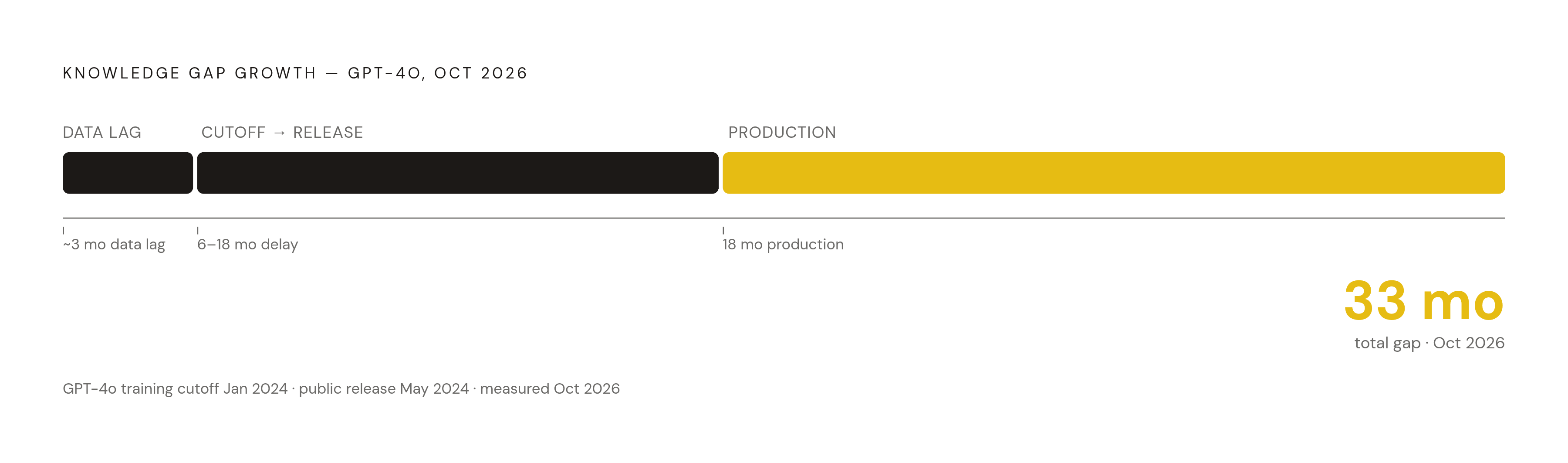
The problem deepens the closer you get to the stated cutoff date itself. Collecting and processing training data takes weeks or months after real-world events happen, so even the months right before a model's official cutoff are thinly represented. And cutoffs do not stay fresh for long after release, either: gaps between training cutoff and public release have run anywhere from 6 to 18 months for major models, and GPT-4o was still running in production API integrations with a knowledge gap of roughly 33 months as of October 2026. A model deployed today is carrying a knowledge gap that started accumulating well before anyone typed a prompt into it, and that gap only widens for as long as the model stays in production without retraining.
Hallucination at a Cutoff Gap
When a model is asked something it does not know, it rarely says so. It produces an answer that sounds right, because the training objective behind next-token prediction rewards fluent, coherent text, not factual accuracy. Nothing in that objective tells the model to flag a gap in its knowledge, so a confident sentence about a recent regulatory change that postdates its training and a confident sentence about a well-documented historical event come out of the same mechanism, with the same tone of certainty. Calibration research on OpenAI's SimpleQA benchmark found that models consistently overstate their own confidence. That means the fluency of an answer tells you how natural the phrasing sounds, not how likely the underlying claim is to be true.
This becomes dangerous inside multi-step agent pipelines. One wrong premise, generated with full confidence at step one, gets carried forward and compounded through every step after it, until the agent takes a real-world action built on a conclusion nobody checked. Retrieval does not automatically fix this, either: when a live search result conflicts with what the model already believes from training, the model frequently sides with its training data over the retrieved document, and the user ends up with a wrong answer wearing a plausible-looking citation. In finance, healthcare, or legal applications, an unverifiable or hallucinated citation becomes a source of real regulatory exposure.
Static RAG and the Freshness Problem
Retrieval-augmented generation was built to solve exactly this kind of gap, and for a specific class of problem, it does. Static RAG pulls relevant passages from a pre-indexed vector database of curated documents and hands them to the model as context before it generates a response, which works well for stable material such as internal documentation or product manuals that do not change by the hour. What happens once the underlying facts start moving faster than the index does?
Static RAG inherits three structural limits. The indexed content goes stale between re-indexing runs, so the database is really a snapshot with an age, not a live feed. The system can only retrieve what someone already chose to ingest, so long-tail or newly-emerged information outside that scope stays permanently out of reach. And someone has to curate, update, and maintain that corpus by hand on an ongoing basis, which is its own continuous cost. Any lag between a real-world change and the next re-indexing run reintroduces the exact hallucination risk RAG was supposed to remove, except now the model is confidently citing a retrieved passage that is itself out of date. Static RAG remains a sound complement to live retrieval for knowledge that genuinely holds still. It stops being sufficient the moment facts change faster than the re-indexing schedule can keep up, which is precisely the condition most financial, news, and competitive-intelligence queries operate under.
A Live Web Search API at the Infrastructure Level
A search API built for feeding language models is a different piece of infrastructure than a traditional SERP API with a new label on it. A standard SERP API hands back ranked URLs, snippets, and metadata, and leaves the developer to fetch each page, parse the HTML, clean the text, and chunk it before any of it can enter a prompt. Every one of those steps is a place where something can break, and every one adds engineering cost. An LLM-optimized search API collapses that pipeline into a single call, returning pre-extracted text passages with source URLs and publication dates already attached and ready for the prompt, though some providers still require a separate call to pull full page content.
Freshness itself becomes something a developer sets, not something fixed by the provider. A breaking-news or financial-data query might need a window measured in hours, while a documentation query can tolerate days or weeks. Setting that window wrong causes the system to either burn budget re-fetching content that has not changed, or serve stale results that produce the same errors retrieval was supposed to prevent. Citation integrity falls directly out of the design: because the API returns source URLs alongside the content itself, the model can attach a verifiable citation to each specific claim it makes. That is a requirement in finance, healthcare, and legal contexts, not an optional nicety. The managed infrastructure behind this, the scraping, the proxy rotation, the CAPTCHA handling, gets abstracted into the API call itself. This moves the maintenance burden off the development team and onto the infrastructure provider. You.com's suite of APIs, including its Web Search, Answer, Contents, Research, and Finance Research APIs, illustrates what purpose-built infrastructure in this category looks like: real-time, structured, cited content delivered at enterprise scale, with web search running at roughly 0.4 seconds at the median and tiered latency on the deeper research endpoints.
Three implementation patterns and their fit
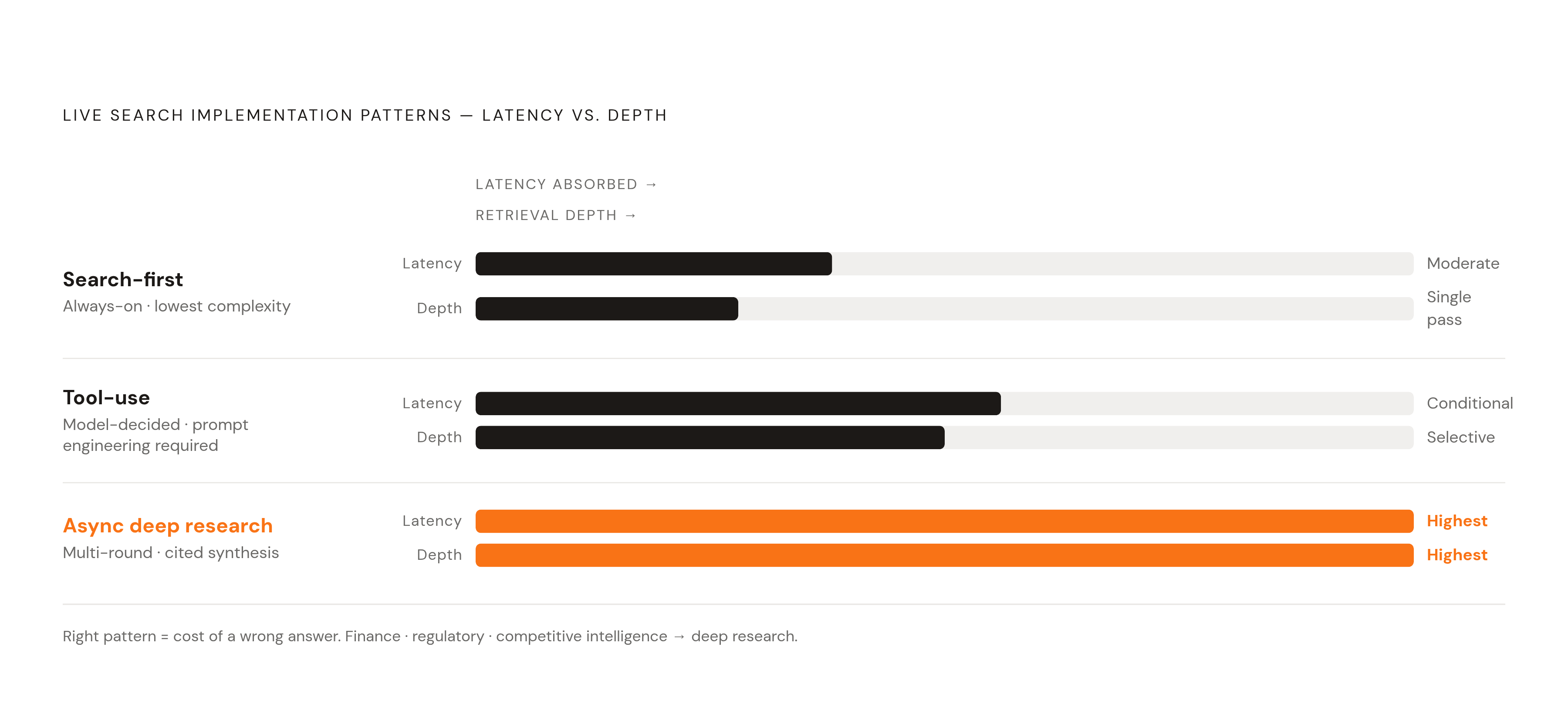
Choosing how to wire a live search API into an application comes down to three variables: how much latency the application can absorb, how much control the developer wants over when retrieval fires, and whether the agent decides for itself when to search or gets results handed to it automatically.
Search-first, or always-on retrieval, fires a search call on every single query and injects the results into the prompt before the model generates anything. This sits closest to a live-web version of RAG, and it fits well when queries are reliably time-sensitive and a stale answer costs more than the extra latency and token overhead.
Tool-use retrieval, sometimes called function-calling retrieval, lets the model itself decide at inference time whether a given query needs a search call. This cuts down on unnecessary API calls for questions the model can already answer from training. It takes more prompt engineering to make sure the model actually triggers retrieval when a query is time-sensitive, and to stop the model's own query rewriting from drifting away from what the user actually asked. Normalizing the query before it gets dispatched, so the search stays anchored to the user's original intent rather than the model's rephrasing of it, matters here.
Asynchronous deep research is built for a different kind of question. It runs multiple rounds of retrieval, synthesizes what it finds across them, and returns cited, structured output, which makes sense for financial analysis, regulatory review, or competitive intelligence, where a slower but thorough research artifact beats a quick conversational reply. The tradeoff across all three patterns sharpens once an agent starts looping on its own: without an explicit budget for how many calls it can make, without caching, and without deduplication logic, costs climb fast. Setting a retrieval budget up front and caching results wherever the freshness window allows is what keeps an agentic system financially sane. That same caching decision matters just as much for compliance.
What enterprise and regulated deployments require beyond functional retrieval
Getting a search API to return accurate, fresh, cited results solves the functional half of the problem. Regulated environments ask for a second layer on top of that: security, privacy, and citation integrity built into the retrieval system itself, not bolted onto the application that calls it.
Citation integrity is a compliance requirement in finance and healthcare. The API has to return source URLs that attach to specific claims the model makes, not a general note that web content was consulted somewhere along the way. Data minimization follows a similar logic: agents should touch only the specific data a task requires, because any broader access introduces risk under GDPR and comparable regional statutes, and ephemeral memory stores that purge data once a task finishes are becoming a standard part of compliance-conscious system design. SOC 2 Type II certification, GDPR compliance, and HIPAA compliance backed by a signed data-protection agreement with the vendor, applied to the search infrastructure itself, now function as baseline procurement requirements for enterprise buyers.
The sharpest risk in this category is search-time poisoning. Malicious SEO, dynamically generated pages built to game retrieval systems, and quiet edits to sources a model has learned to trust all create a permanent, moving attack surface that is genuinely hard to detect at scale. Caching makes this worse rather than better: a poisoned source picked up at ingestion time sits in the cache for its full TTL, serving corrupted content to every user who queries it during that window. Infrastructure that offers an optional zero data retention configuration, available on enterprise agreements for Web Search and Answer API products, alongside SOC 2 Type 2 certification, addresses these requirements at the point where retrieval actually happens. That is a meaningfully different design choice than adding a compliance layer after the fact, and it sets up the question of what happens once general retrieval meets a domain as specialized and high-stakes as finance.
Financial and Domain-Specific AI Agents: Beyond General Web Search
Financial AI agents push every problem discussed so far to its sharpest edge at once: the cutoff gap, the hallucination risk, and the citation requirement all converge in a single workflow. General web search retrieves public text from the open internet, and that is adequate for a lot of applications. A financial agent reasoning over market data, company fundamentals, SEC filings, and real-time news needs something more specific: source-reconciled, cited intelligence pulled from licensed data and domain-specific sources that a general-purpose search API was never built to reach.
The complexity appears concretely in how the data arrives. A financial agent pulling from several specialized data APIs typically gets back raw JSON or raw filing text, which the agent then has to parse, reconcile, and structure before it is usable, and each of those steps introduces another place for errors to occur. An output that cannot be traced back to a specific source and date has no place in serious financial research or decision-making, regardless of how fluent it sounds.
This is the gap purpose-built financial infrastructure is designed to close. You.com's Finance Research API pairs agentic AI with licensed data from providers including S&P Global, and it leads the field on the FinSearchComp T2 benchmark for simple historical lookup, by a substantial margin on that specific sub-task, a result the company has made public as a standard for comparing financial AI infrastructure. Benchmark context matters here, too: You.com's Research API previously held the top position on the DeepSearchQA leaderboard at launch, though as of late 2026 it no longer leads that particular benchmark. Benchmark standing in both general and financial research is a concrete, checkable signal of infrastructure quality, and it can also shift over time as competitors improve. The real distinction between a general web search API and a domain-optimized research API is architectural, running through what data sources are licensed, how the synthesis across those sources is performed, and whether the resulting output can survive a compliance audit.
Engineering around the strongest objection to live web retrieval
Live web retrieval does not eliminate reliability risk. It trades one kind of risk for another. Training data has been implicitly averaged across a huge number of sources over time, smoothing out a lot of its contradictions in the process. Retrieved content has not been through that averaging, so raw disagreement appears far more often in it: two sources contradicting each other on the same fact, pulled into the same context window. When that happens, the model has to adjudicate between them; without clear instructions for how to do that, it often falls back on its training data by default, quietly defeating the purpose of adding retrieval.
A second failure mode sits above the first: browsed content does not persist between calls, so the exact same query, run once with retrieval enabled and once without, can produce two different answers depending purely on whether the trigger logic fired. The grounding a system provides is only as reliable as the logic deciding when to retrieve, and an unreliable trigger carries the same risk as having no retrieval layer.
None of this argues against live retrieval. It argues for building the retrieval layer with the same rigor as the rest of the system. Source quality filtering belongs at the API layer, evaluated before content ever reaches the model, not left for the model to sort out on its own. Retrieved passages should get re-ranked by recency and source authority before they go into the prompt. Prompt instructions should explicitly tell the model to flag any claim it cannot confirm from the context it was actually given. And for claims with real stakes attached, output should get validated against primary sources before anyone acts on it. Retrieved facts can be wrong in ways training data usually is not, and the engineering discipline that catches that is what decides whether live retrieval actually closes the knowledge cutoff gap or just moves it somewhere harder to see.