Prompt Construction for Search-Grounded LLM Responses
Prompt design, not model capacity, determines whether retrieved facts actually ground LLM answers.

Most production hallucination failures trace back to a single bad assumption: that a sufficiently capable large language model will stay grounded in retrieved facts on its own, without anyone having to build the scaffolding that keeps it there. That assumption is wrong, and its cost appears downstream, in confident answers that cite nothing, invent file paths, or restate stale information as current fact. Grounding is a property a pipeline either enforces at every stage or fails to enforce, and the enforcement mechanism, at each stage, is a prompt decision made by the people building the system, not a capability waiting to be unlocked by a bigger model. The rest of this piece treats grounding as what it actually is: an engineering discipline with four distinct intervention points, each of which can be built well or built carelessly, independent of which model sits at the center of the system.
The four-stage grounding pipeline
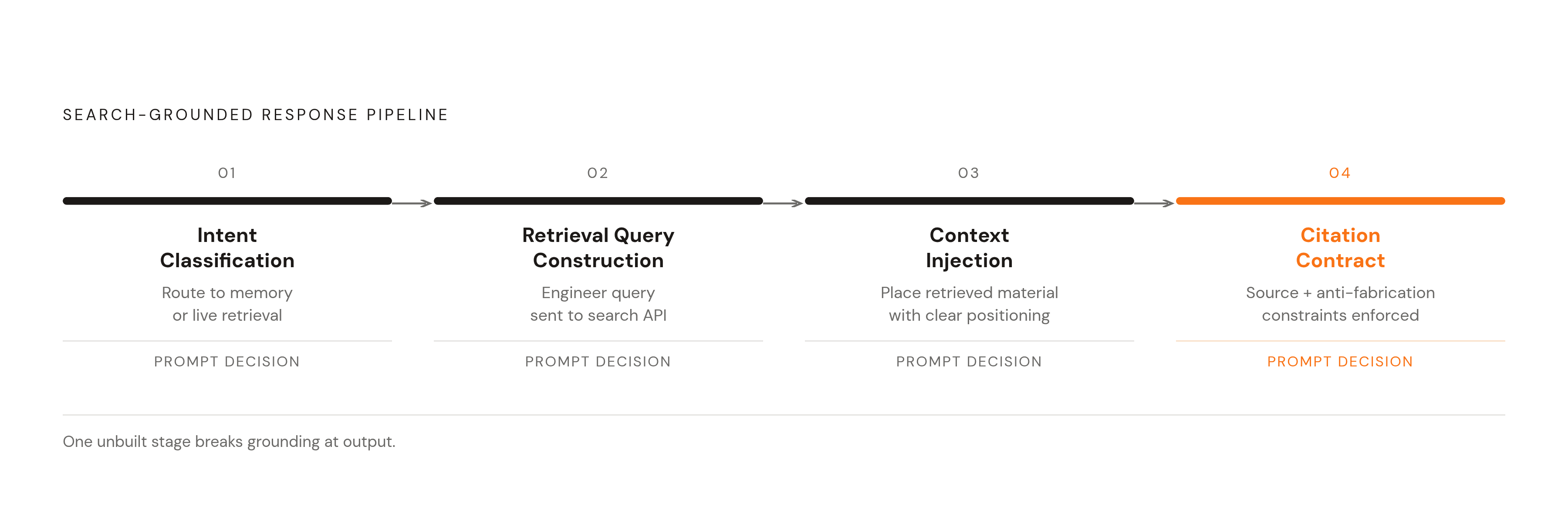
A search-grounded response moves through four stages before a user ever sees it, and at each one a prompt decision, not a model instinct, keeps the final answer tethered to real evidence. The first stage is intent classification: the system has to decide whether a query can be answered from the model's parametric memory or requires a live lookup, and that routing decision is itself driven by prompt instructions rather than some innate judgment the model applies by default. The third stage is context injection, where the retrieved material actually gets placed into the prompt, either explicitly flagged as source material or folded in as background, and the format and position of that injection governs whether the model treats it as authoritative. The fourth stage is response generation under a citation contract, where the model produces its answer subject to explicit constraints on format, sourcing, and prohibited behavior, and the strength of that contract is what decides whether grounding survives all the way to the output surface a user reads.
Classifying intent before retrieval runs
The decision to retrieve has to be made explicit in the prompt, because leaving it implicit lets the model default to parametric memory even on queries where that memory is stale, incomplete, or simply wrong. It answers from whatever it learned during training, with the same confident tone it would use for a verified fact, and nothing in the output signals that no retrieval ever took place. That failure mode is harder to catch than a wrong answer with a wrong citation, because there is no citation to audit.
Two grounding modes drive two different prompt structures here, and conflating them is a common design error. Data and factual grounding, the kind that connects a model to external, verifiable, up-to-date sources, requires the prompt to state that parametric knowledge is insufficient for this query and that retrieval must happen before any answer gets generated. Contextual and domain grounding works differently: it tailors a response to a specific task, user role, or compliance boundary, embedding session context, user state, and behavioral limits as persistent instructions in the system prompt so they hold across turns without needing to be reasserted.
One prompt pattern handles the routing decision cleanly: instruct the model to first categorize the incoming query, time-sensitive fact, domain-specific procedure, or general knowledge, and to output that category before attempting any answer. One might argue that adding a classification step to every query costs latency and tokens that a simpler system would save. That cost is a latency and token overhead on every query, but a misrouted query that produces a confident wrong answer with no retrieval trace is far more expensive to catch and correct after the fact than a routing step is to run before generation even starts.
Constructing the retrieval query so the right evidence comes back
Once a system decides retrieval is necessary, a second and less obvious decision has to be made correctly: the query sent to a search API is not the user's raw input, and treating the two as interchangeable is one of the most common reasons retrieved context turns out to be weak even when the underlying search infrastructure works fine. A user asking a loosely worded question in conversational language is not handing the system a string that any retrieval engine, vector-based or live web, can resolve well on its own. Someone has to construct the actual query, and that construction is a prompt engineering task in its own right.
Temporal scoping matters here in a very concrete way. A search system can only return current results if the query itself signals that freshness is the constraint, because without that signal the system has no basis for preferring a recent document over an older one that happens to score just as well on relevance. Real-time web search APIs change the shape of this problem compared to static vector indexes built over a fixed corpus. Instead of optimizing a query for embedding similarity against documents that were indexed once and sit still, the prompt has to produce something a live search engine can resolve against content that is being indexed continuously. The query itself has to carry the time constraint rather than relying on a corpus boundary to do that work implicitly.
Live web infrastructure built for this purpose exists for exactly this reason. You.com's Web Search API and Research API are built to accept queries generated by an LLM and return results formatted for a model to consume directly: the Web Search API returns structured, passage-level snippets with freshness filtering applied, and the Research API runs multiple searches, synthesizes what it finds, and returns a cited answer in natural language or structured JSON. The output quality from either tool still depends entirely on the query the model sends it. A vague or underspecified query returns passages that are directionally relevant and substantively useless, no matter how well the retrieval infrastructure behind the API performs.
Why exactly does this slip through so often? Because relevance scoring, in many pipelines, happens only after a re-ranker has already promoted the chunk, rather than being applied to each candidate chunk before re-ranking takes place. A re-ranker can promote a chunk that merely mentions the right terms without supporting the claim the model goes on to make, so relevance checks need to run earlier in the pipeline, at the per-chunk level, not only as a final filter on the answer.
Injecting retrieved context into the prompt so the model uses it
Good retrieval solves one problem and leaves another standing: context that has been correctly retrieved still has to be placed into the prompt in a way the model will actually use, and this is where a surprising share of grounding failures occur even in systems that retrieve well. Retrieved content that sits in the prompt without clear formatting or positioning frequently gets underweighted by the model, which falls back on parametric memory even with the right evidence sitting right in front of it. That raises an important question: what structural choices actually move the needle on whether injected context gets used?
XML tagging is one of the more reliable patterns, particularly on prompts that combine multiple sources or multiple sections. System prompts carry a related but distinct job: because they persist across every turn rather than resetting with each new message, they are the right place to state grounding rules outright, instructions like restricting the model to the provided context and prohibiting it from supplementing with general knowledge. A rule like that only works if it holds for the full conversation, not just the first exchange, which is what a system prompt is built to do.
Context size needs a hard limit too. Including identifiers like a source path, a timestamp, or a confidence score alongside each chunk gives the model what it needs to produce citations tied to individual claims, and it gives anyone auditing the output afterward a way to verify that attribution at the same granular level.
One finding here cuts against a common intuition. Few-shot examples, placed ahead of the retrieval block and showing correct citation behavior on a sample case, tend to be a more dependable lever, particularly when the model needs to learn the exact shape of the output or the label boundaries it is expected to respect.
Enforcing a citation contract at generation time
Everything built in the first three stages, correct routing, clean evidence, well-placed context, still fails to guarantee a grounded answer unless the final generation step operates under an explicit citation contract. A citation contract is the set of prompt instructions that spells out what must be cited, in what format, and what kinds of fabrication are explicitly off limits, and it makes groundedness enforceable at the output.
A vague citation instruction like "cite your sources" tends to produce document-level citations, a reference to a whole file or a whole page, that cannot be checked against the specific claim the model just made. A better instruction asks for the exact source chunk behind each factual claim: a file path, a URL, a line range, or a named document section. The AIQATool grounded prompt specification does this directly, requiring answers to cite file paths and line ranges and explicitly instructing the model not to fabricate repository details. That represents something close to the minimum viable citation contract for a code-grounded use case, and the same structure generalizes well beyond code: whatever the source corpus, a contract that demands claim-level attribution and names the specific behavior it prohibits will outperform one that only asks the model to be accurate in general terms.
Structured output schemas push the enforcement one level deeper. A request that can be ignored leaves a citation contract aspirational, while a constraint enforced by the decoding process itself lets that contract actually hold under load. Structured outputs also replace a layer of fragile text parsing that used to be necessary to extract citations from free-form prose, and they make a missing citation something a script can flag automatically instead of something a human reviewer has to catch by reading every response.
Two further mechanisms strengthen the contract further. A prohibition on adding information absent from the retrieved context needs to name the specific behavior being forbidden rather than relying on a general instruction to "be accurate," because a model given only the general instruction has no clear signal about what counts as overstepping. One might object that a regulatory audience cares most about this contract, and that is true, but the contract's value holds for any system where a wrong, uncited claim carries real cost.
Measuring whether grounding held across the full pipeline
Building all four stages carefully still leaves one open question unanswered: how would anyone know, on an ongoing basis, whether the grounding they built is actually holding in production? Spot-checking individual outputs cannot answer that question at scale, because it gives no way to distinguish a retrieval failure from a context injection failure from a citation contract that quietly stopped being enforced after a prompt update. What a system needs instead is a measurement stack that scores each stage independently, so a regression in one place does not get misattributed to another.
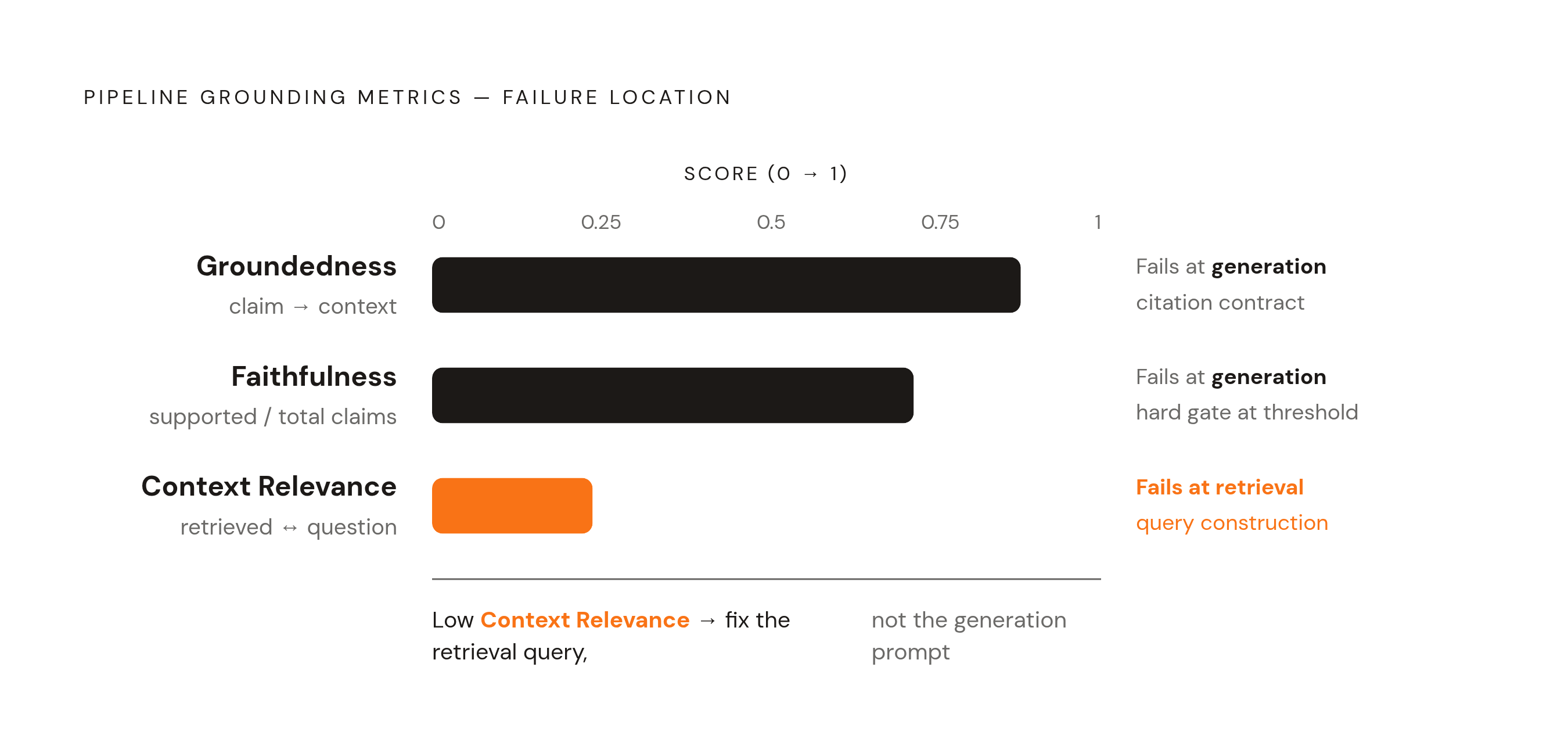
Groundedness is the first of these metrics: does every claim in the final output trace back to something in the retrieved context? It can run as a binary pass or fail gate or as a continuous score depending on the evaluation framework in use, and it should run at every retrieval-augmented step in an agentic system, not only on the final answer the user sees. Scoring groundedness only at the final answer misses intermediate hallucinations that get treated as established fact two reasoning hops later and get cited as though they were verified all along. Step-level groundedness scoring is what stops that cascade before it compounds.
Faithfulness is a related but distinct measure: what proportion of the claims in an output are actually supported by the evidence behind them? It typically runs as a continuous score between 0 and 1, useful for trending dashboards and for comparing one model against another over time, and production systems can also configure it as a hard gate that blocks a response outright if it falls below a set threshold. Context relevance covers different ground entirely: it asks whether the retrieved material could answer the question at all, independent of what the model eventually generated from it. A low context relevance score points back to the retrieval query construction covered earlier in this piece, not to anything wrong with the generation prompt, and conflating the two diagnoses is a common way teams waste time fixing the wrong stage of the pipeline. Taken together, these pipeline-stage metrics are what turn grounding from a one-time design choice into something a team can monitor, trend, and defend over the life of a production system.
Sources
- Web Grounding LLMs Benefits and Implementation
- Grounding by Trying: LLMs with Reinforcement Learning-Enhanced Retrieval
- REIC: RAG-Enhanced Intent Classification at Scale
- When Retrieval Succeeds and Fails: Rethinking Retrieval-Augmented Generation for LLMs
- When Should Active RAG Retrieve? A Budget-Aware Evaluation of Utility, Calibration, and Cost
- Retrieval Augmented Generation Evaluation in the Era of Large Language Models: A Comprehensive Survey
- A Tale of Trust and Accuracy: Base vs. Instruct LLMs in RAG Systems