Low-Latency Data Pipelines for Real-Time AI Applications
Uniting ingestion, retrieval, and inference into one fast system keeps AI decisions actionable.

Low-latency data pipelines give real-time AI current information while there is still time to act on it. Building them well requires more than fast inference. Ingestion, grounding, retrieval, and delivery must work as one system, with accuracy and security treated as design constraints from the outset.
Why real-time AI applications fail in production — and where the latency actually lives
A fraud model that fires after the money is gone has missed its purpose. A recommendation engine that suggests a restaurant that closed two hours ago has made a similar error. Even a strong model can fail in these ways. The input arrived too late for the decision to be trusted. Faster reasoning over that input would not have repaired the answer.
These failures show where batch-driven analytics falls short of continuous intelligence. Fraud detection has to react in milliseconds, personalization has to act while the user is browsing, and predictive maintenance has to warn before equipment fails. The useful decision window is already closing. Scheduled refreshes introduce lag, and that lag becomes operational risk when an application treats old information as current.
Where, then, does latency live? Ingestion lag is the time between a change at the source and its arrival downstream, and transformation, retrieval, and inference add more time before an answer reaches the user. Freshness and response speed are distinct requirements. LLMs have another freshness problem because what they learned in training comes from the past, so they need live grounding even when the internal pipeline is fast.
The four-layer architecture of a low-latency AI data pipeline
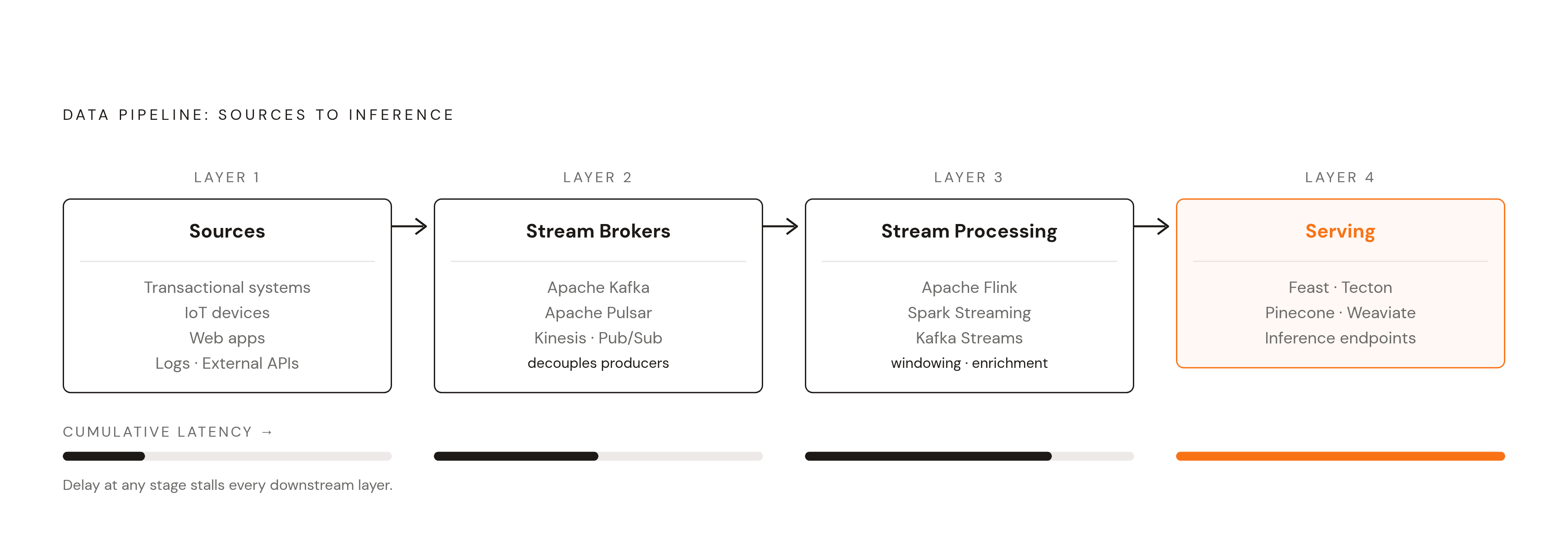
A useful reference model divides the pipeline into four layers, beginning with sources. Transactional systems, IoT devices, web applications, logs, external APIs, and third-party feeds supply the events. Freshness starts at the point of change. Real-time pipelines therefore require event generation at the source rather than periodic polling, which leaves an interval during which downstream systems cannot see new information.
The second layer streams and brokers those events, decoupling producers from consumers while buffering traffic, providing delivery semantics, and supporting horizontal scaling. Apache Kafka, Apache Pulsar, Amazon Kinesis, and Google Pub/Sub serve this role. Kafka-based architectures remain dominant in high-scale enterprise deployments because of ecosystem maturity. This layer separates event production from downstream consumption.
The third layer transforms streams into usable inputs. Apache Flink, Apache Spark Streaming, and Kafka Streams support work including windowed aggregation, anomaly detection, enrichment, feature computation, embedding generation, and normalization. Arrival alone does not make data inference-ready. Processing delay here can leave an otherwise fast delivery layer waiting for features or embeddings.
The fourth layer joins feature stores, vector databases, and inference endpoints. Feast and Tecton serve online features and help prevent training-serving skew, while continuously updated stores such as Pinecone and Weaviate support retrieval-augmented generation. Logging and monitoring predictions, then feeding outputs back into training, closes the loop and makes weaknesses across layers consequential.
Where ingestion bottlenecks form and how change data capture changes the calculus
Scheduled synchronization makes staleness part of the design. A database refresh every few hours, or once a day, cannot support decisions that depend on intervening changes. Change data capture, or CDC, changes that relationship by replacing repeated queries of full database state with streaming row-level changes as they happen. With CDC, downstream feature stores and training datasets can stay seconds behind production.
That pattern connects OLTP databases including Postgres, MySQL, MongoDB, and DynamoDB to destinations including Snowflake, BigQuery, Redshift, and Databricks. But freshness requires more than moving rows quickly. New columns, renamed fields, and changed types can silently break ingestion, leaving models to train on stale or malformed data. Automatic handling of schema changes therefore provides configuration convenience and protection against model degradation.
The operational choice is who maintains that protection. Artie handles schema evolution, backfills, merges, and observability without requiring data teams to maintain Kafka or Debezium themselves. Infrastructure-level streaming platforms suit high-throughput event-driven workloads, while managed replication suits teams that need freshness without owning a cluster. Team capacity should guide that choice. Evaluation also needs source and destination coverage, auto-scaling, and lag monitoring, with sub-second inference requirements distinguished from seconds-to-minutes warehouse freshness.
Grounding LLMs in live web data — and why this requires a different class of API
Internal CDC cannot supply everything an LLM needs to know. LLMs need external grounding to keep up with news, pricing, regulatory changes, and competitor moves. Agents that do procurement research or compliance checks already retrieve and cite live sources, and major cloud providers have added web grounding to their enterprise agent stacks. Search is therefore a required pipeline component.
The distinction begins with the search consumer. A person can browse ranked links, but an agent needs content it can process programmatically across multiple reasoning steps. With raw HTML, an agent has more extraction work to do before it can begin reasoning. AI-native search APIs combine retrieval and extraction, returning cleaned structured text or markdown that avoids a separate scraping step.
Multi-hop research makes this difference more consequential because one answer can trigger many downstream queries. Cost and latency compound with query depth. Provider dependence also became a concrete architectural issue when Microsoft retired the Bing Search APIs on August 11, 2025, redirecting developers to Grounding with Bing Search as part of Azure AI Agents. Many teams switched to independent AI-native search APIs so they would not be locked into one provider.
Inference latency — hardware choices and what the 2026 provider landscape actually offers
Once inputs are fresh and retrieval is fast, inference becomes the remaining delivery constraint. Specialized accelerators, optimized software, and resource management cut the time between a request and a response. Hardware choice has direct performance consequences. Yet a provider comparison is useful only when the workload, model support, compliance needs, and pricing structure remain in view.
Cerebras Systems takes a different approach through its Wafer Scale Engine, offering up to 20× faster inference than traditional GPU-based systems. That option targets a different operating context. Enterprises running massive models may justify premium hardware costs where a more general deployment would not.
Fireworks AI offers a serverless platform optimized for open-source models, sub-second latency, SOC 2 Type II and HIPAA compliance, and multi-cloud GPU orchestration across numerous locations. Those properties suit compliance-bound enterprise workloads. Groq instead uses custom Language Processing Unit hardware designed for inference, supporting high-throughput, low-latency workloads including large language models, image classification, and anomaly detection.
Providers must also be compared on how steady their performance is under load. Hardware architecture, geographic distribution, open-source versus proprietary model support, and compliance certifications all constrain the choice. Serverless and reserved pricing also serve different demand patterns, so response speed cannot be evaluated separately from sustainable operation.
Agent memory as a pipeline component — benchmarks, architectures, and what breaks at scale
Agent memory extends the retrieval layer across conversations, sessions, and tasks. In 2026, its engineering scope includes storage, retrieval, updates, and the application of remembered information. Recall alone is not the whole requirement. An agent may retrieve a past statement correctly yet still need to account for a later statement that superseded it.
LoCoMo tests single-hop, multi-hop, temporal, and open-domain recall across sessions, making it a useful starting point for conversational history. LongMemEval emphasizes knowledge updates, temporal reasoning, and long multi-session histories. BEAM tests much larger context volumes that expanding the context window alone cannot solve, while DolphinBench examines whether memory improves tool-use actions and outcomes. STATE-Bench tests whether agents get better as they draw on past experience when repeating enterprise workflows.
Production architectures increasingly combine semantic, keyword, entity, and graph-based retrieval because a single method can fail at scale. Temporal reasoning, cross-session identity, privacy, and deletion are still hard to get right. Memory staleness reconnects this layer to ingestion freshness, since quickly retrieving obsolete context still gives the model the wrong basis for action. No universal memory score resolves these trade-offs.
Agentic AI traffic at scale — security, bot pressure, and what the threat landscape looks like inside a live pipeline
HUMAN Security’s 2026 State of AI Traffic and Cyberthreat Benchmark Report found that automated traffic grew eight times faster than human traffic year over year in 2025. The report also found that AI-driven traffic almost tripled during 2025, while agentic traffic grew much faster still. Agents are no longer only reading web pages. They are transacting, which changes the trust requirements around external pipeline access.
At that scale, legitimate retrieval encounters anti-bot infrastructure also used against fraud. Identity becomes part of reliable data access. API-level retrieval with proper identity and compliance provenance is operationally safer than raw scraping, linking the grounding decision directly to security architecture. The traffic a pipeline generates cannot be treated as separate from the defenses it encounters.
Stored and transmitted context introduces another cross-layer obligation. GDPR requirements for legal basis, purpose limitation, minimization, access and erasure rights, and accountability remain in force. Enterprise compliance combines semantic detection, deterministic tokenization, runtime enforcement, and auditability with IAM and encryption. LLM training complicates erasure because data is not easily excised, while zero data retention at the API layer removes a category of risk associated with stateful intermediaries.
Where agentic pipelines still fall short — and what that means for how you build now
Live grounding helps models answer factual questions, but completing tasks on their own is harder. Online Mind2Web evaluates agents on 300 verified tasks across 136 live websites without cached pages, exposing them to changing interfaces. The model-agent combination that did best on the benchmark had an accuracy of 42.3%. That result does not support treating general live-browser autonomy as dependable.
Memory weaknesses can compound this gap. Stale facts, failures in temporal reasoning, and mistakes in cross-session identity can lead to a bad action even when every retrieval is fast. Speed cannot substitute for correct context selection. Grounded Q&A and cited research retrieval are mature enough for production at scale, while autonomous multi-step browser tasks require tighter boundaries and human review.
The architectural response is to build explicit fallbacks and human checkpoints for high-stakes actions. Accuracy measurement must also begin before deployment. DeepSearchQA, FinSearchComp, Mind2Web, LoCoMo, and LongMemEval provide ways to evaluate different capabilities rather than assuming that one successful demonstration transfers to another workload. Autonomous scope should follow the evidence. The accuracy limit is a design constraint.
A practical checklist for evaluating every layer of a low-latency AI pipeline before it reaches production
For teams preparing a deployment, the following checks turn the architecture into release criteria.
Ingestion. Check whether updates come through CDC or in scheduled batches. Require automatic schema evolution handling, lag monitoring, health dashboards, and alerts. Match the latency tier to the actual decision window. Choose between managed replication and self-hosted streaming based on what the team can run and maintain.
Web grounding. Require LLM-ready content and citations. Evaluate accuracy through independent benchmarks such as DeepSearchQA and FinSearchComp. Measure p99 latency alongside averages under production load. Require zero data retention and SOC2 certification for enterprise-compliance workloads.
Retrieval and memory. Check that retrieval does not dominate response time. Match the memory benchmark to the workload, using LoCoMo for conversational recall, LongMemEval for changing facts, BEAM for large histories, and DolphinBench for tool-use agents. Evaluate combined semantic, keyword, entity, and graph-based retrieval. Include memory freshness in that evaluation.
Inference. Select GPU clusters or purpose-built accelerators to meet latency requirements. Test consistency under load and check required SOC 2 Type II and HIPAA compliance. Assess model support and geographic distribution. Use serverless pricing for variable demand and reserved capacity for predictable high-throughput workloads.
Production readiness. Provide fallback and error-handling paths at every layer, including dead-letter queues, circuit breakers, and backpressure handling. Gate high-stakes actions with human review. Limit autonomy to capabilities supported by accuracy evidence, and build measurement in from day one.