SOC 2 Compliance for AI Data Pipeline Vendors
Auditors now test AI-specific controls under unchanged SOC 2 criteria.
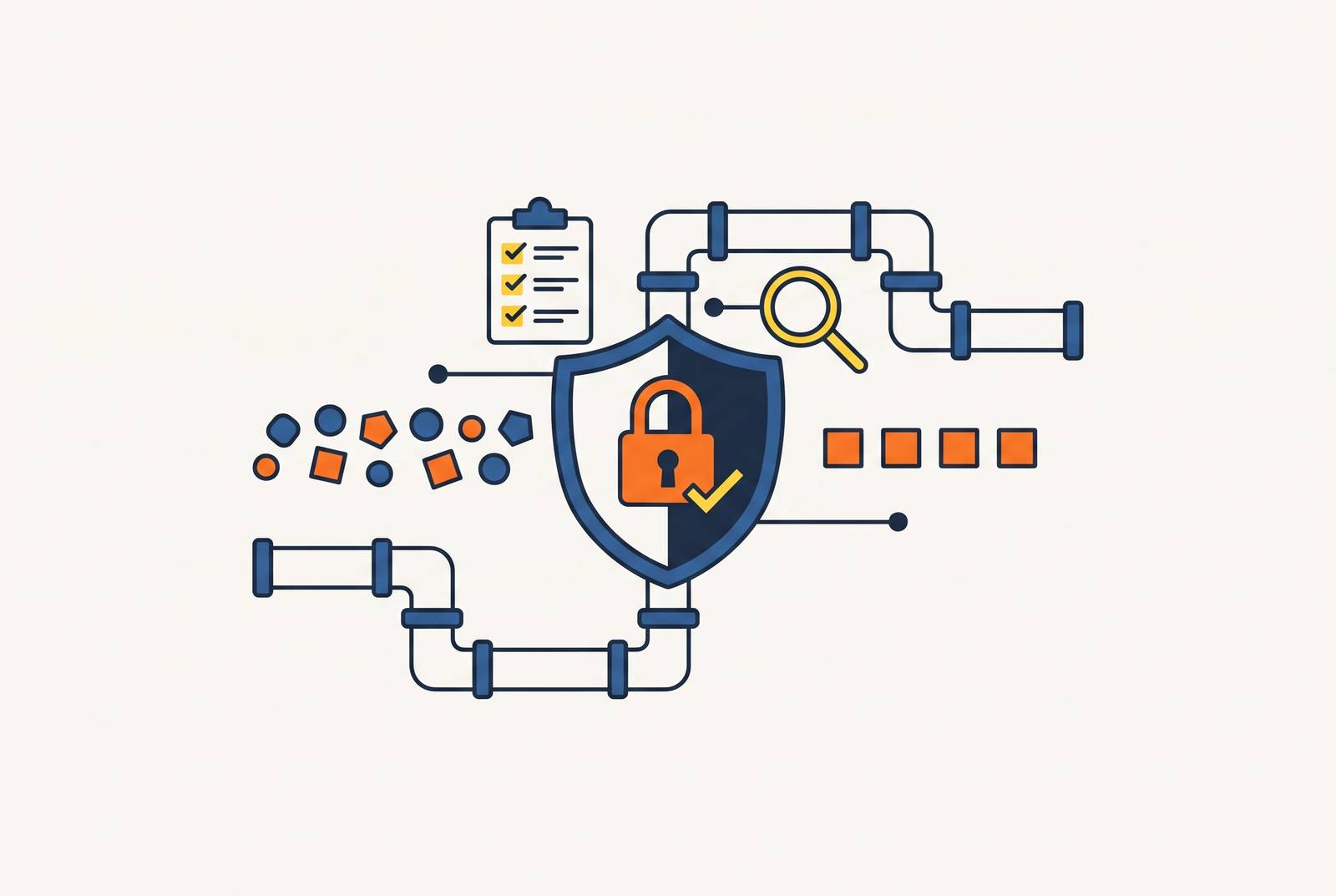
SOC 2 compliance for AI data pipeline vendors turns on a question that a standard SaaS checklist cannot answer. Can the vendor show that its controls cover model changes, external LLM calls, how employees use AI, and autonomous actions through the whole audit period? The Trust Services Criteria have not changed, but the evidence needed to satisfy them has.
Why SOC 2 for AI pipeline vendors is not a standard SaaS checklist
The framework is unchanged, while the risk profile has expanded. This requires interpretation and evidence. AI-fluent auditors apply the Trust Services Criteria to model versioning, prompt audit trails, LLM subprocessor chains, and agentic action accountability. A model that ingests customer data, calls an external LLM, and produces outputs that influence a business decision introduces failure modes beyond those of a typical CRUD application.
Autonomous operations extend that problem into production behavior. Gartner predicts that 40% of enterprise apps will feature task-specific AI agents by 2026, expanding the attack surface auditors must cover. Meanwhile, enterprise procurement treats SOC 2 Type 2 as a baseline rather than a differentiator, with some gates excluding vendors without a current report before scoring begins. What distinguishes an AI vendor is the governance layer above that baseline. Auditors examine whether documented controls reach the places where AI changes how data is processed and decisions are made.
Why Type 2, not Type 1, is the only credible report for an AI pipeline vendor
Type 1 addresses control design on a single date. Type 2 tests whether controls worked as they should over an observation period that usually lasts many months. That distinction is structural for an AI pipeline. Models are retrained, prompts are edited, and hosted LLM endpoints change versions, so a point-in-time inspection cannot demonstrate that a prompt audit trail remained complete through those changes.
What the report can show depends on the observation window. An increasing number of AI-specific RFPs require that window to overlap any major model migration in scope. A migration outside the period does not supply evidence of how controls operated during it. Enterprise vendor risk teams commonly accept Type 1 only as a bridge toward Type 2, while some require Type 2 from the outset.
What model lineage means in practice and how it maps to CC8
Model lineage brings AI deployments into CC8 change management. For traditional SaaS, testing commonly follows the change ticket, pull request review, and deployment log. For an AI pipeline, the auditor’s question is more demanding. Pick a production model and show its history. That history includes the training or fine-tuning dataset, the approval chain, pre-production testing, and a documented, tested rollback procedure.
A model registry gives that history an auditable form. Informal records may help engineers understand a model, but they do not establish a maintained approval process if versions change between sprints without a gate. Auditors need to connect the production version to the inputs and decisions that authorized its release. They also request drift-monitoring output and prompt and inference logs with PII redacted before logging. These artifacts address different points in the lifecycle, from the approved deployment to evidence of its behavior afterward.
How LLM subprocessors expand the audit perimeter beyond your own infrastructure
A hosted LLM call takes the service’s data processing outside the infrastructure the vendor controls. Where customer data flows through that provider, the provider is a subprocessor within the audit scope. Its own security assessment is necessary evidence. The application still has its own controls, contractual commitments, and reporting boundary.
For each provider, auditors request a signed Data Processing Agreement beyond any reference to general Terms of Service. They also seek contractual confirmation that customer data is not used for model training without explicit opt-in, a provider SOC 2 report or ISO 27001 certificate, and a vendor risk assessment recording accepted residual risk. Missing protections can create exceptions under Confidentiality C1 and vendor-risk criterion CC9.2. Auditors focus on what the application permits while also considering the assurance the provider holds.
Credential handling supplies a concrete test of that distinction. LLM API keys must live in a secrets manager, rotate on a documented schedule, and be revoked during offboarding. Auditors are already flagging vendors that handle these credential keys as convenient configuration. A compliant provider does not compensate for an application’s unmanaged access to it.
Why shadow AI is the most common AI-related SOC 2 finding in current audits
Shadow AI occurs when engineers or support staff use unapproved AI tools to process company or customer data without vendor review. Auditors are specifically probing this behavior in 2026. The resulting finding concerns tools the compliance team may not know exist, rather than the AI systems formally deployed by the company.
Three distinct failures explain why this is a control problem. First, when a tool has no inventory entry or risk assessment, there is a gap in vendor management under CC9.2. Second, customer data leaves through a channel without a DPA, confidentiality controls, or documented retention and deletion terms, creating a Confidentiality C1 gap. Third, AI-generated code or configuration reaching production creates a CC8 change management gap when it bypasses the stated approval and testing process.
How real-time data pipelines and autonomous agents create new obligations under Processing Integrity and Availability
The usual evidence for Availability includes uptime monitoring, capacity planning, backup and restore tests, and disaster recovery runbooks. External LLM dependencies add another testable failure point. If a pipeline relies on one endpoint, what happens to the service commitment when that endpoint becomes unavailable? Multi-provider routing or graceful degradation needs documentation and test evidence.
An agent may monitor streaming telemetry, detect an anomaly, choose remediation, and execute an action without human intervention. Processing Integrity testing must show who is accountable for those actions. To check this, auditors ask for logged decision trails, records of human-approval checkpoints for privileged actions, and evidence that agents need an approval gate to make production changes.
Stale grounding can produce inaccurate outputs that output monitoring must detect, connecting real-time data handling to CC7.2 anomaly detection. Cited, source-reconciled outputs make the evidence behind an answer easier to examine. When continuous freshness and source reconciliation are built into the architecture, they support Processing Integrity controls so the vendor does not have to piece that evidence together afterward. They do not, however, replace testing that the controls operated throughout the observation period.
How OWASP LLM Top 10 risks are being mapped to Trust Services Criteria in current audit fieldwork
The Trust Services Criteria define the control framework, while the OWASP LLM Top 10 supplies a vocabulary for AI-specific threats. There is no formal mapping to follow mechanically. Auditors must connect each risk to the relevant control objective and then identify evidence that tests it. This is why knowing the category name is less useful than understanding the failure it describes.
Data and Model Poisoning connects to Processing Integrity and CC6 through dataset provenance controls and quality gates before fine-tuning. Sensitive information disclosure connects to Confidentiality C1 through PII redaction before prompt logging and access controls on inference logs. Prompt-injection risks likewise generate requests for adversarial test results and mitigation evidence. These are operational artifacts. Auditor selection therefore becomes part of readiness, because an assigned auditor without experience reviewing model registries or LLM vendor relationships may apply a traditional SaaS testing programme and miss the relevant evidence.
What the AICPA's June 2026 peer review tightening means for cookie-cutter AI audits
Under the AICPA Peer Review Board’s enhanced oversight, a structured process for monitoring and outreach begins June 1, 2026. It takes a closer look at SOC 2 practices that handle a high volume of work, firms that use third-party automation platforms, and engagements where testing fails to cover the risks the client actually faces. An engagement that overlooks model lineage, LLM subprocessor chains, or agentic controls can face peer review challenge.
The accountability now runs in both directions. Vendors must provide AI-specific evidence, while audit firms must explain why their testing fits the AI-specific risks. That incentive does not establish that every firm has developed the necessary capability. Selecting an auditor with demonstrated pipeline experience remains a risk management decision.
Where SOC 2 ends and ISO 42001 and the EU AI Act begin
Does a SOC 2 report mean an AI vendor is covered? Not across every governance or legal obligation. For vendors in regulated markets or selling to EU enterprise buyers, SOC 2 is necessary but not sufficient. No AICPA-branded “AI SOC 2 certification” exists as of 2026, and a report against the standard Trust Services Criteria does not establish EU AI Act compliance or ISO 42001 certification.
ISO 42001, published December 2023, sets out further requirements for AI governance. Vanta’s documentation explains that it adds AI-specific governance, lifecycle controls, and transparency requirements not covered by ISO 27001 or SOC 2. The frameworks can nevertheless share evidence. Model registries, vendor risk assessments, and model change management records built for SOC 2 can also be used for ISO 42001, so the whole programme need not be rebuilt.
The EU AI Act adds obligations with distinct scopes and dates. The European Commission’s AI Act Service Desk gives December 2, 2027 as the date when rules for high-risk Annex III systems apply. August 2, 2027 applies to GPAI model providers for models placed on the market before August 2025. Article 4 AI literacy requirements are already appearing in enterprise questionnaires, including requests for training records even where the Act does not directly apply to the vendor. Standard SaaS-oriented automation does not yet provide out-of-the-box collection for every AI-specific artifact, leaving that evidence layer with the vendor.
A practical evidence checklist for each layer of the AI pipeline audit
The practical preparation task is to organize evidence by pipeline layer. This lets a compliance team connect its architecture to the records an auditor will request, while retaining the criterion mappings developed above. Each layer has a distinct evidence burden. The following checks translate that burden into records the team can assemble before observation begins.
Model and training evidence starts with a formal registry that lists every version used in production. Each record should connect the training dataset snapshot, code commit, hyperparameters, approval chain, and rollback procedure. The records from pre-production testing should include results from adversarial prompt-injection tests. Drift-monitoring output also needs documented response procedures so that detection is connected to an established control.
Inference and prompt evidence should show redaction before logging. Prompt and inference logs need access controls and a written retention schedule. Input sanitization, output filtering, and system-prompt hardening require mitigation evidence, while output-monitoring exception logs should demonstrate continuous CC7.2 anomaly detection. The distinction is between having a monitoring policy and showing its operation.
LLM subprocessor evidence should connect contracts to access controls. For every hosted provider, there must be a signed DPA, clear training-use terms, the provider’s security assurance evidence, and a risk assessment that records the residual risk accepted. API key records should demonstrate secrets management, scheduled rotation, and revocation on offboarding. Where zero data retention is configured, the contractual and configuration evidence should substantiate that confidentiality commitment.
Agentic and pipeline evidence should show who is accountable for privileged actions. That includes human-approval checkpoint documentation and decision trails attributable to an accountable identity or approval gate. Availability evidence should show that provider failover has been tested and cover rate-limiting and controls on the cost of LLM consumption.
Shadow AI and vendor management evidence should cover employee behavior. The inventory of approved tools needs risk assessments to back it up, and detection or attestation controls should show that the company monitors unapproved use. Offboarding records should demonstrate that AI tool access is revoked with other system access. These controls are best established before the observation period opens, because fieldwork can inspect historical operation but cannot create it retroactively.