Zero Data Retention Requirements for Enterprise AI APIs
Real ZDR is an architecture to verify, not a policy to trust.
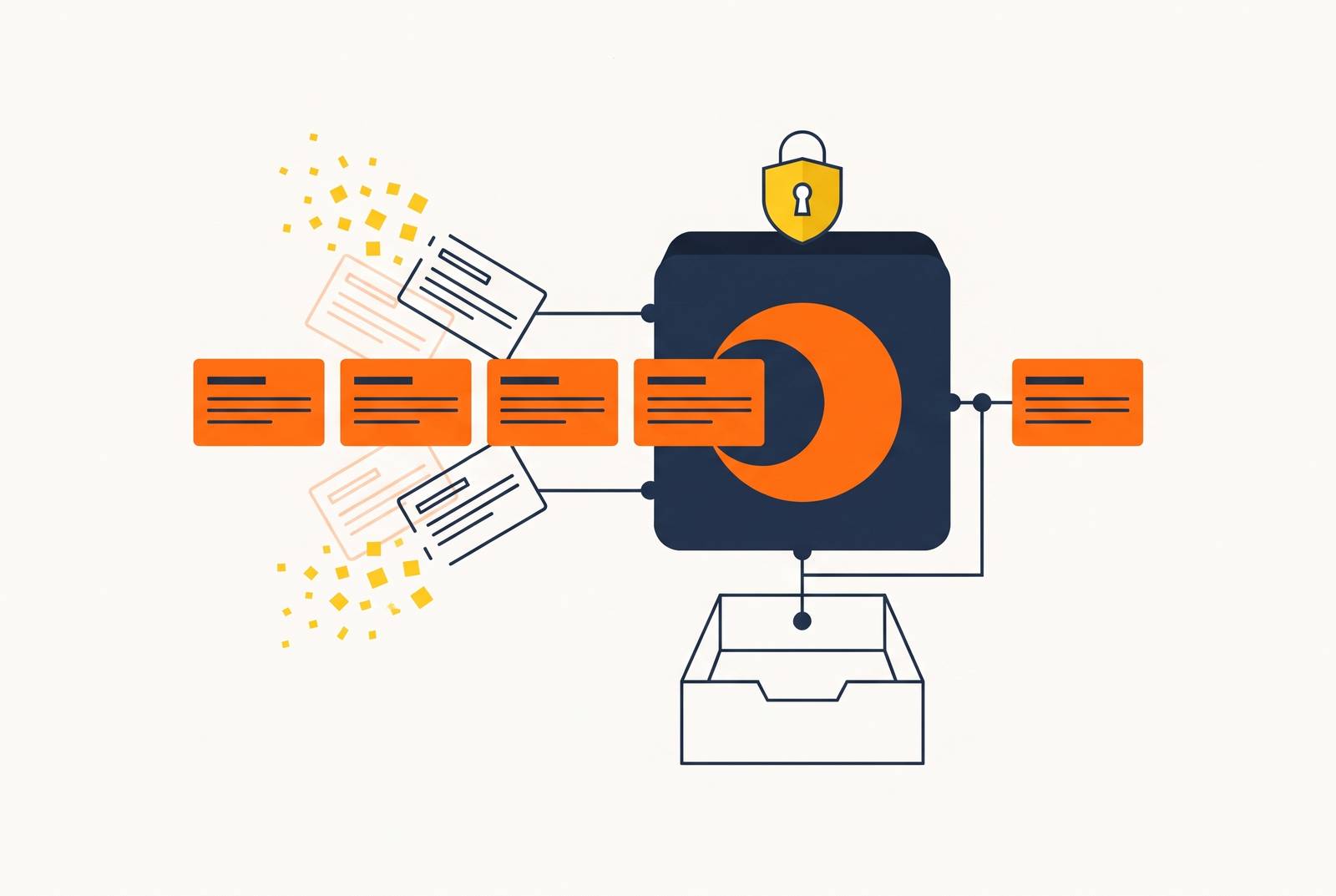
Zero data retention requirements for enterprise AI APIs go well beyond what a provider’s privacy policy says. ZDR is a layered architectural commitment. Meaningful procurement depends on knowing where content can persist, which services the promise covers, and what evidence supports it. The whole inference pipeline must preserve the API’s ZDR guarantee.
Why "zero data retention" means something different at the infrastructure layer than in a provider's marketing
A provider can promise not to train on customer data without promising to discard it after inference. Those are different commitments. The first limits how data may be used, while the second limits whether it remains available at all. Enterprises that treat them as equivalent can sign a contract that protects against model training while leaving prompts and responses in storage.
Abuse monitoring introduces another distinction. A provider may exclude customer content from training but keep it for a trust-and-safety review window. A true ZDR agreement ends that content-retention window instead of changing what the stored content is used for. Yet prompts must still be in memory while the model processes them, so zero retention still involves contact with data. The useful vocabulary separates training use, post-request retention, safety logs, and persistent storage during processing, because each describes a different boundary.
What genuine ZDR architecture requires technically, as distinct from a policy promise
NeuralTrust’s ZDR analysis identifies a stateless AI gateway as a central architectural control. The gateway intercepts every request without writing its content to disk, leaving no recoverable session content in its own persistent storage when processing ends. That is the key distinction from scheduled deletion. Data minimization permits content to persist temporarily, whereas genuine ZDR prevents prompts, context, and outputs from entering persistent storage in the first place.
The same analysis places two controls around that gateway, namely dynamic PII masking before transmission and metadata-only audit logging. Masking reduces what identifiable information reaches the model. Audit records can then capture timestamps, token counts, policy outcomes, and anomaly flags without preserving prompts or responses. Together, these controls separate the content needed for inference from the evidence needed to govern it. Does the audit trail document the transaction, or reproduce it?
Traditional security controls do not establish that boundary by themselves. Encryption at rest and scheduled deletion both work on data that has been stored, while conventional DLP on its own cannot show what happens during inference. ZDR removes the risk of exposing stored content by keeping no copy that needs to be secured. It does not eliminate every security risk during processing, and a stateless gateway cannot establish how an upstream provider handles the same request.
Why agentic workloads raise the data exposure stakes beyond single-turn API calls
An autonomous agent can expose data through the actions it takes as well as through a conversation’s opening prompt. A Salesforce opportunity can enter its context, a BambooHR employee record can become an update, and a Xero invoice can become a financial transaction. Each action adds another payload that must be processed. NeuralTrust’s analysis describes the required lifecycle as a single transit through infrastructure, followed by disposal when the response is delivered.
That lifecycle becomes harder to preserve as orchestration expands. A model endpoint may discard content while enterprise logging or a message queue preserves a copy elsewhere in the pipeline. Establishing whether task orchestration handles raw payloads or only metadata, and whether any intermediate component writes content to disk, therefore requires more than broker names alone. For Kafka or RabbitMQ, assessment must go beyond the presence of a broker in the architecture to examine the actual queue configuration and persistence behavior.
Where the regulatory frameworks land — and where a signed BAA alone is not enough
A signed Business Associate Agreement creates legal obligations while leaving technical retention controls to the architecture. That distinction is especially important for agents handling protected health information. NeuralTrust’s regulatory mapping identifies HIPAA safeguards, access controls, and a BAA as required protections, while treating ZDR as a best-practice architecture with no statutory mandate. A BAA is necessary but not sufficient. It cannot make a gateway stateless or stop middleware from recording a payload.
The same analysis links GDPR Article 25 to data protection by design, which favors architectures that keep data out of storage over those that delete it later. It also connects SOC 2 CC6.1 logical access controls with ZDR at the model layer. These mappings explain why the architecture supports compliance, but they do not make it a substitute for the surrounding obligations.
Data location is a separate legal question. Where a hosted inference request transfers personal data internationally, GDPR Chapter V restrictions apply to that transfer even if the provider stores nothing afterward. No retention does not mean no transfer. The emergence of “Regional ZDR” in 2026 reflects this distinction, combining non-retention with processing in a specified jurisdiction through region-specific GPU clusters.
Scope gaps that ZDR agreements routinely leave uncovered
A chat-completions guarantee does not automatically cover every endpoint in the same enterprise account. Image generation, fine-tuning, and file uploads may have different retention rules. Coverage can also vary by model and feature. The contract must cover what is actually deployed, even when that differs from the product category procurement believes it has bought.
Metadata needs its own examination because a policy covering inference inputs may not cover timestamps, token counts, or user identifiers. Compatibility with metadata-only auditing requires a defined boundary. What metadata remains, and under which rules? Providers may also keep the right to access or retain data for legal requests and abuse investigations. Explicit exceptions make the promise assessable without assuming every carve-out defeats its purpose.
PremAI’s 2026 platform evaluation asks what these gaps leave uncovered, what providers have signed, where processing happens, and what shows that the rules are enforced. Its scope extends beyond ordinary API calls to agents, file storage, batch processing, memory, and flagged requests. These are useful distinctions for a vendor conversation. A signed DPA and documentation of enforcement answer different questions, so neither should stand in for the other.
How OpenAI's August 2026 ZDR expansion and Private Safety Processing changed the frontier-model landscape
OpenAI’s August 2026 announcement extended ZDR availability to frontier models for eligible API customers. Its commitment is that prompts and model responses are not retained after a request is processed, while enterprise customer data is not used for training unless customers explicitly opt in. The expansion confronts a genuine architectural tension. More capable models can take on longer tasks, but serious safety risks may become visible only across related interactions.
Coordinated probing of safeguards, harmful intentions, and agentic misalignment may not be apparent in any single request. Safety checks that look at one interaction at a time cannot see that broader pattern on their own. How can a provider monitor it without building a readable archive of customer content? The announcement presents Private Safety Processing as a proposed resolution, separating cross-interaction safety monitoring from personnel access to the underlying content.
OpenAI previewed Private Safety Processing on August 19, 2026, and began rolling it out to API customers on September 22, 2026. The design offers two storage options. Content can remain on customer-controlled infrastructure under ZDR, or it can be stored on OpenAI infrastructure encrypted with customer-controlled keys. Even when content is encrypted, keeping it on the provider’s infrastructure still counts as storage. When a risk is identified, the provider receives only a narrowly defined signal about the activity.
Customers use information in their own systems to look into alerts and enforcement decisions. They may choose to share content to support an investigation or appeal. OpenAI’s announcement names Glean, Databricks, Abridge, and Microsoft as enterprise supporters of the approach. That support establishes only interest in the design.
The verifiability problem that no ZDR announcement resolves on its own
An enterprise cannot inspect a provider’s disks from outside its infrastructure to establish that every request left no persistent copy. This holds even when the architecture is described in detail. A public ZDR statement is a claim about behavior. The constructive response is to put the commitment into a contract, a DPA, and an audit scope with explicit audit rights.
SOC 2 Type II certification offers a proxy for independent verification by assessing whether controls operated as designed over a period. Its value as a verification proxy depends on whether the audit covers the ZDR controls being assessed. A certification label alone leaves that question unanswered.
Organizations are still responsible for how they build prompts, handle outputs, and keep logs in their own pipelines, even when the model provider keeps nothing. ZDR remains a sound standard for how to build systems under this stress test. Its practical strength depends on how precisely the commitment is contracted, supported by evidence, and extended across the full processing path.
What ZDR compliance requires from grounding and web-search APIs inside agentic pipelines
Grounding introduces another processor into that path. Agents need live information because model knowledge cutoffs can lag present-day facts by months or years, but retrieval creates its own opportunity for persistence. A stateless model endpoint cannot stop a search API or RAG pipeline from storing intermediate content. The grounding layer therefore requires the same scrutiny as inference.
OpenAI’s ZDR announcement does not describe grounding coverage, and the Agents API and related agentic endpoints are explicitly listed as ZDR-ineligible. Endpoint eligibility remains a separate question. What a model can do and what its retention terms say do not show how every tool attached to it behaves.
Finance, legal, and research workflows also need source-attributed, verifiable results. Retention controls and evidentiary quality solve different problems, so a grounding API must address both. NeuralTrust’s analysis describes a complementary pattern in which masking removes names and specific financial figures before they reach the model, while API-level ZDR prevents retention in the retrieval layer. Neither control alone establishes that an output can support serious research or an auditable decision.
What a procurement checklist for ZDR-compliant AI infrastructure actually needs to cover
The procurement test starts with the deployment’s exact models, endpoints, and API surfaces. Does the signed DPA or MSA cover them, with explicit audit rights, or does the guarantee exist only on a policy page? The terms must name the safety-monitoring, abuse-investigation, and legal-request exceptions and set limits on each. The SOC 2 Type II audit scope should include the relevant ZDR controls. For frontier models, the review also needs the cross-interaction monitoring architecture and a clear account of any content retention it introduces.
The next test follows the payload through the pipeline. Does the grounding API or RAG system write intermediate results to disk, and does enterprise logging middleware preserve content between the user and the model? Message queues need the same examination, including whether they handle raw payloads or metadata. Processing location belongs in this review too. Regional requirements cannot be established solely by a promise to discard data after inference.
In healthcare, does the BAA cover the primary model provider and every subprocessor in the inference pipeline? For financial services and legal work, does grounding produce source-attributed results that can support an audit trail? For GDPR-scoped processing, is each international transfer through hosted inference covered by a valid Chapter V mechanism? These questions set the terms for deploying ZDR so that regulated teams can use capable AI while keeping data confidential.